Checklist for Cross-Platform Campaign Consistency
Last updated: April 25, 2026
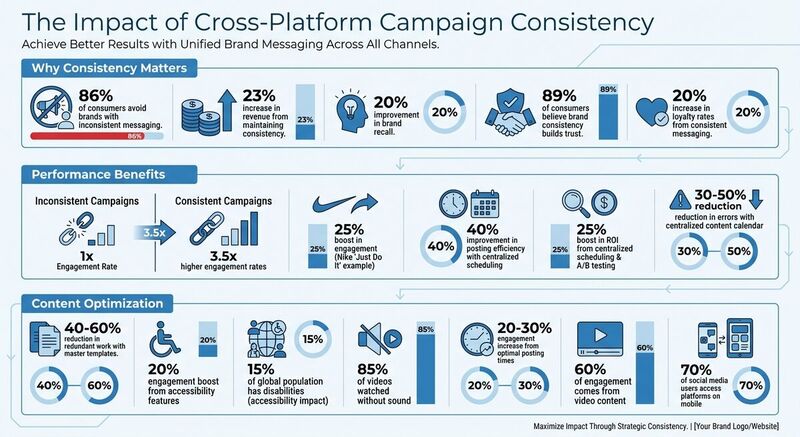
Want your brand to stand out across platforms? Consistent messaging is the key. A study shows 86% of consumers avoid brands with inconsistent messaging, while maintaining consistency can increase revenue by 23%. This guide breaks down everything you need to know to ensure your campaigns stay aligned, boost engagement, and build trust.
Key Takeaways:
- Why it matters: Consistency improves brand recall by 20% and drives higher engagement.
- How to plan: Create brand guidelines, define platform-specific specs, and set measurable goals.
- Content creation tips: Use master templates, tailor posts to each platform, and ensure accessibility.
- Scheduling tools: Centralize your calendar to avoid errors and post at peak times.
- Monitor results: Track metrics, review feedback, and adjust strategies based on performance.
Use this checklist to streamline your workflow, maintain consistency, and make an impact across platforms.
Pre-Campaign Planning Checklist
Define Brand Guidelines and Core Messaging
Start by creating a concise one-page style guide that outlines your brand's tone, logo rules, colors, fonts, and key messaging pillars. For example, specify your brand tone - whether it's professional, playful, or authoritative. Include logo usage rules, such as maintaining a minimum size of 100 pixels with clear spacing around it. Define your color schemes with precise hex codes (e.g., #007BFF for primary blue) and typography standards, like using Roboto for headings and Open Sans for body text. Don’t forget to include your core tagline and 3-5 pillar messages that capture your brand’s essence. A great example of this is Nike’s "Just Do It" campaign, which adapted its messaging across platforms while maintaining its empowerment theme, leading to a 25% boost in engagement[1].
To ensure consistency, build a messaging framework. This should include your core campaign message and variations tailored for different platforms. For instance, use a short version for X (formerly Twitter): "Unlock growth now! #CampaignConsistency", and an expanded version for LinkedIn: "Discover how seamless strategies drive consistent growth across platforms." Save this framework in a shared document or use tools like TheBlue.social's content scheduler to make it accessible for your entire team.
Finally, outline each platform's specific requirements to ensure your style guide adapts smoothly across all channels.
Identify Platform-Specific Requirements
Create a spec sheet that details the technical requirements for each platform, including character limits, image dimensions, and video guidelines. For example:
- X (Twitter): 280 characters, 1200x675px images
- Instagram: 2,200 characters, 1080x1080px square images
- LinkedIn: 3,000 characters, 1200x627px images
- Threads: 500 characters
- Pinterest: 1000x1500px images in a 2:3 ratio
- Bluesky/Mastodon: 300 characters, images up to 16MB
For videos, Instagram Reels cap at 90 seconds, while LinkedIn supports videos up to 10 minutes. Make sure your visuals use the correct aspect ratios to avoid awkward cropping that could disrupt your campaign's visual flow.
Understanding audience behavior on each platform is just as crucial. For example, X thrives on real-time, conversational updates; Instagram emphasizes visual storytelling with emotional imagery; LinkedIn is better suited for professional, data-driven content. Use platform analytics or tools like TheBlue.social's Bluesky analytics to identify these trends. Then, tailor your content format accordingly - try polls on X or carousels on Instagram - while keeping your core message intact. You can also test how your content looks across platforms using tools like TheBlue.social's OG Preview tool.
Once platform-specific details are sorted, focus on defining campaign goals and success metrics.
Set Campaign Goals and Success Metrics
Establish SMART goals that can be measured through metrics like reach, engagement (likes, shares, comments divided by reach), click-through rates, and UTM-tracked conversions. For example, you might aim to increase brand awareness by 20% or boost engagement by 15%. Set overarching KPIs, such as total reach and average engagement rate, while keeping in mind that industry benchmarks suggest 1-3% engagement is healthy[1].
While your overall goals should remain consistent across platforms, adapt your metrics to match platform-specific behaviors. For instance, track video views on TikTok, profile visits on LinkedIn, and story completions on Instagram. Use past campaign data as a baseline to set realistic targets. Centralize your tracking with a dashboard like TheBlue.social's scheduler to monitor performance across platforms like X, Threads, Instagram, Pinterest, LinkedIn, Bluesky, and Mastodon. This approach ensures you stay aligned with your unified message while keeping an eye on platform-specific results.
Content Creation and Adaptation Checklist
Create Master Templates
Start by building master templates that include your brand's key visual elements - logo placement, color palette (with hex codes), typography, and primary messaging. Use a high-resolution base image (at least 2000x2000px) that can be cropped and resized for different platforms without compromising quality. For example, your template might have fixed brand assets like your logo and colors, alongside flexible sections that can adjust for varying aspect ratios or text limits.
For captions, design a structure that includes a fixed opening to reflect your brand's voice, a customizable middle section for platform-specific details, and a consistent call-to-action at the end. These templates help maintain a unified look and tone across platforms. Store them in a shared design tool to ensure your team can access and use them efficiently. By implementing this system, you can cut down redundant work by 40-60% while preserving your brand's visual identity.
Customize Content for Each Platform
Once your templates are ready, adapt them to meet the specifications and audience preferences of each platform. Adjust image dimensions to fit platform requirements: 1:1 or 4:5 for Instagram Feed, 9:16 for Instagram Stories and Threads, 1.91:1 for LinkedIn, and 2:3 (1000x1500px) for Pinterest. Modify captions to suit the tone and character limits of each platform. For example:
- Use short, punchy language for X (formerly Twitter, under 280 characters).
- Add professional context for LinkedIn (up to 3,000 characters).
- Use a conversational tone, emojis, and line breaks for Instagram and Threads.
Before publishing, preview how your content will appear using tools like TheBlue.social's OG Preview tool. This ensures your visuals remain consistent across platforms. Since 70% of social media users access platforms on mobile, always test your content on mobile devices to confirm that cropping doesn’t cut off key elements or messaging. Once visuals and captions are tailored, double-check that all content meets accessibility standards.
Check Accessibility Standards
Make your content accessible by including concise alt text (100-125 characters) for every image and ensuring captions for videos are nearly perfect. Alt text should clearly describe what’s in the image, its purpose, and any visible text. Avoid generic descriptions like "product photo." Instead, write something like: "Blue wireless headphones on a white background with the product name and $99 price tag visible." This approach benefits the 15% of the global population with disabilities and can boost engagement by up to 20% on social platforms.
For efficiency, use tools like TheBlue.social's Generate Alt Text tool to create descriptions for your images. For videos, ensure captions are accurate (99%) and include details like dialogue, sound effects (e.g., [music playing]), and speaker identification. This is especially important since 85% of videos are watched without sound. Finally, test all alt text with screen readers to confirm it aligns with your brand’s tone and purpose.
Scheduling and Publishing Checklist
Use a Centralized Content Calendar
Keeping your content organized and on schedule is key to maintaining a consistent brand message. A centralized content calendar lets you manage posts for X, Instagram, LinkedIn, Pinterest, Threads, Bluesky, and Mastodon all in one place. This approach helps avoid overlaps, prevents scheduling conflicts, and ensures your messaging stays aligned across platforms. In fact, research indicates that planning content in one location can cut down errors by 30–50% by establishing clear roles and approval checkpoints[4][5].
Tools like TheBlue.social's cross-posting scheduler make this process seamless. From one dashboard, you can manage your entire content calendar, schedule identical posts, or customize them for specific platforms - all without logging into each account separately. Start by outlining your campaign goals. Then, map out all your posts, including dates, platforms, and any assets you’ll need.
Preview Content Before Publishing
Once your schedule is set, double-check how your content will appear on each platform. This step is crucial because links, images, and captions often display differently depending on the social network. For instance, X (Twitter) limits messages to 280 characters, so it’s smart to keep your key points upfront. Meanwhile, Instagram posts tend to perform better with square or vertical images, and LinkedIn favors wider images with a 1.91:1 aspect ratio.
You can use tools like the OG Preview Tool to ensure your links, titles, descriptions, and images display properly across platforms. Also, confirm that your alt text and other metadata match your brand guidelines. Since many users access social media on their phones, test how your posts look on mobile devices to ensure a smooth user experience.
Time Posts for Maximum Impact
Timing plays a major role in how well your posts perform. Posting when your audience is most active can boost engagement by 20–30%[4][6]. These peak times vary depending on the platform and your specific audience. For US users, Instagram often sees high activity on weekdays between 9–11 AM EST, LinkedIn performs best from Tuesday to Thursday between 9 AM and 12 PM EST, and X (Twitter) tends to have higher engagement during evening hours.
Use platform analytics to identify when your audience is most active. For Bluesky, TheBlue.social's Bluesky Network Statistics can help you track engagement trends and follower growth. Don’t forget to factor in time zones, especially if your audience spans multiple US regions. With your centralized scheduler, you can automate posts to go live during these optimal windows. Keep an eye on performance metrics and adjust your timing strategy as needed to maximize results.
Monitoring and Optimization Checklist
Track Performance Metrics
Once your campaign is live, keep an eye on key metrics to identify any inconsistencies and evaluate overall performance. Focus on indicators like engagement rate (likes, comments, and shares per post), reach and impressions (the number of unique users who saw your content), click-through rates (CTR) for links, and conversions such as sign-ups or sales. According to the Hootsuite Digital Report 2023, brands that maintain consistent messaging across platforms achieve engagement rates that are 3.5 times higher than those with inconsistent campaigns [2].
To simplify tracking, set up a unified dashboard that consolidates data from all platforms. For instance, if LinkedIn consistently shows a 5% higher engagement rate than Instagram for similar posts, it might indicate that your messaging needs to be tailored for each platform. For Bluesky campaigns, tools like TheBlue.social's Bluesky analytics provide detailed insights into engagement and follower growth, allowing for comparisons with other networks like X or Mastodon. Make it a habit to review metrics weekly and flag any variances exceeding 10% for immediate action.
Review Audience Feedback and Trends
Beyond numbers, qualitative insights from your audience can reveal opportunities for improvement. Pay attention to platform-specific feedback - comments, mentions, and direct messages - and categorize them by sentiment (positive, negative, or neutral) to detect patterns. For example, if Threads users seem confused by a call-to-action but LinkedIn followers respond positively, you might need to tweak your visuals or wording to better suit each platform.
Stay alert to trends that could influence your strategy. Short-form video remains a dominant format, with a 2023 Hootsuite report showing that 60% of engagement comes from video content. If video isn’t part of your regular strategy, you could be missing out on up to 40% more reach. Tools like TheBlue.social's hashtag generator can also help you capitalize on trending tags while staying true to your brand identity.
Update Strategies Based on Results
Use performance data and audience feedback to refine your approach and improve future outcomes. Turn your findings into actionable steps. For instance, if LinkedIn conversions are three times higher than on other platforms, it might make sense to adopt a more professional tone there. Likewise, if engagement rates drop below 2% on any platform, it’s a signal to reassess and adjust your content strategy.
Document every adjustment and regularly audit campaign results against your original goals. According to the Buffer State of Social 2024, campaigns that use real-time monitoring and A/B testing can achieve up to a 25% boost in ROI [3]. Keep all insights and strategies in a shared repository to build on what works and avoid repeating past mistakes.
Conclusion
Benefits of Consistent Messaging
Sticking to consistent messaging pays off in measurable ways. The 2022 Lucidpress Brand Consistency Study found that 89% of consumers believe brand consistency builds trust, which directly leads to a 20% increase in loyalty rates. When your brand identity is unified, it fosters trust and recognition, which naturally drives better engagement and higher conversion rates.
The numbers back this up. According to the Buffer State of Social Media Report 2024, centralized scheduling can improve posting efficiency by 40% and boost ROI by 25%. By minimizing errors and saving time, you create a seamless experience that resonates with your audience across all platforms. These results make a strong case for taking immediate steps toward consistent messaging.
Next Steps
With these benefits in mind, it’s time to fine-tune your campaigns. Align every stage of your process - planning, content creation, scheduling, and monitoring - to ensure your brand leaves a lasting impression across platforms.
Start by auditing your current campaigns. Compare them to a checklist of best practices: review your brand guidelines, account for platform-specific nuances, and implement a centralized content calendar to streamline your workflow. Tools like TheBlue.social’s cross-posting scheduler simplify this process, allowing you to manage content across platforms like X (Twitter), Threads, Instagram, Pinterest, LinkedIn, Bluesky, and Mastodon - all from one dashboard.
Take advantage of free tools to enhance your efforts. Use the OG Preview tool to see how your links will look before publishing. The hashtag generator helps maintain consistent tagging, while the alt text generator ensures your images meet accessibility requirements. For Bluesky campaigns, TheBlue.social's analytics provide detailed insights into engagement and follower growth, helping you track and refine your messaging across platforms.
Audit your campaigns, apply this checklist to your next post, and scale what works. Consistent messaging isn’t just a one-time effort - it’s an ongoing habit that turns scattered content into a cohesive brand story your audience will trust and remember.
Campaign Online Briefing: Cross-platform content – how to do it right
FAQs
What should a one-page brand style guide include?
A one-page brand style guide is all about keeping your branding consistent and easy to follow. It should highlight the core visual identity by covering essentials like logo usage, your color palette, typography, and the overall imagery style.
Make sure to include guidelines for your brand voice and tone, so your messaging reflects your brand's personality every time. Add a few key messaging points that capture the essence of your brand. To keep things cohesive across platforms, outline platform-specific usage tips, such as preferred hashtags, image dimensions, and any other practical details for social media or other channels. This way, your branding stays polished and unified, no matter where it's seen.
How do I keep one message consistent across different platform formats?
To keep your content consistent across platforms, it's important to adapt it to match each platform's unique style, audience, and technical requirements. Avoid simply copying and pasting the same post everywhere. Instead, tweak the tone, visuals, and hashtags to align with the specific culture of each platform while staying true to your core message.
Using tools like TheBlue.social can help you schedule and optimize your posts efficiently. Additionally, tracking analytics is crucial. By reviewing performance data, you can fine-tune your messaging to make it clearer and more impactful.
What metrics best demonstrate cross-platform consistency?
Metrics such as engagement rates, follower growth, and sentiment analysis play a crucial role in assessing cross-platform consistency. These indicators help you understand how your audience interacts with your content and how they perceive your messaging across various channels. By analyzing these numbers, you can gauge whether your communication resonates effectively, no matter where it's shared.