5 Common Bluesky Hashtag Mistakes
Last updated: February 28, 2026
Hashtags on Bluesky can boost your visibility, but using them poorly can hurt your engagement. Unlike other platforms, Bluesky's discovery relies on user-created custom feeds, not algorithms. This means your hashtag strategy needs to be precise. Here are the five biggest mistakes to avoid:
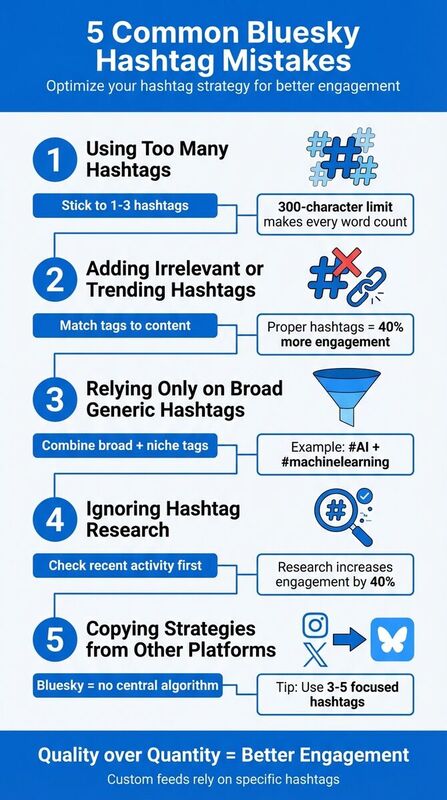
- Using Too Many Hashtags: Overloading posts with 10+ hashtags looks spammy and wastes the platform's 300-character limit. Stick to 1–3 relevant tags for clarity and better reach.
- Adding Irrelevant Hashtags: Using unrelated trending tags disrupts niche feeds and damages credibility. Always ensure your tags match your content.
- Relying on Generic Hashtags: Broad tags like #TechNews often lack activity. Combine general tags with niche ones like #saasmarketing for better engagement.
- Skipping Hashtag Research: Inactive or irrelevant hashtags won’t help your reach. Take time to check hashtag activity and align with community conversations.
- Copying Strategies from Other Platforms: Bluesky’s decentralized system requires a different approach. Avoid excessive tags and focus on targeted, active hashtags.
How to use hashtags effectively on bluesky (2025)
1. Using Too Many Hashtags Per Post
With Bluesky's 300-character limit, every word matters [4]. Filling your posts with hashtags takes away space for meaningful content. Plus, posts overloaded with 10 or more hashtags can come across as spammy and insincere, which doesn't align with the authentic interactions Bluesky users value.
Bluesky’s decentralized setup depends on custom feeds that follow specific hashtags. Loading your posts with excessive tags not only muddles your message but also confuses readers and makes algorithmic feeds less effective.
"Overusing hashtags looks cluttered and reduces clarity. Stick to active, relevant tags to improve visibility without overwhelming your message." - Distribution AI [1]
This advice highlights the importance of a smarter hashtag strategy. Overloading hashtags can make your posts seem desperate rather than engaging. To keep things clean and appealing, aim for 1–3 hashtags for the best balance of visibility and readability [1]. If you need to target niche audiences, try not to exceed 5 hashtags [6]. Focus on picking a few relevant ones - quality always beats quantity when it comes to hashtags.
2. Adding Irrelevant or Trending Hashtags
Throwing in trending hashtags that have nothing to do with your content might seem like a shortcut to gain attention, but on Bluesky, it can backfire. Unlike platforms driven by algorithms where this tactic might temporarily boost visibility, Bluesky operates on a decentralized system with user-curated custom feeds. Using irrelevant tags disrupts these carefully organized spaces, making your posts feel out of place and diminishing their credibility.
On top of that, unrelated hashtags can make your content look spammy and damage audience trust. BluePilot emphasizes that this strategy "erodes audience trust" [4]. Since Bluesky lacks a central "For You" algorithm, your reach depends on appearing in the right custom feeds. Users following those feeds expect content that fits their interests - irrelevant posts often lead to muting or ignoring your account altogether.
The stats underline this point: posts with properly chosen hashtags on Bluesky can see up to 40% more engagement [3]. But this only happens when your tags genuinely reflect your content. With Bluesky’s tight 300-character limit, wasting space on irrelevant hashtags not only weakens your message but also risks alienating the community.
To steer clear of these mistakes, always check the context of a hashtag before using it. Search for the hashtag on Bluesky and review recent posts. If they don't align with your content, skip it, no matter how popular the tag might be. Instead, stick to 2–3 hashtags that are directly relevant to your message. On Bluesky, staying genuine will always outweigh chasing fleeting trends.
3. Relying Only on Broad Generic Hashtags
Using generic hashtags like #TechNews or #MarketingTips might seem like a safe bet, but on Bluesky, they often fall short. Unlike other platforms, Bluesky doesn't rely on a central algorithm for content discovery. Instead, users create custom feeds that curate posts based on specific hashtag rules. If your hashtags aren't tied to these niche feeds, your posts might not reach the right audience at all [1].
Another issue with broad hashtags is their lack of activity. For instance, while #marketingtips might sound useful, it often remains inactive on Bluesky. On the other hand, more specific tags like #saasmarketing or #contentmarketing are tied to active and engaged communities [1]. Plus, given the platform's character limits, sticking to relevant, niche hashtags ensures you use your space wisely [4].
Data supports this approach: targeted hashtags can increase engagement by up to 40% [3] and help establish credibility within specific communities [1]. Regularly using niche hashtags also signals the focus of your account, making it easier for the right audience to find you [1].
A smart strategy is to combine broad and niche hashtags. For example, pair a general tag like #AI with a more specific one like #machinelearning to appeal to both wider and focused audiences [1][4]. Before posting, take a moment to check a hashtag's recent activity on Bluesky to ensure it’s actively used.
"Quality engagement with fewer, targeted hashtags outperforms broad reach with irrelevant tags." - BluePilot [4]
4. Ignoring Hashtag Research and Community Context
Skipping hashtag research on Bluesky can leave your posts invisible within niche custom feeds. These user-created feeds rely on specific hashtag rules to pull in relevant content. If you're not using the right hashtags, your posts won't show up where your audience spends their time [1].
Using inactive hashtags is another common mistake that keeps your content from reaching its intended audience [1]. To avoid this, search for the hashtag on Bluesky and check for recent activity - look for likes, replies, and reposts from the past few days. This simple step ensures your hashtags match not only active feeds but also align with what the community is currently discussing.
Beyond hashtag research, understanding your community's context is just as important. Bluesky emphasizes authentic interactions over self-promotion. Misusing hashtags without understanding the conversations within those communities can result in your posts being muted [4][7]. For example, the #WritersCommunity hashtag is for genuine discussions about writing, not for promoting products.
"Ignoring community context and existing conversations within hashtag communities can alienate potential audience members." - BluePilot [4]
To refine your strategy, combine active hashtag research with a focus on community context. Start by identifying the custom feeds your audience follows and note the specific hashtags those feeds prioritize. Pay attention to tag clusters, such as #AI and #machinelearning, which can help your content appear across multiple feeds [1]. A well-researched approach like this can increase engagement by up to 40% compared to random hashtag use [3].
5. Copying Hashtag Strategies from Other Platforms
What works on Instagram or X (Twitter) doesn’t necessarily translate to Bluesky. For example, Instagram users often load posts with 10 or more hashtags, but on Bluesky, that comes off as spammy. Why? Bluesky values authentic conversations, and its 300-character limit makes excessive hashtags impractical [4].
Another key difference is how content gets discovered. Unlike X or Instagram, Bluesky doesn’t use a centralized algorithm to push content to users [4]. It also lacks a built-in trending tab [2], meaning strategies like jumping on trending topics require manual effort. This difference highlights why copy-pasting strategies from other platforms won’t work on Bluesky.
Hashtag use also varies. On X, 2–3 hashtags are ideal for real-time conversations. Bluesky, however, benefits from 3–5 focused hashtags that help posts connect with niche communities. Plus, hashtags on Bluesky have a longer shelf life, giving posts a chance to gain traction over several days instead of just minutes [5].
To succeed on Bluesky, it’s essential to adjust your strategy. Combine one broad hashtag (like #Tech) with a couple of specific community-focused tags (like #DecentralizedSocial). This blend balances reach with targeted engagement. Be sure to research hashtags beforehand to ensure they’re active. Following this tailored approach could increase engagement by up to 40% [3].
Conclusion
Steering clear of these five common hashtag mistakes can make a noticeable difference in your Bluesky engagement. Focus on quality over quantity by sticking to 3–5 relevant hashtags per post. Avoid hopping onto unrelated trends, and strike a balance between broad tags like #Tech and more specific ones like #DecentralizedSocial. Always research hashtags before using them - clever but inactive tags won’t help your visibility.
Bluesky’s decentralized and algorithm-free setup requires a fresh approach compared to platforms like Instagram or X. With its 300-character limit and emphasis on community, your hashtag strategy should aim for genuine engagement rather than viral hits. Posts that get this right often see meaningful boosts in interaction [3].
To streamline your efforts across platforms, consider using tools that simplify scheduling and analytics. For example, TheBlue.social offers a cross-posting scheduler tailored for platforms like X, Threads, Instagram, Pinterest, LinkedIn, Bluesky, and Mastodon. It also provides Bluesky Analytics to track which hashtags foster real conversations, along with a free hashtag generator to assist in your research.
Start with a focused approach, keep your hashtags relevant, and refine your strategy based on feedback from the community. Hashtags should spark conversations, not just echo into emptiness. Aligning your strategy with Bluesky’s community-focused ethos is key to building lasting engagement.
FAQs
How can I find active hashtags on Bluesky?
To uncover active hashtags on Bluesky, start by exploring trending topics and hashtags directly on the platform. Dive into community posts to spot hashtags that consistently appear in popular content. This hands-on approach gives you a sense of what’s resonating with users.
For a deeper look, consider using analytics tools. These can help track hashtag performance, showing which ones drive the most engagement. By combining your observations on Bluesky with data from analytics, you can pinpoint and leverage the most effective hashtags for your content.
Do hashtags work differently in custom feeds?
Hashtags in custom feeds, such as those on Bluesky, serve primarily as clickable tools to organize content and foster community interactions. Since Bluesky lacks trending sections like other platforms, using hashtags effectively requires a more deliberate and strategic approach. This includes conducting thoughtful research and selecting hashtags carefully to boost both visibility and engagement.
How many hashtags should I use on Bluesky?
Using 2-5 hashtags per post on Bluesky is a great way to boost engagement and visibility. This range ensures your posts stay focused while still connecting with the right audience.