How Hand-Drawn Logos Boost Brand Identity
Last updated: February 18, 2026
Hand-drawn logos are gaining popularity because they offer a personal, human touch that stands out in a world dominated by polished, digital designs. These logos, created with tools like pencils, pens, or digital styluses, showcase imperfections like uneven lines and textures, making them feel more relatable and memorable.
Key takeaways:
- Emotional Connection: Hand-drawn logos feel personal, much like a signature, creating stronger bonds with consumers.
- Memorability: Their irregular details make brands stand out in a sea of machine-perfect designs.
- Versatility: They work well for industries like food, tech startups, and small businesses, emphasizing craftsmanship and care.
To create your own hand-drawn logo:
- Start with pencil sketches, embracing imperfections.
- Digitize your design using free tools like Adobe Scan or Illustrator.
- Refine it while maintaining its handcrafted essence.
This approach can help businesses of all sizes convey warmth, individuality, and a sense of care, making their brand identity more approachable and distinct.
Why Hand-Drawn Logos Improve Brand Identity
Personal Connection and Authenticity
Hand-drawn logos have a charm that feels like a personal signature, creating an immediate sense of care and attention. In fact, 78% of consumers view logos as works of art [5], and one design studio reported that 95% of their clients specifically chose them for the approachable, hand-drawn quality of their designs [2].
The beauty of these logos lies in their imperfections. Those slightly uneven lines and soft edges tell a story - a real person crafted the design, not a machine. Adobe describes this as the "signature effect", where it feels like "someone in the company took the time to personally inscribe a product" [1]. For smaller businesses trying to stand out against larger competitors, this human touch can make all the difference. It sends a message that you care deeply about your visual identity, just as much as you care about your products or services.
These imperfections don’t just connect on a personal level - they also help your brand stand out in a world where digital perfection is the norm.
Standing Out and Being Remembered
In a sea of perfectly polished, geometric designs, hand-drawn logos offer a refreshing alternative. Their unique, spontaneous details can’t be replicated by digital templates or AI tools [2]. This makes your brand feel distinct and memorable.
This approach is gaining traction, especially among tech companies like Mailchimp, Buffer, and Intercom, which have incorporated hand-drawn elements to break away from the overly polished designs dominating their industry [7]. The reasoning is simple: it signals a preference for authenticity over perfection and substance over style.
Rion Harmon, Creative Director at Day Job, explains it best:
If all that matters is the product, well, then the brand should look scribbled, fast and loose... It emphasises that you aren't paying for the brand or the packaging – you're paying for the product [8].
This kind of branding creates a sense of transparency. A hand-drawn logo suggests that a company prioritizes quality over flashy marketing. That honesty builds trust and fosters emotional connections that slick, corporate branding often misses.
What’s more, the versatility of hand-drawn logos makes them a great fit for a variety of industries.
Works Across Different Industries
The ability of hand-drawn logos to create personal connections and stand out from digital precision makes them incredibly versatile. They thrive in industries like food and beverage (think Bonne Maman’s handwritten calligraphy or Ben & Jerry’s playful typography), tech startups aiming to humanize their products, and eco-conscious brands emphasizing natural values [6][7].
This style is especially impactful for creative professionals, small businesses, and artisans - whether it’s coffee shops, Etsy sellers, furniture makers, or craft breweries [6]. The imperfections in hand-drawn logos evoke a sense of old-world craftsmanship and personal dedication. Beyond these traditional uses, they’ve also proven effective for wellness brands, boutique hotels, and educational services, where a warm, approachable identity is key.
The secret to success lies in aligning the logo’s style with your brand’s values. Hand-drawn logos shine when your business genuinely emphasizes craftsmanship, honesty, and human connection. When those values match, your logo becomes more than just a design - it becomes a symbol that resonates deeply with your audience.
Hand-drawn logo design - A course by Aron Leah | Domestika English
How to Create Hand-Drawn Logos Without a Designer
Sketching Your Ideas
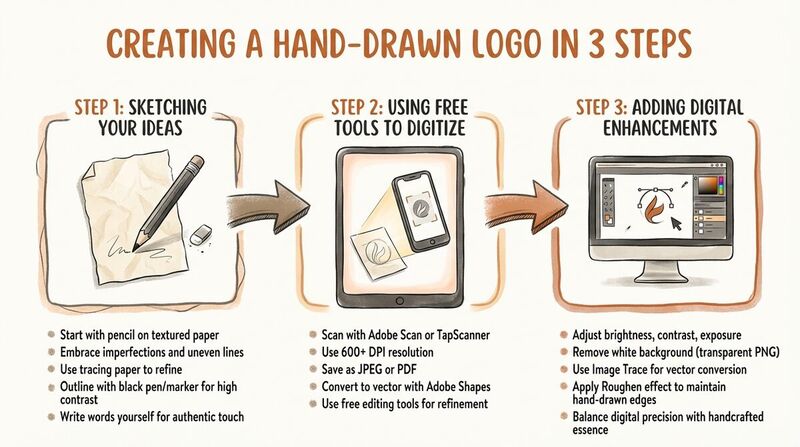
Every great hand-drawn logo begins with the basics: pencil and paper. Designer George Bokhua highlights the importance of using textured paper, noting that "textured paper is very important. It gives more character" [1]. Start sketching freely, embracing the quirks and imperfections - those uneven lines and organic shapes are what give hand-drawn logos their unique charm.
Once you’ve drafted a rough idea, use tracing paper to refine your design. This step-by-step refinement helps simplify and clean up your visual elements until you achieve a focused and polished sketch [1][4]. When you’re happy with the result, outline it with a black pen or marker to create bold, high-contrast lines that will make digitization easier [6]. Designer Lenore Ooyevaar also encourages adding a personal touch: "Some typefaces have a hand-drawn look, but you can always feel that they were computer-generated. Don't be afraid to write the words yourself" [1]. Once your hand-drawn concept feels complete, you’re ready to bring it into the digital world.
Using Free Tools to Digitize Designs
With your refined sketch ready, the next step is to digitize it. Start by scanning your design using free apps like Adobe Scan or TapScanner. These apps ensure your sketch is captured in high resolution (at least 600 DPI), preserving the fine details and character of your work [6]. The scan can be saved as a JPEG or PDF for easy editing.
To convert your sketch into a scalable vector format, tools like Adobe Shapes are incredibly useful. These mobile apps automatically transform your hand-drawn design into vector files, making it ready for resizing and further adjustments [6]. If you need additional help fine-tuning your logo, free tools from TheBlue.social can come in handy. For example, the Profile Picture Editor or the Generate Alt Text for Images tools can enhance your logo’s usability, while the Extract Text from Images tool ensures handwritten text is accurately captured.
Adding Digital Enhancements
Once your logo is digitized, it’s time to refine it further with digital tools. Free software like Photoshop allows you to enhance your design by adjusting brightness, contrast, and exposure - making your lines sharper and more defined [6]. To remove the white background and create a transparent logo, use Photoshop’s "Color Range" tool with the eyedropper feature [6].
For vector adjustments, Adobe Illustrator (available with a free trial) is a great option. Its "Image Trace" feature converts your sketch into scalable paths, while the "Roughen" effect can be applied to maintain the hand-drawn, imperfect edges that make your logo stand out [9][3]. This balance between digital precision and hand-drawn spontaneity is key. As Adam Vicarel, Founder of Vicarel Studios, explains, "A computer cannot replicate the spontaneous and nuanced imperfections afforded by the human hand" [2]. The goal is to enhance your design without losing its handcrafted essence, ensuring it remains authentic and visually striking across all platforms.
Best Practices for Hand-Drawn Logo Design
Keep It Simple and Scalable
Hand-drawn logos often start as intricate sketches but need to be pared down to their core elements. Simplify your design by redrawing it multiple times, stripping away unnecessary details until you’re left with the essential form - something that could almost be described as a "single doodle" [1][4]. This approach ensures your logo stays clear and recognizable, whether it’s blown up for a billboard or shrunk down for a social media icon.
Scalability matters. Once you’ve finalized your design, convert it into a vector file format like EPS or AI. This allows the logo to be resized without losing sharpness or quality [6][10]. Test it at small sizes, such as on app icons or stickers, and simplify further if any details blur or become unrecognizable. As Tailor Brands explains:
The fewer details you have, the easier it will be to preserve the quality of your design when you resize your logo [6].
Your logo should also work in various formats - full color, grayscale, and black-and-white - to ensure it looks great in any context, from digital screens to print [1][5]. A streamlined design lays the groundwork for a logo that effectively communicates your brand’s message.
Matching Your Brand Values
Once the design is simplified, it’s time to make sure it aligns with your brand’s identity. Before you even start sketching, think about your brand’s personality. If your business were a person, how would they look or act? For example, a children’s entertainer might lean toward playful fonts and bright colors, while a craft brewery could benefit from intricate, artisanal strokes that highlight a dedication to quality [5][6][10].
Authenticity should always take precedence over perfection. As designer Lenore Ooyevaar points out:
If you do use a hand-drawn-looking typeface, manipulate it... If you have two of the same letters in a word, you don't want them to be identical [1].
This kind of attention to detail ensures your logo feels handcrafted rather than resembling generic clip art.
Colors also play a big role in reinforcing your brand values. Subtle, muted tones often feel more in tune with a hand-drawn aesthetic compared to overly bright, digital hues [3]. Think about the emotions you want to evoke - blue can project trust and professionalism, while red might suggest energy and passion [6]. Every aspect, from the line weight to the color palette, should contribute to the story your brand is trying to tell.
Testing Across Different Platforms
Your logo’s ability to maintain its authenticity across platforms is crucial. Social media platforms like X (Twitter), Instagram, Bluesky, and Threads often display profile pictures in small circular frames. Export your logo as a transparent PNG and test it on various background colors to ensure the details remain crisp and clear [6][10]. Pay close attention to how the hand-drawn elements translate in these small, confined spaces.
To further refine your design, use digital mockups to see how your logo looks on business cards, packaging, T-shirts, or website headers [3]. For platforms like Bluesky, tools such as TheBlue.social's Profile Picture Editor can help optimize your logo for specific profile picture requirements. The ultimate goal is to ensure your logo’s hand-drawn charm shines through, preserving that personal, human touch that sets it apart from overly polished, computer-generated designs.
Conclusion
Hand-drawn logos have a unique way of building a genuine connection with your audience. Their softer lines and subtle imperfections convey approachability and craftsmanship - qualities that 78% of consumers associate with artistic value [5]. This distinct style can help set your brand apart in a crowded market [2].
These designs go beyond aesthetics; they create an emotional bond between your brand and its audience. As Adam Vicarel, Founder of Vicarel Studios, puts it:
The softer edges and loose imperfections of hand drawn logos is something that feels authentically human, and many brands could use a bit more approachability and humanity [2].
Getting started with hand-drawn logos is simpler than you might expect. Free tools are available to help you experiment with this style and turn your sketches into polished, professional designs. TheBlue.social, for instance, offers resources like a Profile Picture Editor to tailor your logo for social media and an Alt Text Generator to ensure accessibility across platforms.
Whether you're running a cozy coffee shop, launching a tech startup, or selling handmade crafts, a hand-drawn logo can help you stand out. Start with a pencil and paper, embrace the imperfections, and let your brand's personality shine through.
FAQs
Are hand-drawn logos still professional?
Hand-drawn logos are absolutely seen as professional. They give brands a distinct edge by offering a one-of-a-kind, personal feel that’s hard to replicate. This style often conveys a sense of authenticity and care, making the brand feel more approachable and relatable. By incorporating a handcrafted element, these logos can help businesses establish a memorable and impactful identity.
What file format should I save my hand-drawn logo in?
To keep your hand-drawn logo sharp and scalable, save it as a vector file format like SVG or AI. These formats ensure your design stays crisp and clear, no matter the size or application.
How do I make a hand-drawn logo look good as a social profile picture?
To transform a hand-drawn logo into an effective social profile picture, start by digitizing it while preserving its original character. Focus on refining the design to ensure it’s clear and simple, as intricate details can become indistinct when resized. Once polished, make sure the logo aligns with the platform's profile image dimensions. This approach ensures your logo remains unique and visually striking.