How Often to Post on Social Media in 2025
Last updated: February 9, 2026
Figuring out how often to post on social media in 2025 comes down to balancing consistency, quality, and platform-specific strategies. Each platform has its own rhythm, and posting too much or too little can hurt your engagement. Here’s a quick breakdown:
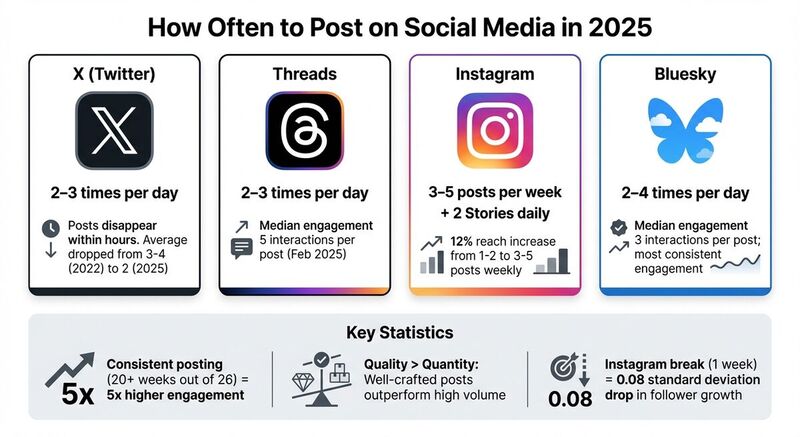
- X (formerly Twitter): Post 2–3 times daily to stay visible in fast-moving feeds.
- Threads: Aim for 2–3 posts daily to encourage steady growth.
- Instagram: Stick to 3–5 posts weekly, plus 2 Stories daily for consistent reach.
- Bluesky: Post 2–4 times daily to maintain engagement without overloading followers.
Key Takeaways:
- Consistent posting (e.g., 20 out of 26 weeks) can increase engagement by 5x.
- Quality matters more than quantity - well-crafted posts perform better.
- Use analytics to track what works and adjust your social media schedule accordingly.
The goal isn’t to post more but to post smarter. Focus on maintaining a schedule that fits your resources while keeping your audience engaged.
Masterclass: How Often You Should Post On Each Platform On Social Media
Why Posting Frequency Affects Engagement
How often you post has a direct impact on both how algorithms treat your content and how your audience reacts to it. For example, on Instagram, taking a week-long break can reduce follower growth by 0.08 standard deviations. On the flip side, increasing your posts from 1–2 to 3–5 per week can boost your reach by about 12% [4]. If you push to 10+ posts weekly, you might see a 24% increase in reach, but the extra effort often leads to diminishing returns [4][5]. That first jump in frequency is where most of the benefits lie.
On fast-moving platforms like X and Threads, recency and timeliness are key. Posts quickly lose relevance, so aiming for 2–3 posts per day is crucial to staying visible in users' feeds [5][6]. In contrast, platforms like LinkedIn and Pinterest allow content to linger and circulate for weeks or even months. This means quality often matters more than quantity on those platforms [5][6]. For platforms with fast-paced feeds, higher posting frequency increases your chances of landing a standout post.
How Algorithms Work in 2025
To understand why posting consistently matters, it helps to look at how algorithms function today. In 2025, algorithms prioritize consistency over sheer volume. Platforms like Instagram and Threads use AI to reward accounts that post regularly. For example, accounts that post consistently - 20 or more weeks out of 26 - see 5x higher engagement per post [2]. If you suddenly drop from daily posts to once a week, your reach is likely to take a hit.
Adam Mosseri, Instagram's Head, has addressed this directly:
Posting too often will not lose you followers... the more you post, the more chances you have to be discovered [6].
However, posting too infrequently can cause the algorithm to deprioritize your content. On platforms like X, where timeliness is everything, posts older than a few hours often get buried, making 2–3 daily posts essential [5][6]. Threads, on the other hand, rewards conversational and interactive content, favoring replies and ongoing discussions over one-way broadcasts [1].
What Your Audience Expects
Your audience's habits are just as important as algorithm behavior. On X, where feeds refresh constantly, posting 2–3 times daily helps ensure your content doesn't get lost in the shuffle.
Instagram users, however, interact differently. Around 60% of consumers engage with brand content on Instagram multiple times per week [3]. For this platform, posting 3–5 times weekly hits the sweet spot - it keeps your brand visible without overwhelming your followers. Posting too often on Instagram can actually hurt your previous posts' performance, as they compete for the same audience's attention [9].
On Bluesky, users lean toward meaningful and consistent interactions rather than high volume. Posting 2–4 times daily works well here, helping you maintain engagement while staying authentic.
How Often to Post on Each Platform
Each social platform has its own rhythm, and understanding these differences can help you maximize your reach while avoiding burnout. The recommendations below are based on 2025 engagement data, reflecting how algorithms and audiences interact on each network.
X (Twitter): 2–3 Times Per Day
X is fast-paced, with posts often disappearing from view within hours. To stay relevant, aim for 2–3 posts daily. This keeps you visible without overwhelming your audience. While some power users post more frequently, the average for brands has dropped to 2 tweets per day in 2025, down from 3–4 in 2022 [3]. The platform thrives on viral content, with a high engagement variation - some posts can explode in reach even if others barely gain traction [1]. Focus on joining trending conversations early and ensure your content is meaningful. As Trish Riswick, Social Media Manager at Hootsuite, says: "Three quality posts are worth more than five low-quality posts" [6].
Threads: 2–3 Times Per Day
Consistency is key on Threads. Posting 2–3 times daily helps maintain visibility and encourages steady growth. In February 2025, Threads' median engagement rose to 5 interactions per post, surpassing X’s 4 [1]. The platform values conversational content, so engage actively with followers rather than just broadcasting. Paige Schmidt from Hootsuite's Social Team recommends: "A good rule of thumb [on Threads] is to post 2 to 3 times per day. While you definitely can post more than that, I wouldn't recommend less!" [6]. Threads offers a reliable way to build community and foster engagement.
Instagram: 3–5 Times Per Week
For Instagram, the sweet spot is 3–5 feed posts per week, including Reels, carousels, and photos. This frequency balances growth with sustainability, doubling follower growth compared to posting only 1–2 times weekly [4]. Increasing from 1–2 posts to 3–5 posts weekly can improve reach per post by around 12% [4][5]. For Stories, aim for 2 per day to keep your audience engaged [6]. Although posting more than 10 times weekly can boost reach by 24%, the returns diminish with each additional post, making 3–5 posts the most efficient target [4][5]. Regular posting over time also pays off - accounts posting consistently for 20 out of 26 weeks see engagement per post increase fivefold [2]. Focus on visually appealing content and Reels, as short-form videos continue to dominate [3][6].
Bluesky: 2–4 Times Per Day
Bluesky takes a different approach compared to X and Threads. Here, niche and thoughtful content performs better than chasing viral hits. Posting 2–4 times daily helps maintain engagement without compromising authenticity. In early 2025, Bluesky’s median engagement was 3 interactions per post, with the smallest engagement variation (a standard deviation of 279) among major platforms [1]. This means engagement is more consistent, even if growth is slower than on Threads or X. Bluesky is ideal for fostering meaningful conversations and building a tight-knit community rather than focusing on high-volume posting. You can also find relevant communities using Bluesky starter packs to accelerate your growth. It’s a platform that rewards genuine connections over sheer numbers.
How to Find Your Best Posting Frequency
Start with Platform Guidelines
Consistency plays a big role in keeping your audience engaged. The platform-specific recommendations shared earlier - like posting 2–3 times daily on X and Threads or 3–5 times weekly on Instagram - are great starting points based on 2025 engagement data. However, your audience might not follow the averages. Use these numbers as a baseline, not a hard rule. Test them for 2–3 weeks, and monitor metrics like engagement, reach, and follower growth to see how your audience responds.
Use Analytics to Adjust Your Schedule
Once you've tested your initial posting schedule, dive into your analytics to refine it. Look for patterns in your data, focusing on median engagement rather than averages. Why? A single viral post can skew your averages, making them less reliable [1][2]. Key metrics to track include reach per post, follower growth rate, and total engagements. For example, increasing Instagram posts from 1–2 to 3–5 per week has been shown to boost reach by about 12%, though gains tend to level off beyond that [4][5].
Be mindful of gaps in posting, too. Weeks with no posts can hurt your account, leading to stagnation or even a drop in followers compared to your usual performance [4]. Kirsti Lang, Senior Content Writer at Buffer, emphasizes:
Posting at least weekly is ideal, but you can give yourself a week's grace here and there... the key isn't perfection - it's progress [2].
Consistency matters. Accounts that post consistently - at least 20 out of 26 weeks - see 5x more engagement per post than those with sporadic activity [2].
Use TheBlue.social for Scheduling
Managing multiple platforms and testing different posting frequencies can be overwhelming. That’s where tools like TheBlue.social come in handy. This platform lets you schedule posts across X, Threads, Instagram, Bluesky, LinkedIn, and Mastodon from a single dashboard. You can batch-create content, queue posts to maintain consistency, and even schedule threaded posts for platforms like Bluesky.
The built-in AI assistant can help refine your tone and suggest content ideas, while the analytics dashboard tracks key metrics like reach, clicks, and follower growth. This makes it easier to see how your posting frequency affects performance. Plus, TheBlue.social offers data-driven recommendations on the best times and days to post based on your audience's behavior, so you’re not relying on generic industry averages.
The free version covers basic scheduling, while paid plans unlock advanced analytics and personalized recommendations. By automating your posting schedule, you can spend less time manually publishing and more time creating high-quality content.
Mistakes to Avoid
After fine-tuning your posting schedule, steer clear of these common missteps.
Posting Too Much
Flooding your audience with posts can actually do more harm than good. On Instagram, posting more than twice a day might hurt the visibility of earlier posts, as they end up competing with each other for attention [9]. Similarly, on X (formerly Twitter), increasing your posting frequency to 20 times a day can lead to less engagement per post compared to a more moderate schedule of 10 posts [9]. The numbers don't lie - while increasing from 1 to 3 Instagram posts per week shows noticeable growth, jumping from 5 to over 10 posts delivers much smaller benefits [4] [5].
Beyond the numbers, an overly aggressive posting schedule can lead to creator burnout and even trigger penalties from platforms for inactivity during inevitable breaks [3] [4]. As Ann Handley wisely points out:
Posting less is a power move that gives teams room to create more meaningful, resonant content [3].
Choosing Quantity Over Quality
Chasing numbers by churning out low-quality posts won't win over your audience. Julian Winternheimer, a Data Scientist at Buffer, explains:
You're probably not going to see big gains in followers and reach by pumping out low-quality posts [4].
In fact, two well-crafted posts a week can outperform 20 mediocre ones in terms of engagement [6]. Today’s audiences value originality and authentic connections over sheer volume. Instead of struggling to produce a constant stream of new ideas, focus on repurposing strong content. For example, a single blog post can be transformed into a carousel, a short video, and a text-based update. This approach not only maximizes your content but also keeps the quality intact.
And remember, monitoring your engagement metrics is just as important as balancing quality and quantity.
Ignoring Your Engagement Data
While industry benchmarks provide a helpful starting point, they won’t tell you what resonates with your audience. Brayden Cohen from Hootsuite recommends:
Try testing different posts at different times and different quantities to see what drives the best performance for your content and channel. Continue to test, learn, and pivot [6].
Regularly analyzing your engagement metrics helps you catch patterns, like when higher posting frequencies lead to diminishing returns or when your audience shows signs of fatigue. For instance, if your second post of the day consistently underperforms, it might be a sign to stick to just one daily post [6]. Keep an eye on metrics like likes, comments, and shares to gauge how well your content is connecting [7].
Since algorithms are constantly changing, relying on outdated strategies can quickly make your efforts ineffective. Staying on top of your metrics ensures your approach evolves with the platforms [6] [8].
Conclusion
Finding the ideal posting frequency depends on balancing consistency, content quality, and what your audience values most. Research shows that being consistent leads to better engagement [2]. Whether you're posting 2–3 times a day on X and Threads or sticking to 3–5 posts a week on Instagram, the most important thing is to pick a schedule you can reliably maintain without overwhelming yourself.
When it comes to social media, quality beats quantity every time. As Kirsti Lang from Buffer wisely says:
The best posting schedule is one you can stick to consistently [4].
Rather than spreading yourself too thin across every platform, focus on creating content that connects deeply with your audience. Pay attention to your engagement metrics - if you notice, for example, that your second daily post consistently falls flat, it might be a sign to scale back and prioritize fewer, higher-impact posts.
Tools like TheBlue.social simplify this process. Their cross-posting features let you manage content across platforms like X, Threads, Instagram, Pinterest, LinkedIn, Bluesky, and Mastodon - all from one dashboard. With their analytics tools, you can see what’s working and adjust your strategy based on real insights, not guesswork. Plus, you can batch-create and repurpose content, keeping your schedule consistent without the stress of daily manual posting. It’s a practical way to streamline your approach and stay aligned with your goals.
FAQs
How does how often you post on social media impact engagement?
How often you post on social media can make or break your engagement. Regular, well-timed posts are essential for increasing likes, comments, and shares. But here's the catch: each platform has its own rhythm, and understanding that is crucial.
Take Instagram and Facebook, for example. These platforms thrive on consistent activity. For Facebook, posting 1 to 4 times daily works well, while Instagram sees strong engagement with 3 to 7 posts spread out over the week. On TikTok, however, the pace is faster - 1 to 4 posts a day keeps your audience hooked.
Then there’s X (formerly Twitter), where the fast-moving feed means you need to post about 6 times a day to stay visible. For newer platforms like Bluesky and Threads, it’s all about timing your posts to align with when your audience is most active.
The bottom line? Each platform has its own rhythm, and your success depends on adapting to those dynamics while staying consistent.
Why is it better to focus on quality over quantity when posting on social media?
Focusing on quality over quantity when it comes to social media posts is a smart way to build trust and stronger connections with your audience. Content that’s well-thought-out, relevant, and engaging is far more likely to strike a chord, encourage meaningful conversations, and even get shared - helping your brand grow in both reputation and reach.
On the flip side, posting too often with content that feels rushed or less impactful can backfire. It might overwhelm your followers, water down your message, and even cause them to tune out. Instead, aim to create posts that offer real value and feel genuine. This keeps your audience interested and engaged for the long haul, without the risk of burnout or diminishing results.
How can I use analytics to find the best times to post on social media?
Figuring out the perfect time to post on social media starts with diving into your analytics. Look closely at metrics like likes, comments, shares, and reach to see when your audience is most engaged. This data helps you spot patterns, so you can adjust your posting schedule to match the times your followers are most active.
For platforms like Bluesky, tools such as TheBlue.social offer analytics designed specifically to track engagement trends and follower growth. By regularly reviewing these insights, you can fine-tune how often you post, keeping a consistent presence without overwhelming your audience. Taking a data-driven approach ensures your content reaches more people and helps build stronger connections with your followers.