Top 5 Tools for Generating Alt Text Automatically
Last updated: June 14, 2026
Alt text describes images for people using screen readers and gives search engines useful context. AI tools can write a first draft quickly, but I still review the result before publishing. A wrong description is worse than a slow one.
TheBlue.social fits when the image is part of social publishing work: generate a draft alt text, extract text from the image if needed, then use it in a scheduled post.
- TheBlue.social: Free for quick alt text drafts, with OCR and social publishing tools nearby.
- AltText.ai: Offers a freemium model and creates contextually relevant alt text tailored to different image types.
- Popupsmart: Free and user-friendly but lacks CMS integration, making it better suited for smaller tasks.
- Tailwind: Integrated with Tailwind’s social media tools, ideal for platforms like Instagram and Pinterest.
- Caseo.ai: Focuses on SEO while supporting batch processing and CMS integration. Requires a subscription.
Quick Comparison
| Feature | TheBlue.social | AltText.ai | Popupsmart | Tailwind | Caseo.ai |
|---|---|---|---|---|---|
| Pricing | Free | Freemium | Free | Subscription | Subscription |
| Accessibility | High | Moderate | Moderate | Moderate | High |
| Bulk Processing | Yes | Limited | No | No | Yes |
| Integration | Social Media | API | None | Social Media | CMS |
Choose based on where the image goes next. A CMS-heavy site may need API or plugin support. A social post may only need a fast draft, manual review, and a place to use the description.
AltText.ai Review & Tutorial - The Ultimate Image Alt Text Generator ($69 AppSumo LTD)
1. TheBlue.social alt text generator
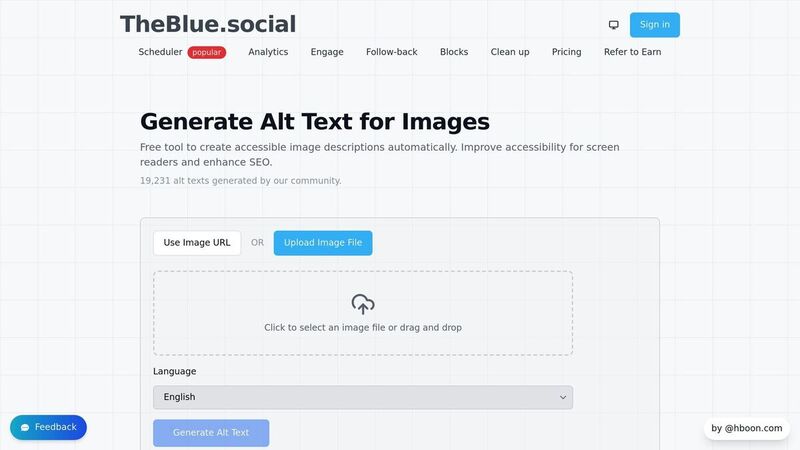
TheBlue.social's Alt Text Generator is a free web tool for drafting image descriptions. Upload an image or paste an image URL, get a draft, then edit it before using it.
The tool uses AI to describe visible content. I treat that as a starting point, not a final accessibility decision. If the image has context the model cannot know, add it yourself.
For social images, the useful draft is short, concrete, and focused on what matters in the post. Avoid keyword stuffing. Do not describe decorative details unless they change the meaning.
The practical advantage is the surrounding workflow. TheBlue.social also has OCR for images with embedded text, an Open Graph preview tool for shared links, a hashtag generator, and a scheduler for X, Threads, Instagram, Pinterest, LinkedIn, Bluesky, Mastodon, and TikTok when connected. It is strongest when the image is headed into social posts, especially Bluesky and cross-posting work.
Review the generated alt text. AI can miss text, misread objects, or describe the wrong thing as important.
2. AltText.ai
AltText.ai takes the hassle out of creating alt text by using advanced AI to produce descriptions tailored to different types of images. Its strength lies in crafting alt text that aligns with accessibility standards while being contextually relevant.
This tool also stands out with its user-friendly interface, making the process of alt text automation straightforward and efficient.
3. Popupsmart AI Alt Text Generator
Popupsmart's AI Alt Text Generator provides a simple and efficient way to create descriptive alt text for images. With this free tool, users can upload an image, click "Generate alt text", and get a description in just a few seconds [1].
What stands out is how quick and user-friendly the process is, making it a great option for those who need alt text without any complicated setup. You can visit the website and start generating descriptions instantly.
Another advantage is its cross-platform functionality. The alt text created by Popupsmart works smoothly on websites, social media platforms, and e-commerce sites [4][5][6]. This makes it especially useful for content creators who manage multiple channels and want consistent accessibility across all platforms. But, as with any tool, there are trade-offs.
The process requires users to manually upload images, generate the alt text, and then copy it over [1][5]. While fine for smaller tasks, this can be time-consuming for larger projects.
A bigger limitation is the lack of integration with content management systems (CMS). Although the generated alt text is compatible across platforms, the tool doesn’t directly integrate with CMS platforms [4][5][6], meaning users have to manually paste the text into their content.
If you only need a quick solution on occasion, Popupsmart's AI Alt Text Generator is a dependable and free option.
4. Tailwind Image Alt Text Generator
Tailwind's Image Alt Text Generator is an AI-driven tool designed to create descriptive alt text for images in seconds. Seamlessly integrated with Tailwind's social media management platform, this free tool simplifies content creation for visually rich platforms like Instagram and Pinterest [7].
Here’s how it works: upload an image, and the AI generates alt text that doesn’t just identify objects - it provides detailed descriptions that can improve SEO. That said, there are a few limitations to keep in mind.
For instance, the tool processes only one image at a time and doesn’t include built-in features specifically tailored for social media optimization. This means you might need to make manual adjustments if you’re working with multiple images or fine-tuning for specific platforms.
If you already use Tailwind, this alt text generator is a handy, cost-free addition. It supports accessibility and organic reach while fitting into your existing content creation process.
5. Caseo.ai
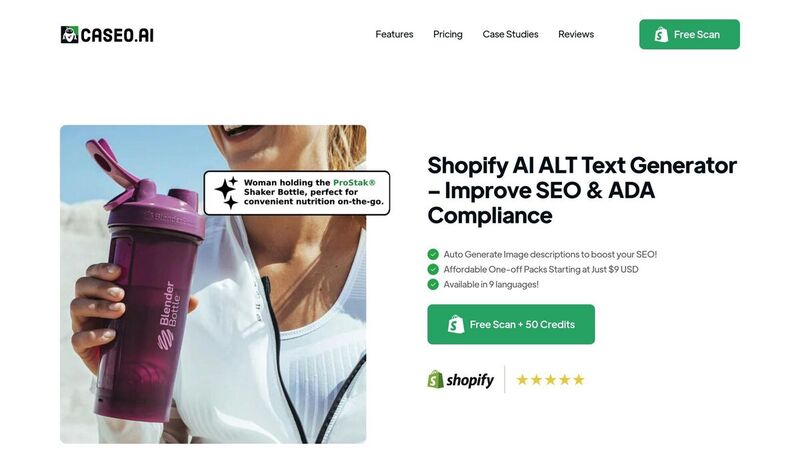
Caseo.ai stands out among alt text generators with its SEO-focused approach. Designed to enhance both accessibility and search engine optimization, this platform helps users create keyword-rich, concise descriptions for their images.
With Caseo.ai, you can upload images and receive optimized alt text. It also supports batch processing, which helps teams handle larger image libraries.
The platform requires a subscription for full access, but it is built for popular content management systems. That makes it useful for content teams working with large image libraries.
Caseo.ai is a better fit when accessibility, SEO, and scale matter more than a quick one-off description.
Tool Comparison Table
Picking the right alt text generator comes down to understanding your specific needs. Here's a side-by-side comparison of five popular tools, focusing on their key features:
| Feature | TheBlue.social | AltText.ai | Popupsmart | Tailwind | Caseo.ai |
|---|---|---|---|---|---|
| Pricing | Free | Freemium model | Premium subscription | Subscription-based | Subscription required |
| Accessibility Focus | Drafts that need review | Screen reader optimized | Basic accessibility | Standards-compliant | Accessibility & SEO |
| Bulk Processing | Bulk page available for paid use | Limited on free plan | Available | Available | Available |
| Language Support | Multiple languages supported | Primarily English | Multi-language | Primarily English | Multiple languages |
| Integration Options | Web tool + social scheduler | API available | CMS plugins available | Design workflow tools | CMS integration |
| Character Limits | Optimized for social media use | Varies by subscription | Standard limits | Platform specific | Tailored for SEO |
| Processing Speed | Fast processing | Quick | Responsive | Real-time | Efficient |
This breakdown helps users identify the best tool for their workflow.
Key Takeaways
TheBlue.social: Best for quick social-image alt text drafts, OCR, and posting prep. It is not a CMS plugin or API-first enterprise tool.
AltText.ai: Offers a freemium model, making it a practical option for users who only need occasional alt text generation without committing to a subscription.
Popupsmart: Useful for occasional one-off image descriptions.
Tailwind: Useful if you already use Tailwind for visual social content.
Caseo.ai: Combines accessibility with SEO optimization, making it ideal for businesses aiming to improve user experience while enhancing search rankings.
Choosing the Right Tool
Your decision should align with your specific requirements:
- If you need a quick social-post draft, TheBlue.social is a good starting point.
- For occasional use, AltText.ai's freemium model is a flexible option.
- Teams handling large image libraries should look for CMS, API, or batch workflows.
- Creative professionals already using Tailwind may prefer staying in that workflow.
- Businesses looking to balance accessibility and SEO can rely on Caseo.ai for optimized results.
Conclusion
Automated alt text tools are useful because they remove the blank-page problem. They do not remove the review step.
For a website with thousands of product images, use a tool with CMS or API support. For a social post, a simple generator plus manual review is usually enough.
Search engines use alt text to understand images, but accessibility comes first. Write the description for the person who needs it, not for a keyword list.
The top tools on the market achieve accuracy ratings of 8–9.5/10 in independent evaluations, with platforms like AltText.ai earning customer ratings of 4.7 out of 5 from over 100 reviews. They offer flexible pricing, from free plans covering 50–100 images per month to paid options starting at just $5 per month, making them accessible for organizations of all sizes[8].
Integrations with WordPress, Shopify, and Squarespace put alt text generation inside existing publishing workflows[2][3][8]. That helps teams review accessibility before images go live.
With increasing pressure to meet ADA and WCAG standards, automated tools are helping organizations create more inclusive digital spaces.
Use TheBlue.social Alt Text Generator when you need a fast draft for social publishing. Use a heavier tool when you need CMS automation, API access, or large image-library workflows.
FAQs
How accurate are AI tools for generating alt text, and should I review the results before using them?
AI tools rely on image recognition and captioning models to create alt text from visual content. They can produce useful descriptions, but accuracy depends on image complexity. AI might misidentify objects or overlook subtle details.
Review every generated description when the image has important context, visible words, people, charts, or safety details.
What should I consider when selecting an alt text generator for my needs?
When selecting an alt text generator, focus on tools that deliver clear and precise descriptions. The generated text should effectively communicate the image's purpose while adhering to accessibility standards, ensuring inclusivity for all users.
Choose a tool with easy-to-use features, such as a straightforward interface and support for various languages, to simplify the process. It's also important that the tool creates descriptions optimized for SEO, helping improve your content's online visibility. By keeping these aspects in mind, you can find a tool that supports both accessibility and content performance goals.
How do automated alt text tools improve accessibility and SEO, and why does this benefit my content strategy?
Automated alt text tools help by creating a first draft. They can make accessibility work faster, but they do not guarantee compliance or accuracy by themselves.
On the SEO side, alt text gives search engines useful image context. That can help relevant images appear in search. Use generated text as a draft, then edit it so the description stays accurate for readers.