How to Use Data for YouTube Niche Research
Last updated: December 22, 2025
Finding the right YouTube niche is all about using data to make informed decisions. Here's the bottom line: 95% of YouTube videos get fewer than 1,000 views because creators often rely on guesses rather than understanding demand and competition. To succeed, you need to analyze trends, audience behavior, and revenue potential.
Key Takeaways:
- Demand vs. Supply: A niche with high interest but low competition increases your chances of success.
- High-Earning Niches: Personal Finance earns $12–$18 per 1,000 views, while Gaming earns $2–$4.
- Tools to Use: Platforms like YouTube Analytics, Google Trends, vidIQ, and TubeBuddy help you identify trending topics, validate keywords, and track competitor performance.
- Check Profitability: Combine CPM (ad rates) with audience engagement to estimate earning potential.
- Focus on Sub-Niches: Instead of broad topics like "Gaming", narrow down to specific areas like "Budget roguelike games under $10."
By leveraging tools and analyzing data, you can find a niche that aligns with your interests, engages viewers, and generates sustainable revenue.
YouTube niche research guide 2024 | Find YOUR perfect niche
Step 1: Find Trending Topics and Keywords
The first step in diving into data-driven niche research is figuring out what people are actively searching for right now. Thankfully, YouTube and Google offer free tools that give you real-time insights into trending topics and keywords.
Start by exploring YouTube’s built-in discovery tools.
Use YouTube's Search Autocomplete
YouTube’s search bar is a goldmine for uncovering high-demand keywords. To get the most accurate results, open an incognito window - this ensures the suggestions aren’t influenced by your personal watch history. Then, type in a broad “seed” keyword related to your niche idea (e.g., "reselling" or "home workouts") and jot down the autocomplete suggestions. These suggestions are based on what real users are searching for right now.
Want to dig deeper? Try using the asterisk (*) wildcard in your searches. For instance, typing "Samsung Galaxy S*" will reveal specific models and variations people are actively looking for. Each suggestion represents a potential content idea with proven demand. Once you’ve compiled a list of keywords, cross-check them with Google Trends (filtered for "YouTube Search") to see if interest is growing, stable, or declining.
This method isn’t just theoretical - it works. Over a 12-month span ending in 2019, Ahrefs adopted a keyword-focused content strategy for their YouTube channel. Instead of targeting broad, high-volume terms, they went after specific topics with verified search interest. The result? Their monthly organic views shot up from 10,000 to 200,000, and they gained 50,000 new subscribers during the same period [7].
Use Google Trends for YouTube Data
Google Trends adds another layer of insight by providing historical context for your keywords. Make sure to switch the dropdown to "YouTube Search" for platform-specific data.
The "Compare" feature is especially useful. For example, if you compare "iPhone XS unboxing" to "iPhone 5S unboxing", you can quickly see which one has more relative interest. Pay close attention to trend directions - keywords with a steady decline aren’t worth chasing, while those with rising or stable interest signal good opportunities for content creation.
It’s also worth checking for seasonality. Adjust the time range to "Past 5 years" or "Past 12 months" to spot patterns. Some topics, like holiday-related niches or product launches, see periodic spikes. These insights can help you plan your content calendar effectively. Additionally, compare "Web Search" and "YouTube Search" for the same keyword. As Joshua Hardwick, Head of Content at Ahrefs, explained:
"Google Trends tells us that searches for 'pizza dough recipe' are slowly declining in recent years on Google… whereas they're on the rise on YouTube" [7].
With this data, you can refine your content strategy to align with what’s gaining traction on YouTube.
Check Recent Video Performance
After validating your keywords, the next step is to analyze how recent videos in your niche are performing. This helps confirm whether there’s real audience demand. Look for "outlier videos" - content that racks up 5x to 10x more views than the channel’s subscriber count. These videos indicate topics with such strong demand that they outperform the creator’s usual reach.
Pay special attention to small or newer channels with high-performing videos. This often signals a content gap - an area where viewers are hungry for more information but aren’t finding enough quality content. Check the view-to-subscriber ratio and engagement metrics, like comments per view, to measure how passionate the audience is. Don’t skip the comment sections - they’re packed with questions and requests for additional details that current videos aren’t addressing. These gaps are opportunities for you to create content that’s more thorough and satisfying.
Step 2: Analyze Competitor Performance
Now that you’ve pinpointed some promising keywords and topics, the next step is to dig into what’s working for others in your niche. By analyzing competitor performance, you can uncover their strengths, weaknesses, and opportunities that might be waiting for you to seize.
Find Top Channels in Your Niche
Start by searching for niche-specific keywords and taking note of the channels that consistently rank at the top. These channels provide a snapshot of what resonates with your target audience. But don’t just stop at the obvious metrics like subscriber counts - look deeper. A smaller channel with fewer subscribers but higher engagement might be outperforming a larger one in terms of influence.
For example, focus on average views per video rather than total subscriber numbers. A channel with 50,000 subscribers averaging 5,000 views per video often has a more engaged audience compared to one with 200,000 subscribers averaging just 3,000 views. Also, check the like-to-view ratio and the comment-to-view ratio to gauge how invested the audience is in the content.
Keep an eye out for channels that seem to be stagnating. If a leading channel hasn’t gained many subscribers in the last 90 days, that could indicate an opening for a new voice to step in. Growth plateaus can signal opportunities for fresh content and perspectives.
Use vidIQ and TubeBuddy for Deeper Insights
Tools like vidIQ and TubeBuddy are invaluable for diving deeper into competitor metrics. These platforms can show you data like views per hour (VPH) and 30-day subscriber growth, which help you assess how quickly a channel is gaining traction.
Pay attention to outlier videos - those that perform significantly better than a channel’s average. Look closely at their titles, thumbnails, and angles to understand what made them stand out. These videos can give you clues about high-demand topics that you can approach in your own unique way.
Additionally, check the keyword competition score for phrases your competitors are ranking for. This score balances search volume with competition, helping you identify keywords where you have a realistic chance to rank. Another factor to consider is upload frequency. If top channels in your niche post inconsistently, this could be your chance to fill the gap by maintaining a steady posting schedule and building audience loyalty.
Create a Competitor Comparison Table
A competitor comparison table is a great way to organize your findings and spot patterns quickly. Here’s an example of what it might look like:
| Metric | Why It Matters | Source |
|---|---|---|
| Subscriber Count | Shows overall reach and authority | Channel homepage |
| Avg. Views per Video | Reflects active audience interest | Review last 10–20 uploads |
| Posting Frequency | Reveals consistency and potential gaps | Check upload dates |
| Engagement Rate | Measures audience interaction | Ratio of comments/likes to views |
| Outlier Topics | Highlights viral potential | Videos with 5–10x avg views |
| Content Gaps | Points to unmet audience needs | Read comments for common questions |
| Monetization Status | Indicates earning potential | Use TubeLab Monetization Checker |
Once you’ve gathered this data, look for areas where top channels are falling short. Maybe their production quality is lacking in high-demand topics, or they’re not addressing questions their audience frequently asks in the comments. These gaps could be your opportunity to stand out. As Aditi from OutlierKit puts it:
"The more specific your niche, the easier it is to grow initially. You can always expand later once you have an audience" [3].
Don’t limit your analysis to the biggest players. Smaller channels with recent growth spurts can point you toward emerging niches where demand is growing but competition is still manageable. These rising areas are often the perfect place to establish yourself before they become oversaturated.
Step 3: Check Niche Profitability with Data
 After identifying competitors and trending topics, the next step is figuring out if your chosen niche is financially viable. A niche might have an enthusiastic audience, but if it doesn’t generate enough revenue to cover your time and production costs, it’ll be tough to keep your channel going in the long run.
Combine Keyword Data with Revenue Estimates
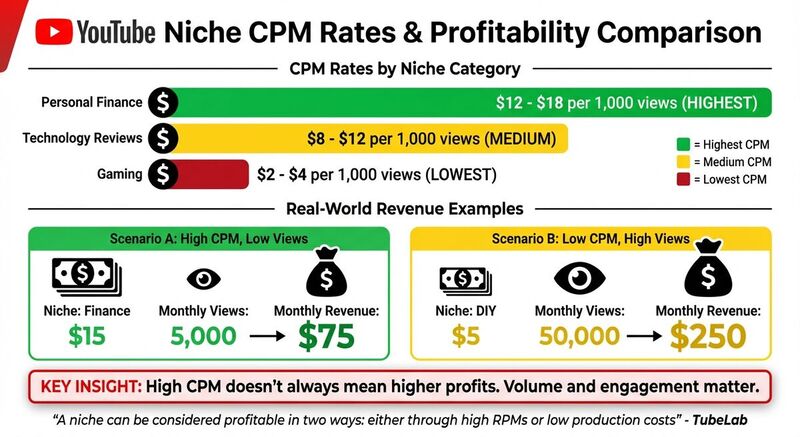
CPM (Cost Per Mille) is a key metric that shows how much advertisers pay to reach 1,000 viewers in your niche. CPM rates can vary a lot - Personal Finance channels can earn between $12 and $18 per 1,000 views, while Gaming channels typically earn $2 to $4. Technology Reviews land somewhere in the middle, with CPMs ranging from $8 to $12[3].
But here’s the thing: a high CPM doesn’t always mean higher profits. For example, a Finance channel earning $15 CPM but only getting 5,000 monthly views will make about $75. On the other hand, a DIY channel with a $5 CPM but racking up 50,000 engaged views can bring in $250. Tools like vidIQ can help you combine search volume and CPM data to estimate your potential earnings. As TubeLab explains:
"A niche can be considered profitable in two ways: either through high RPMs or low production costs"[1].
The next step is to confirm that your audience engagement backs up these financial projections.
Review Audience Insights and Retention Rates
Even if a niche has a high CPM, it won’t matter much if viewers aren’t sticking around. Use YouTube Analytics to check for audience drop-off points and retention. Look at metrics like average view duration, retention graphs, and engagement ratios (such as comments per view and like-to-dislike ratios) to see if your content is keeping viewers hooked[5].
Additionally, YouTube Studio’s Research tab can help you uncover what your audience is searching for but not finding. This can highlight content gaps - areas where there’s demand but not enough supply[6].
Once you’ve validated revenue potential and audience engagement, it’s time to narrow your focus even more.
Find Sub-Niches with Answer The Public

Broad niches like "Gaming" or "Fitness" are often overcrowded. To stand out, drill down into more specific sub-niches. Tools like Answer The Public can help by generating question-based search queries, revealing untapped opportunities. For instance, instead of competing in the broad "Gaming" niche with a CPM of $2–$4, you could focus on a sub-niche like "Budget Roguelike games under $10", which might have strong search interest and less competition[3].
Sean Cannell, author of YouTube Secrets, advises:
"If you're struggling to find an identity or purpose for your YouTube channel, we recommend building it at the intersection of your passion, your proficiency, and your profit"[4].
Step 4: Tools for Validating Your Niche Choice
Once you've confirmed that your niche has potential in terms of profitability and engagement, it's time to validate your choice using specific tools and manual checks. By leveraging data, you can ensure your niche has room for growth before diving into content creation.
Use MorningFame to Gauge Topic Potential
MorningFame is a handy tool for assessing whether a topic is likely to succeed on YouTube. It compares your channel's size to the competition and identifies standout videos that perform significantly better than average. For instance, if you're thinking about creating content for a niche like "Budget roguelike games under $10", MorningFame can show whether similar videos are drawing unusually high view counts. These outliers signal strong audience interest in areas where content demand might not yet be fully satisfied.
Manually Analyze Competition on YouTube
While tools are helpful, nothing beats a manual review to refine your niche choice. Open an incognito browser window and search for your niche keywords to avoid personalized results. Look at the top-ranking videos and compare subscriber numbers to view counts. Are smaller creators getting solid engagement, or do large channels dominate the space? Pay close attention to engagement ratios, like views and comments, to spot gaps where your content could thrive.
Plan and Promote with TheBlue.social
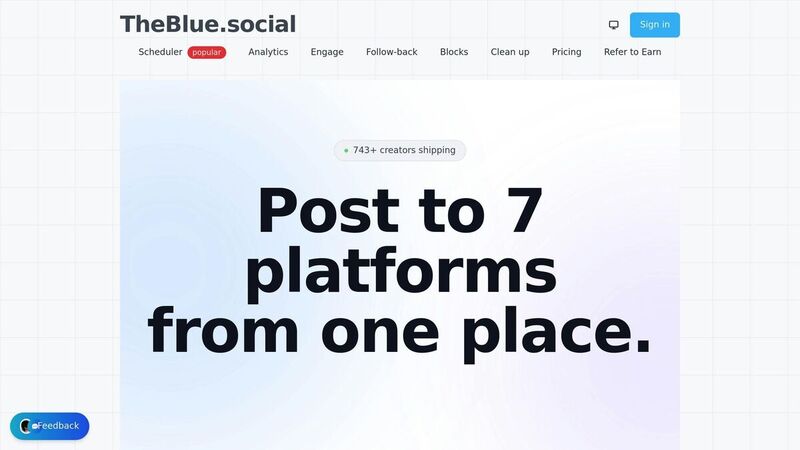
Once you've validated your niche, it's time to think about promotion. TheBlue.social provides a cross-posting scheduler that simplifies sharing your YouTube videos across platforms like X (Twitter), Threads, Instagram, Pinterest, LinkedIn, Bluesky, and Mastodon - all from one dashboard. This tool is especially beneficial for building an audience around niche topics. It also offers free tools like a hashtag generator and an emoji tool to help expand your reach. By automating video announcements and tracking which platforms bring the most traffic to your channel, you can fine-tune your strategy and ensure your audience is engaged across multiple platforms. This streamlined approach not only enhances your content's visibility but also supports consistent channel growth.
Conclusion
Key Points for Niche Research
Finding a profitable YouTube niche requires a thoughtful, data-driven approach. Start by exploring trending topics using tools like YouTube's autocomplete and Google Trends. Then, dig deeper by analyzing competitor performance to see what resonates with audiences in your chosen space. The trick? Refine your focus. Instead of sticking with broad categories like "Gaming", narrow it down to something more specific, like "Budget roguelike games under $10." This approach gives you a better shot at standing out in a crowded field [3].
The best niches often lie where your passion, skills, and earning potential overlap. As Sean Cannell, author of YouTube Secrets, advises:
"If you're struggling to find an identity or purpose for your YouTube channel, we recommend building it at the intersection of your passion, your proficiency, and your profit."
[4] Before fully committing, use tools to assess a niche’s potential for monetization - like CPM rates - to set realistic expectations for your channel's revenue from the start.
Once you've validated your niche, focus on keeping up with changes and maintaining consistent effort as trends shift over time.
Stay Consistent While Monitoring Trends
Success on YouTube isn’t just about finding the right niche - it’s about staying ahead of the curve. Niches evolve, moving through phases like Rising, Established, and Declining. This means what works today might not be as effective a few months down the line. Conducting regular audits every few months can help you spot new trends and identify "outlier videos" that perform significantly better than others. These high-performing videos often signal shifting audience preferences [2][8].
Don’t abandon your niche at the first sign of a slowdown. Stick with it - upload consistently (1–2 videos per week) for at least six months to give your channel a fair chance [3]. Use incognito mode when researching trends to avoid skewed results, and pay attention to competitor comment sections. Unanswered questions in those comments can reveal content gaps you can step in to fill [5][3]. Striking the right balance between staying consistent and adapting to change is what helps channels thrive while others fall behind.
FAQs
How can I find profitable YouTube niches with high demand and low competition?
To find profitable YouTube niches, think of it as navigating an "attention marketplace." Here, demand is the audience's interest in a topic, and supply is the number of creators already producing content in that area. The goal? Spot niches where the audience is large, but competition is limited. Tools that analyze YouTube data can be a big help here. Focus on metrics like high viewership, low creator saturation, and strong earning potential.
Prefer a hands-on approach? Open an incognito browser and search for broad keywords tied to your interests. Pay close attention to YouTube’s autocomplete suggestions - they highlight what people are actively searching for. Check out the top-ranking videos for these terms and look for patterns: high views paired with creators who have fewer subscribers or post inconsistently. These are often signs of untapped potential. By blending these observations with analytics tools, you can confirm the demand and ensure the niche aligns with your goals.
What are the best tools for researching YouTube niche trends and analyzing competitors?
To identify profitable YouTube niches and assess competitor performance, tools like OutlierKit and TubeLab can be incredibly useful. OutlierKit specializes in uncovering low-competition keywords, analyzing top-performing videos, and validating niche ideas before you invest your time and resources. Meanwhile, TubeLab offers features like a Niche Analyzer, which evaluates market size, saturation, and monetization potential, and a Niche Finder that highlights emerging trends and breakout channels.
Here’s what these tools can help you achieve:
- Pinpoint high-demand topics with minimal competition
- Compare metrics like RPM, revenue, and ad performance against similar channels
- Streamline your research process, freeing up time for content creation
When you combine the keyword insights from OutlierKit with TubeLab’s trend analysis and ranking capabilities, you’re equipped to make smarter, data-driven decisions. This approach not only helps grow your YouTube channel but also keeps you ahead of the competition.
How can I evaluate if a YouTube niche is profitable before starting?
To figure out if a YouTube niche could be profitable, start by diving into a few key metrics. Look at audience demand (how many people are searching for or watching content on the topic), competition (how crowded the space is with other creators), and monetization potential (like the average RPM - revenue per 1,000 views). Ideally, you want a niche with high demand, minimal competition, and an RPM of $5–$10 or higher. This combination signals a solid opportunity to earn.
Once you've gathered this data, calculate your potential earnings using this formula: (average monthly views ÷ 1,000) × RPM. For instance, if your niche pulls in 100,000 views per month and the RPM is $8, you'd be looking at $800 in monthly revenue. Compare this to your financial goals - say you need $500–$1,000 a month to break even. If the niche also shows steady growth in both views and new creators, it’s a promising option to consider.