X vs. Bluesky: Engagement Rate Trends Compared
Last updated: June 20, 2026
X and Bluesky should not be measured the same way.
X is built for scale and volatility. Bluesky is better for smaller, more deliberate communities where replies, follows, and link discussion can matter more than raw reach.
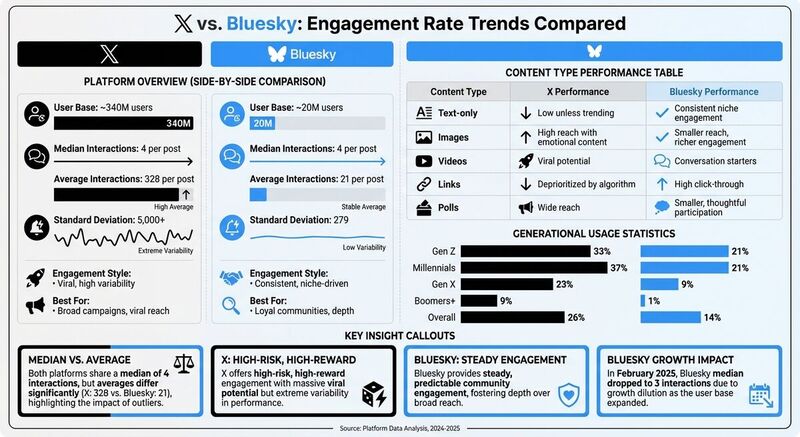
- X: Larger audience (~340M users) and high variability in post performance. Viral potential exists, but most posts see modest engagement.
- Bluesky: Smaller audience (~20M users) with consistent, community-driven engagement. Growth has diluted per-post interactions slightly.
Key insights:
- Both platforms share a median of 4 interactions per post, but averages differ significantly (328 on X vs. 21 on Bluesky).
- X thrives on viral moments, while Bluesky excels in niche, meaningful interactions.
- Bluesky's rapid growth has created more competition for attention, lowering median engagement in 2025.
Quick Comparison:
| Metric | X | Bluesky |
|---|---|---|
| User Base | ~340M | ~20M |
| Median Interactions | 4 | 4 |
| Average Interactions | 328 | 21 |
| Engagement Style | Viral, high variability | Consistent, niche-driven |
For marketers, I would use X for reach and news-cycle spikes. I would use Bluesky for community work: thoughtful replies, link discussion, creator discovery, and repeated contact with a narrower audience.
Comparing Twitter (X) vs Bluesky: why did I switch?
Historical Engagement Rate Trends
Between 2024 and late 2025, engagement patterns on X and Bluesky began to show noticeable differences. Although both platforms started with similar baseline metrics, their trajectories diverged as user behaviors and platform dynamics shifted over time.
Quarterly Engagement Rate Comparisons
At first glance, both platforms appeared to have comparable median engagement rates. However, a closer look at the data revealed significant contrasts in variability. In 2024, X posts averaged 328 engagements per post, while Bluesky posts saw just 21. The difference in variability was even more striking: X had a standard deviation exceeding 5,000, compared to Bluesky's 279[1]. This highlights how X functioned as a high-variance platform, where most posts received modest engagement but a small percentage went viral. Bluesky, on the other hand, offered more consistent, community-driven engagement.
By February 2025, this apparent parity had eroded. Bluesky's median engagement dropped to just 3 interactions per post, while X maintained a slightly higher median of 4[1]. This decline for Bluesky coincided with a period of rapid user growth - 13 million new users joined in just six weeks, pushing the platform to 20 million users by mid-November 2024[4]. As the user base expanded, feeds became more crowded, intensifying competition for attention. Meanwhile, X continued to deliver occasional viral spikes, thanks to its broader variability. These trends hinted at bigger shifts that became more apparent by early 2025.
Events That Changed Engagement Trends
Several key events further shaped engagement patterns on both platforms. On X, algorithm updates and policy changes introduced more volatility. While these changes made viral posts more frequent, their predictability decreased, further widening the platform's engagement variability[1][3]. Additionally, major events like news cycles, sports playoffs, and cultural moments created temporary spikes in engagement, boosting quarterly averages.
Bluesky followed a different trajectory. The platform experienced a surge in activity during its post-election user boom in late 2024. However, by mid-2025, PR analysts observed a decline in engagement as the initial excitement wore off and timelines became increasingly crowded[4]. The February 2025 drop in median engagement marked a classic "growth dilution" effect: as the platform's user base expanded, more content competed for attention, leading to slightly lower per-post engagement despite an overall increase in network activity. Furthermore, Bluesky's structure played a role in limiting post reach. With roughly 50% of users having only one follower and just 0.01% surpassing 10,000 followers, posts on Bluesky struggled to achieve the same level of spread as those on X, which benefits from a more established follower network[5].
For marketers, track each platform against its own job. Tools like TheBlue.social's Bluesky analytics help with the Bluesky side: post engagement, follower growth, and patterns you can compare over weeks instead of reacting to one noisy post.
Engagement Trends by Content Type
Breaking down how different types of content perform on X and Bluesky gives a clearer picture of engagement patterns across these platforms.
Content Type Performance Breakdown
The kind of content you share plays a big role in how well it performs. X and Bluesky reward different formats, so tailoring your approach for each can make all the difference.
Text-only posts perform very differently on these platforms. On X, short text posts often get lost in the fast-paced feed unless they tap into trending topics or provoke strong reactions. The algorithm favors breaking news and controversial takes, so text that doesn't grab immediate attention tends to underperform. Meanwhile, Bluesky's community-focused vibe rewards thoughtful threads and niche discussions. Weekly AMAs, deep dives into specialized topics, or detailed creator diaries often spark steady engagement here.
Image posts thrive on X due to its massive reach and rapid-fire timeline. Visuals that evoke humor, outrage, or surprise - like memes or emotional snapshots - can gain traction, especially when paired with trending hashtags. On Bluesky, while images may reach fewer people, they often generate richer interactions, especially within niche groups like art enthusiasts, fandoms, or tech communities.
Video content on X has strong viral potential, particularly when tied to live events. Thanks to its investment in video infrastructure, X can amplify longer clips and live streams, even if their reach can be inconsistent. On Bluesky, videos act more as conversation starters within smaller, engaged communities. Most videos are shared as links or embeds, sparking discussions rather than chasing wide-scale visibility.
Link-sharing reveals key differences between the platforms. X deprioritizes external links in its algorithm, making it harder to drive traffic unless the link is tied to a trending topic or shared by a major account. Bluesky, however, offers a more favorable environment for links. Users are more likely to click, read, and discuss, making it a great platform for promoting blogs, newsletters, or other long-form content.
| Content Type | X Performance | Bluesky Performance | Best Platform |
|---|---|---|---|
| Text-only | Low engagement unless tied to trends | Consistent, thoughtful engagement in niche groups | Bluesky for depth; X for viral moments |
| Images | High reach with emotional or trending visuals | Smaller reach but richer engagement in niche communities | X for scale; Bluesky for quality |
| Videos | Viral potential with timely or polarizing content | Sparks discussions in focused groups | X for visibility; Bluesky for dialogue |
| Links | Often deprioritized by the algorithm | High click-through and meaningful discussion | Bluesky |
| Polls | Wide reach with native polls | Smaller, thoughtful participation via replies or prompts | X for scale; Bluesky for nuanced feedback |
For polls, X's native tools make it easy to gather thousands of votes on trending topics. On Bluesky, polls are approximated through reply prompts or external surveys, leading to fewer but more meaningful responses.
If you're refining a Bluesky strategy, TheBlue.social's Bluesky analytics helps track which posts get replies, reposts, likes, and follower growth. That is more useful than copying an X post and hoping the same hook works.
How Platform Algorithms Affect Content Performance
The algorithms powering X and Bluesky are built on entirely different principles, which directly shape how content performs.
X's algorithm prioritizes engagement metrics like likes, replies, reposts, and watch time. Posts that generate quick and intense reactions - like controversial takes, memes, or polarizing videos - are more likely to be promoted across the platform. The system is designed to keep users scrolling, so sensational or divisive content often outshines more measured or thoughtful posts.
Bluesky, on the other hand, leans on community-driven discovery. Its custom feeds, follows, and interest-based networks (like Starter Packs, which include over 86,252 curated packs) make it ideal for niche content. Instead of chasing broad reach, Bluesky focuses on connecting content with the right audience. Detailed threads, in-depth discussions, and link shares tend to perform well because the platform emphasizes organic discovery and respectful conversations.
This difference explains why the same content can perform so differently on each platform. A detailed thread might get buried in X's endless stream but spark meaningful replies on Bluesky. Conversely, a snarky meme tied to a trending topic could explode on X but barely register on Bluesky. Algorithms actively shape what succeeds, so adapting your content strategy to each platform is key.
Demographics and Usage Patterns
User demographics and usage patterns shape the distinct engagement dynamics of X and Bluesky. X attracts a large, diverse audience across all age groups, with about 26% of U.S. respondents using the platform daily. In contrast, Bluesky's approximately 35.2 million users lean toward privacy-focused early adopters and younger, tech-savvy individuals who prioritize community-driven interactions over broad exposure. This creates a clear distinction: X offers scale and viral potential, while Bluesky fosters smaller, more tightly-knit communities where engagement feels more personal and predictable.
These differences in audience size and focus directly impact how users interact on each platform. X's real-time feed often sparks viral moments during trending events but also results in a significant number of posts with minimal interaction. Bluesky, with its smaller network and community-oriented approach, encourages slower, more meaningful engagement - users post and browse less frequently, but conversations and link-sharing tend to generate more thoughtful replies relative to the audience size. These patterns set the stage for understanding how different generations engage on these platforms.
Engagement by Generation
Generational data highlights how each platform performs across age groups. While X leads Bluesky in daily usage across all generations, the gap narrows among younger users and widens significantly among older ones.
| Generation | X Daily+ Usage | Bluesky Daily+ Usage | Bluesky Non-Participation |
|---|---|---|---|
| Gen Z | 33% | 21% | 72% |
| Millennials | 37% | 21% | High (similar to Gen Z) |
| Gen X | 23% | 9% | 88% |
| Boomers+ | 9% | 1% | 97% |
| Overall | 26% | 14% | - |
Millennials are the most active users on X, with 37% engaging daily, followed closely by Gen Z at 33%. These two groups also make up Bluesky's core audience, each with 21% daily usage. However, Bluesky struggles to attract older generations - 88% of Gen X and a staggering 97% of Boomers+ don't use the platform at all. This makes Bluesky a better fit for brands targeting younger, values-driven audiences but limits its utility for campaigns aimed at older demographics.
On X, younger users drive high interaction volumes, creating a "high risk, high reward" dynamic. While the median post garners only about four engagements, the average soars to 328 due to occasional viral hits. Older generations, though less active, contribute to the platform's reach during major events. On Bluesky, engagement is more consistent and community-focused. The average was 21 engagements per post with less variance, so viral spikes are less common and steady responses from a close-knit audience matter more.
For U.S. marketers, this means positioning X as the go-to platform for broad, multi-generational campaigns and Bluesky as the preferred channel for engaging early adopters and fostering community connections. Use X for mass-appeal, time-sensitive initiatives - like product launches, live events, or announcements - targeting Millennials and Gen Z while still capturing incremental reach from Gen X and Boomers. On Bluesky, focus on deeper engagement strategies, such as behind-the-scenes content, long-form discussions, value-driven messaging, and feedback loops aimed at younger, tech-savvy users. Tools like TheBlue.social's Bluesky analytics can help identify which posts resonate with this niche audience, while cross-posting and scheduling features allow you to test how different generations respond to the same content across both platforms.
Cross-Platform Posting Strategies
Understanding the engagement differences between X and Bluesky is just the beginning - the real challenge lies in managing content effectively across both platforms while keeping quality intact. X operates on a high-risk, high-reward model, with an average of around 328 engagements per post but significant variability[1]. This means frequent posting and quick responses are essential to capitalize on viral moments. On the other hand, Bluesky offers a steadier engagement rate, averaging 21 interactions per post with much less fluctuation[1]. It rewards thoughtful, community-driven content that sparks meaningful conversations. Trying to balance these distinct rhythms manually can feel overwhelming, but a unified scheduling tool can make the process much more manageable.
Using TheBlue.social for Analytics and Cross-Posting
These differences call for a tailored posting strategy. TheBlue.social combines cross-post scheduling with Bluesky-focused analytics. Draft the core message once, then adjust the text, links, hashtags, and images for each connected account.
For launches and live events, schedule the Bluesky and X versions separately instead of blasting the same message everywhere.
Bluesky analytics and the Bluesky Network Statistics tool help answer practical questions. Do threads get more replies? Do link posts get follow-up discussion? Did a post grow followers or just collect likes?
The supporting tools matter too. The alt text generator improves accessibility, Open Graph preview checks link cards before you post, and the follow-back tools help manage relationship-building on Bluesky.
Tailoring Content for Each Platform
Effective cross-platform management also means tailoring your content to fit each platform's unique strengths. Avoid simply duplicating posts. Start by defining your campaign goal - whether it's sign-ups, raising awareness, or gathering feedback. Then, craft a core message and a standout visual.
For X, focus on short, attention-grabbing posts designed for virality. Use a compelling opening line, one or two key hashtags, and perhaps a poll or striking image. Timing is crucial - schedule posts during U.S. peak hours, such as mid-morning, lunch breaks, or early evening when activity tends to spike.
For Bluesky, take a different approach. Expand on your core message with threads that provide background details, encourage discussion, and engage specific niche communities. This platform thrives on deeper, more personal interactions, so use it to invite opinions and foster meaningful conversations. Use TheBlue.social to schedule these posts, staggering them by minutes or hours, and then analyze performance metrics after 24-72 hours. Compare X's immediate metrics (like impressions and reposts) with Bluesky's longer-term indicators (such as replies and follower growth) to refine your strategy for future campaigns.
Posting frequency and timing also vary between the platforms. X's fast-paced environment and large user base support higher volumes - several posts daily - without overwhelming followers, especially during peak U.S. activity periods. Bluesky, with its smaller, community-focused audience, benefits from a more measured approach: one to three carefully crafted posts or threads daily, leaving room for conversations to unfold. TheBlue.social helps you schedule those versions with different copy and timing, so X can move fast while Bluesky gets the slower, discussion-oriented post.
Conclusion
X and Bluesky each bring their own flavor to social media engagement. X thrives on unpredictability, with its high-variance environment capable of catapulting certain posts to massive audiences. With 26% daily U.S. usage and algorithm-driven amplification, it's a great fit for broad, fast-moving, multi-generational campaigns that aim to go viral in real time[1][2].
On the other hand, Bluesky offers a more stable and community-centered experience. Its smaller, values-driven user base leans toward thoughtful threads, link-sharing, and genuine conversations. This makes it an excellent platform for cultivating loyal niche communities over time, with far less of the volatility seen on X[1].
I would treat the platforms as complementary. X is useful for fast, reactive posts. Bluesky is useful for slower discussion, link-sharing, and community-building.
To manage both, use a scheduler that lets you adapt the post per platform. TheBlue.social handles that workflow and gives you Bluesky analytics plus network statistics for the Bluesky side.
Review the last 60-90 days of posts on both platforms. Compare replies, reposts, link clicks, and follower movement against the job each platform is doing for you. Then schedule the next batch with those differences in mind.
FAQs
What are the key differences in engagement styles between X and Bluesky?
X thrives on fast-paced, real-time interactions, focusing on trending topics and quick responses. On the other hand, Bluesky leans toward a community-driven experience, emphasizing meaningful conversations without heavy algorithmic influence. This makes X perfect for instant updates, while Bluesky caters to those seeking deeper and more thoughtful exchanges.
What types of content get the most engagement on X versus Bluesky?
On X, short and snappy content like trending topics, breaking news, and quick updates tends to grab the most attention. The platform thrives on speed and brevity, making it perfect for fast-paced conversations and viral moments.
Bluesky, however, stands out for its focus on community-driven content. It's the go-to space for sharing multimedia posts, diving into niche discussions, and building meaningful connections. Whether it's creative projects or visually engaging updates, Bluesky encourages a more interactive and thoughtful exchange.
How can marketers make the most of X and Bluesky for their campaigns?
Marketers looking to make the most out of both X and Bluesky need to adapt their strategies to play to each platform's unique strengths. On Bluesky, features like real-time analytics and follow-back managers can be powerful for building an active audience and keeping tabs on performance. Meanwhile, success on X often hinges on timely, high-quality posts that tap into trending topics to spark visibility and interaction.
Cross-platform scheduling tools can take the hassle out of managing content, ensuring each post is tailored to resonate with its specific audience. By combining these approaches, marketers can drive stronger engagement and expand their reach across both platforms.