Bluesky vs. Instagram: Age Verification Compared
Last updated: January 13, 2026
Setting up a social media account now requires more than just a username and password - it often involves proving your age. Platforms like Bluesky and Instagram have developed distinct systems to meet legal requirements and protect younger users, but their approaches differ significantly.
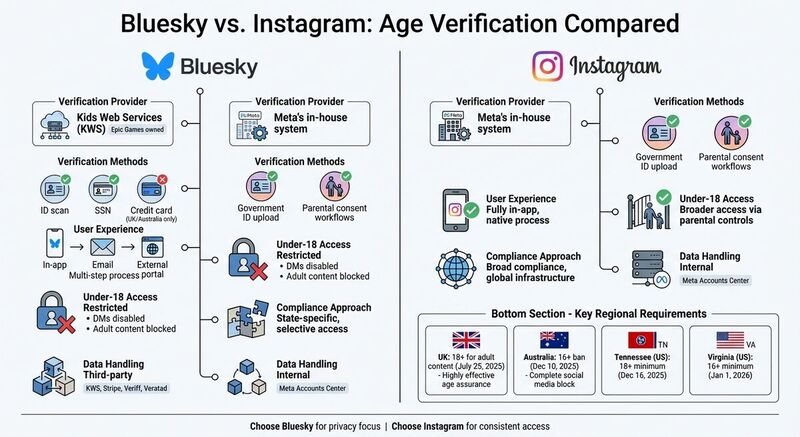
- Bluesky: Uses third-party verification via Kids Web Services (KWS). Age verification involves submitting personal details (e.g., ID, SSN, or credit card) and may include face scans in certain countries. Features like direct messaging and adult content are restricted for users under 18.
- Instagram: Relies on Meta's internal system. Verification is done directly in-app, using tools like government ID uploads or parental consent workflows. Younger users have broader access, with safety managed through parental controls.
Both platforms face challenges complying with global and state-specific regulations, such as the UK's Online Safety Act, Australia's under-16 social media ban, and varying U.S. state laws. Bluesky has opted to block access in some regions rather than implement complex compliance systems, while Instagram's resources allow for broader implementation.
Quick Comparison:
| Feature | Bluesky | |
|---|---|---|
| Verification Provider | Kids Web Services (KWS) | Meta's in-house system |
| Methods Available | ID, SSN, credit card, face scan | ID upload, parental consent |
| User Experience | Multi-step process | Fully in-app |
| Under-18 Access | Restricted | Parental controls |
| Compliance Approach | State-specific, selective access | Broad compliance |
If privacy and minimal data collection are priorities, Bluesky may appeal to you. For consistent access and a simpler process, Instagram is likely a better fit.
Bluesky Age Verification Process
How Bluesky Verifies Age
Bluesky partners with Kids Web Services (KWS), a company owned by Epic Games, to handle its age verification process. When users need to verify their age, they receive an email with a link to the KWS portal. There, they must provide their full legal name, home address, and choose a verification method [7].
In the U.S., users can verify their age through scans of government-issued IDs, credit card checks, or Social Security number (SSN) verification [4]. In the UK and Australia, users have an additional option: facial geometry estimation [4][3].
KWS connects the verification status to a hashed email address, which means users don’t have to repeat the process for other services powered by KWS. This system also ensures email privacy. However, users who either skip the verification process or are under 18 face restrictions, such as limited access to adult content and disabled direct messaging [2][3].
This outsourced approach helps Bluesky align with legal requirements in different states.
US State Law Compliance
Bluesky takes a state-specific approach to comply with varying regulations across the U.S. This includes different minimum age requirements and verification methods based on local laws.
For example, in Ohio, age verification became mandatory on September 29, 2025. Users must confirm their age using an ID scan, credit card, or SSN before gaining access to certain types of content [4][1]. Similar measures were introduced around the same time in South Dakota and Wyoming.
Virginia's law, effective January 1, 2026, prohibits users under 16 from accessing the platform altogether [1]. In Tennessee, regulations that took effect on December 16, 2025, raised the minimum age to 18 [1]. Meanwhile, Mississippi implemented stricter requirements, such as tracking children's online activity and establishing parental consent workflows. Bluesky decided not to comply with these measures, citing the complexity and resource demands. Instead, the platform now blocks all users under 18 in Mississippi and requires age verification for those 18 and older [1].
| State | Effective Date | Minimum Age | Verification Methods |
|---|---|---|---|
| Ohio | Sept 29, 2025 | 13 | ID scan, Credit card, SSN |
| Virginia | Jan 1, 2026 | 16 | ID scan, Credit card, SSN |
| Tennessee | Dec 16, 2025 | 18 | ID scan, Credit card, SSN |
| Mississippi | Dec 2025 | 18 | ID scan, Credit card, SSN |
Privacy and User Experience
Bluesky’s age verification process is designed to protect user privacy. Sensitive data, such as IDs and SSNs, is sent directly to KWS and its partners - Stripe (for credit card checks), Veriff (for ID verification), and Veratad (for SSN verification) [7]. Bluesky itself does not store or even view this information.
In November 2024, CEO Jay Graber commented on this approach, saying, "We don't take IDs or anything like that... That's very private information. I think companies like us would want to make sure we're handling that private user data very responsibly" [6].
For users in areas without specific age verification laws, Bluesky continues to rely on self-reported birth dates. This avoids collecting unnecessary personal data while still maintaining a user-friendly experience.
As Bluesky explained on its official blog, "Our goal is to respect the law while balancing safety, free expression, and user privacy to serve the greater good of our community" [1].
Instagram Age Verification Process
How Instagram Verifies Age
Instagram employs a layered approach to confirm user ages during account setup. This process includes specialized verification systems, parental consent protocols, and infrastructure designed to comply with age-related laws across various regions [1].
In states like Ohio, where age verification laws are particularly strict, Instagram requires users to submit a government-issued ID to access specific types of content [4]. Meta, Instagram's parent company, has built the necessary technical framework to adapt to these regional legal requirements [4]. This setup allows Instagram to navigate the challenges of operating in areas with intricate age verification regulations.
Global and US Legal Requirements
Instagram's age verification efforts are part of a broader strategy to meet both international and domestic legal obligations. For instance, in the United Kingdom, the platform must adhere to "highly effective age assurance" standards outlined in the Online Safety Act, which became enforceable on July 25, 2025, for platforms hosting adult or harmful content [3]. Failure to comply can lead to penalties as high as £18 million (approximately $24 million) or 10% of global revenue, whichever is greater [3].
In Australia, a law effective December 10, 2025, completely bars users under 16 from accessing social media platforms [1]. Meanwhile, in the United States, state-specific laws dictate varying age requirements: Virginia mandates a minimum age of 16 starting January 1, 2026, while Tennessee sets the threshold at 18 as of December 16, 2025 [1].
| Jurisdiction | Age Requirement | Effective Date | Key Requirement |
|---|---|---|---|
| United Kingdom | 18+ for adult content | July 25, 2025 | "Highly effective age assurance" |
| Australia | 16+ for social media | December 10, 2025 | Age assurance for all users |
| Tennessee (US) | 18+ | December 16, 2025 | Age assurance compliance |
| Virginia (US) | 16+ | January 1, 2026 | Age assurance compliance |
| Ohio (US) | 18+ for adult content | - | Government ID upload |
Privacy and User Experience
Instagram goes beyond meeting legal standards by focusing on user safety and a seamless experience. Through the Meta Accounts Center, users can manage security settings and review devices logged into their accounts [8]. The platform also encourages enabling two-factor authentication (2FA) to safeguard personal data during the verification and login process [8].
Depending on the user's location, Instagram may accept self-reported birth dates or require additional verification steps for full account access. Security experts recommend keeping an eye out for unusual password reset requests and using Meta's built-in tools to maintain account security [8]. While Instagram has not disclosed any recent security breaches, its verification process does involve sharing sensitive personal information in areas with stricter compliance rules.
Bluesky vs. Instagram: Main Differences
Side-by-Side Comparison
Bluesky relies on Kids Web Services (KWS) for age verification, while Instagram uses Meta's internal system for the same purpose [1][4]. This distinction shapes the verification methods each platform provides and impacts the overall user experience.
Bluesky's process involves multiple steps, starting with an in-app prompt that redirects users to an external portal. Verification options include facial scans (available in the UK and Australia), government-issued ID, credit card, or SSN verification (for users in the US) [4][9]. On the other hand, Instagram simplifies this experience with a fully native, in-app process using its proprietary workflows [4][9]. These differences highlight how each platform aligns with regional legal requirements.
In response to Mississippi's regulations, Bluesky stated, "We will not follow the law's requirements to track children's online conduct in detail, and we will not devote our limited resources to build the verification systems, parental consent workflows, and compliance infrastructure the law requires" [1].
| Feature | Bluesky | |
|---|---|---|
| Verification Provider | Kids Web Services (Epic Games) [2] | In-house Meta infrastructure [4] |
| Methods Available | Face scan (UK/Australia), ID, credit card, SSN (US) [4] | Proprietary workflows and parental consent systems [4] |
| User Experience | Multi-step: In-app → Email → External portal [9] | Native, in-app verification [4] |
| Data Requirements | Email, full name, date of birth, physical address (varies by region) [9] | Managed through Meta Accounts Center [8] |
| Implementation Status | Active in the UK, Australia, Mississippi (18+), Ohio, Virginia, Tennessee [1] | Global infrastructure; assessing some state laws [9] |
| Under-18 Access | Restricted DMs and adult content filters [1] | Managed via parental consent workflows [1] |
These differences in verification methods lead to unique experiences for users. For instance, Bluesky restricts under-18 users from accessing direct messaging and adult content, though browsing the platform remains possible [1][2]. Instagram, however, offers broader access for younger users, managed through its parental consent systems that adapt to changing regulations [1].
As Sarah Perez from TechCrunch observed, "These legal requirements could ultimately hurt smaller startups like Bluesky... Having to verify their age may deter potential new users and divert the team's attention from other areas where it could innovate" [4].
The Truth About Those Age Verification Pop-Ups
What This Means for Platform Migration
Switching from Instagram to Bluesky involves a more thorough age verification process, especially in regions like the UK, Australia, and certain US states (Mississippi, Ohio, Virginia, Tennessee). These challenges echo the strict verification systems discussed earlier. Bluesky relies on Kids Web Services (KWS), which requires users to register with an email and choose from verification methods such as face scans (outside the US), uploading a government ID, providing credit card details, or entering the last four digits of a Social Security number.
This complex process naturally raises privacy concerns. Many users may feel uneasy about the involvement of third-party services like KWS, Veratad, and Veriff in the verification process. These privacy worries, coupled with the multi-step setup, could deter users from completing registration. As Zac Hall from 9to5Mac aptly noted:
"For Bluesky, I'd guess that it's restrictive enough to turn a lot of potential users away from the service" [7].
Regional regulations play a big role in shaping the migration experience. While Instagram operates seamlessly across all US states using its in-house systems, Bluesky has encountered hurdles. For instance, it initially blocked access in Mississippi because its smaller team couldn’t implement the necessary parental consent workflows.
For users under 18, the experience on Bluesky is even more restrictive in regulated regions. Features like direct messaging are disabled, and access to adult-appropriate content is blocked until age verification is completed. In contrast, Instagram’s parental consent systems offer younger users broader access.
To avoid delays when migrating, have a government-issued ID or credit card ready. Meanwhile, users in regions without strict regulations can bypass verification entirely, creating a fragmented experience that varies by location. These challenges highlight the need to carefully review verification requirements before making the switch to Bluesky.
Check Username Availability Before Creating Accounts
Before diving into age verification, make sure to secure your username. With Bluesky hitting 22.7 million users by late 2024 - and adding 8.7 million new signups following the 2024 U.S. presidential election - usernames are in high demand. Locking in your handle early can make the transition smoother and complements the verification steps mentioned earlier [10].
TheBlue.social provides free tools to instantly check username availability for Bluesky and Instagram. This saves you from the headache of completing verification only to find that your desired username is already taken.
Consistency in your online identity is key when switching platforms. Using the same username across platforms ensures your followers can easily find you. If your Instagram handle isn’t available on Bluesky, you can take advantage of Bluesky’s custom domain feature. Over 270,000 users have already linked their usernames to personal domains like @yourname.com, which doubles as a verification method [11].
Keep in mind that Instagram usernames are capped at 30 characters, while Bluesky offers more flexibility. You can opt for a standard handle like @name.bsky.social or go for a custom domain. Short, clear usernames - ideally under 15 characters and free of extra numbers or underscores - are easier for people to remember [12][13].
Once you’ve confirmed availability, act fast and create your account immediately. Waiting could mean losing your preferred username and even opens the door to impersonation - especially with the recent exposure of 17.5 million Instagram usernames [8].
Conclusion
Bluesky and Instagram take very different approaches to age verification. Bluesky uses third-party verification through Epic Games' Kids Web Services (KWS), while Instagram manages this process internally using Meta's infrastructure [4]. This difference highlights the platforms' philosophies - Bluesky focuses on privacy and avoids tracking children's online behavior extensively, even when state laws push for it [1].
Regional regulations also play a big role in how these platforms operate. Bluesky has chosen to limit access in some states rather than build large-scale compliance systems. For users under 18, this means restricted features like direct messaging and adult content [1][2][4]. On the other hand, Instagram works to meet these requirements by implementing tracking systems, which helps them maintain broader access [4].
These differences significantly impact user experience and can influence which platform someone chooses. If privacy and minimal data collection are your priorities, Bluesky's model might appeal to you. The platform even lets its 270,000+ users self-verify with custom domain handles like @yourname.com [5]. However, if you need a platform that provides consistent access across all states without age-related limitations, Instagram's centralized system could be a better fit.
For users, understanding how these platforms handle age verification is crucial. Whether you're switching from Instagram or signing up for the first time, knowing these differences can help you avoid surprises, like unexpected restrictions or data-sharing requirements. Ultimately, being informed about these approaches makes it easier to choose the platform that aligns with your privacy preferences and compliance needs.
FAQs
How does Bluesky handle age verification while protecting user privacy?
Bluesky prioritizes user privacy during age verification by teaming up with Epic Games’ Kids Web Services. This partnership allows users to verify their age through options like a credit card, face scan, or ID. Importantly, all verification data is securely handled and stored by the third-party service, meaning Bluesky never directly accesses or retains any personal information.
How do regional laws impact age verification on Bluesky and Instagram?
Regional regulations play a key role in shaping how platforms like Bluesky manage age verification. Take the United Kingdom, for instance - its Online Safety Act requires platforms hosting adult content to confirm users' ages. To comply, Bluesky uses Kids Web Services (KWS), which offers methods such as face scans, ID uploads, or payment card verification. Users who remain unverified or are under 18 face restrictions, including limited access to features like direct messaging and adult content.
In the U.S., laws vary by state, leading to different approaches. Ohio, for example, requires a government-issued photo ID to access adult content. Meanwhile, Mississippi's stringent regulations have pushed Bluesky to completely block its service in the state due to the challenges of compliance.
These legal requirements force Bluesky to rely on third-party verification tools, limit features for unverified users, and even cease operations in areas where meeting the rules is too expensive or intrusive. Information about how Instagram handles age verification under similar regional laws wasn't available in the provided sources.
What makes Bluesky's age verification process challenging for new users?
Bluesky's age verification process requires users to complete steps such as uploading a government-issued ID, scanning their face, or providing a payment card. While these measures are designed to improve security, they might feel invasive to some users, potentially making the sign-up process less appealing.
For those who opt out of verification, certain features may be restricted. This limitation could affect their overall experience on the platform and discourage others from becoming members.