Bluesky vs X: Demographic Growth Trends
Last updated: January 26, 2026
In January 2026, Bluesky has grown to 42 million users, while X (formerly Twitter) remains dominant with 550 million users. However, user behavior and growth patterns reveal key differences:
- Bluesky: Rapid growth driven by younger users, left-leaning influencers, and professionals seeking alternatives to X. Growth surged post-2024 U.S. election, with 519% growth in the U.S. and 352% in the U.K. Users prefer community-driven engagement, with an average of 21 interactions per post.
- X: Maintains a massive user base with higher engagement (328 interactions per post). It appeals broadly across age groups and political affiliations, especially for real-time news and viral content.
Quick Takeaway: Bluesky offers smaller, niche-focused communities, while X excels in reach and engagement. Tailor your strategy and cross-post between X and Bluesky based on audience priorities and platform strengths.
How Bluesky Grew From A Twitter Side Project To An X Competitor

Overall User Growth Trends
Bluesky is expanding quickly, while X continues to dominate with its vast user base. As of January 26, 2026, Bluesky's numbers remain much smaller than X's, which is 13 times larger, but their growth trajectories tell different stories.
Bluesky has seen dramatic, event-driven surges in user numbers. In 2024, the platform experienced a 930% year-over-year growth globally, largely fueled by users leaving X after controversial policy changes and key political events [8]. A notable moment came in November 2024, when Bluesky gained 1 million users in just one week [1]. Its monthly growth peaked at 189% before leveling off [8]. By January 2026, the platform's annual growth rate had steadied at 25.1%, with new users joining at a pace of 0.39 per second [2][9].
X, on the other hand, has shown minimal growth. Its website visits increased by only 2.4% month-over-month in December 2024 [8]. Despite some high-profile user departures, X has maintained a stronghold in the U.S., with a daily active user base more than 10 times larger than Bluesky's [1][3]. Let’s explore these trends further by looking at user demographics and interests.
Bluesky's User Growth
Bluesky's rise has been marked by sharp, event-driven spikes rather than gradual adoption. The platform hit a major milestone following the 2024 U.S. presidential election, climbing to No. 1 on the U.S. App Store by November 13, 2024, while X lagged behind at No. 41 [1].
The platform's growth has been driven by users seeking alternatives to X. When X introduced controversial changes - such as modifying its "block" feature and allowing user data to be sold to AI companies - many users turned to Bluesky for a different experience [1][7]. Bluesky's COO, Rose Wang, noted:
the majority of the new users on the decentralized social network are from the US [7].
Bluesky has also made it easier for newcomers to join with tools like Starter Packs and browser extensions, which have been particularly appealing to journalists and thought leaders [3][7]. By March 2025, the proportion of news influencers with Bluesky accounts had risen from 21% before the 2024 election to 43% [10].
After its initial surge, Bluesky's growth began to stabilize. Monthly momentum dropped from 189% in November 2024 to under 10% in December 2024, eventually settling at 22.5% by early 2026 [2][8]. Sarah Perez, a Consumer News Editor at TechCrunch, observed:
Bluesky's massive growth slowed in December in the U.S., after having surged from 9+ million in September to north of 20 million users in November [8].
Unlike Bluesky's dramatic growth pattern, X's user trends are more about steady retention.
X's User Growth
X's growth strategy relies on retaining its enormous user base through its scale and network effects. While Bluesky has seen dramatic spikes, X has maintained stability, focusing on keeping its existing users rather than aggressive acquisition. It continues to be the leading platform for real-time news and viral content [4].
Retention has been a key strength for X. Over 80% of news influencers were still active on X in early 2025 [10]. This indicates that while users may explore Bluesky, they are not abandoning X entirely.
X also excels in driving user engagement. Posts on the platform average 328 interactions, highlighting its potential for viral reach [4]. Tamilore Oladipo, Senior Content Creator at Buffer, explained:
X is the best platform for viral reach, even though posting there means you run the 'risk' of modest engagement [4].
Though X's growth may appear modest, its massive user base and established infrastructure provide a strong foundation. For users aiming for maximum visibility and viral success, X remains the platform of choice.
Growth by Age Group
Age demographics reveal distinct preferences between the two platforms. Bluesky tends to resonate with younger audiences, while X showcases a more even distribution across various age groups. This contrast aligns with the broader user growth trends previously outlined.
Bluesky's Growth Across Age Groups
By November 2025, more than 57% of Bluesky's users were under 35 years old. Breaking it down further:
- 18–24 years old: 30.57%
- 25–34 years old: 26.06%
- 35–44 years old: 15.13%
- 45–54 years old: 11.41%
- 55–64 years old: 10.04%
- 65 and older: 6.79% [5] Using a Bluesky analytics dashboard can help track these shifting demographics in real-time.
While younger users dominate the platform, Bluesky has also seen a noticeable uptick in adoption among middle-aged professionals. This shift suggests the platform is gradually expanding its appeal beyond its youthful base.
X's Growth Across Age Groups
X, on the other hand, maintains a broad appeal across all age groups, with a particularly strong foothold among older professionals. In early 2025, over 80% of news influencers - many established professionals in their 40s, 50s, and older - remained active on X, even as some explored other platforms [10].
X's ability to retain users across generations stems from its powerful network effects and reputation as the go-to source for real-time news and trending content. This cross-generational reach continues to bolster its overall user count, even as younger audiences test out emerging platforms like Bluesky.
Growth by Gender
Looking at gender trends gives us a clearer picture of how each platform's user base is changing. By late 2025, Bluesky's users were 59.6% male and 40.4% female, while X showed a similar split at 57.8% male and 42.1% female [5].
Bluesky's Gender Distribution Growth
Bluesky initially drew a predominantly male tech-savvy audience. However, the platform is now seeing more women and non-binary users joining, particularly in communities centered around digital art, mental health advocacy, and activism [12].
"Yes, Bluesky still leans male, but it's no longer a boys' club." - Techpoint Africa [12]
Several factors explain this shift. Bluesky's decentralized moderation system and flexible identity options (detailed in our Bluesky guides) eliminate the need for binary gender choices, making it more inclusive. Additionally, growing concerns about safety features and misinformation on X have led women and marginalized groups to explore Bluesky's customizable tools [11][12].
This evolving gender balance contrasts with X's more consistent distribution.
X's Gender Distribution Growth
X continues to maintain a gender split of 57.8% male and 42.1% female [5], reflecting its widespread, multi-generational appeal. However, the platform has seen a drop in daily active users. Concerns about increasing politicization and changes to features like the "block" function have driven some - especially women - to consider alternative platforms. Migration data reveals that 69% of left-leaning news influencers have shifted to Bluesky, compared to only 15% of right-leaning influencers [10].
Growth by Professional and Interest Groups
Professional communities highlight how differing content needs and political leanings are shaping the growth of platforms like Bluesky and X. These two platforms are charting distinct paths, each drawing in groups with specific priorities and preferences.
Bluesky's Community Growth
Bluesky has emerged as a go-to platform for journalists and news influencers, particularly those aligned with left-leaning political views. A Pew Research Center study conducted in early 2025, surveying 500 news influencers with over 100,000 followers, revealed that 43% had joined Bluesky - a noticeable jump from 21% before the 2024 U.S. election. The divide is stark: 69% of left-leaning influencers made the move to Bluesky, compared to just 15% of right-leaning influencers [10].
Following the U.S. presidential election, Bluesky saw a dramatic 519% surge in app usage within the U.S. The platform's "Starter Packs" feature played a key role in connecting users to communities ranging from science to government. New users can also use a Bluesky follow back tool to quickly rebuild their professional networks. By mid-November 2024, Bluesky had reached 32.2 million daily active users on its mobile app in the U.S. [3].
Major media outlets like The New York Times, The Washington Post, and Financial Times have established verified presences on Bluesky using domain-based handles. These organizations serve as "Trusted Verifiers", lending credibility to the platform [2]. As these networks grow, users often need to clean up Bluesky followings to maintain a high-quality feed.
However, despite its growth, Bluesky's activity levels remain lower compared to X. Only 31% of news influencers on Bluesky post four or more days per week, and posts average just 21 engagements [4][10].
X's Professional and Interest Group Growth
X continues to lead in professional engagement thanks to its vast reach and high levels of user activity. Around 82% of news influencers maintain accounts on X, and 83% post at least four days a week [10]. Posts on X average 328 engagements - more than 15 times the engagement seen on Bluesky [4].
The platform remains especially popular among right-leaning influencers, with 87% actively using their accounts. Even among left-leaning professionals who have joined Bluesky, 75% keep their X accounts active [10]. X's "high risk, high reward" environment, characterized by a standard deviation exceeding 5,000 engagements, makes it an attractive choice for content aimed at achieving viral success [4].
While X retains a stronghold on professional communities, its increasing politicization and shifting policies have led some users to explore additional platforms. Nevertheless, X remains the primary choice for breaking news, mass reach, and engagement across political divides. These dynamics among professional groups pave the way for a closer look at geographic growth trends next.
Growth by Geographic Region
Bluesky's growth story takes on a fascinating dimension when viewed through a geographic lens. The United States dominates its traffic, accounting for 52.53% of users, reflecting its largest market share [5]. Within the U.S., Bluesky experienced a dramatic spike in usage, as confirmed by COO Rose Wang, who detailed these figures in a press kit update, who stated that the "majority" of new users hailed from the U.S. [7]. This concentrated growth in the U.S. stands in contrast to the platform's more sporadic gains in other regions.
For instance, Brazil briefly became a hotspot for Bluesky, driving 37.7% of its traffic during a temporary ban on X [11]. During that week alone, Bluesky added a staggering 3 million new users [11]. However, this surge proved short-lived, as many users returned to X once the ban was lifted. Even so, Bluesky's usage in Brazil remained 17 times higher than earlier in the year, highlighting the potential for regional spikes [3].
Globally, Bluesky's growth remains overshadowed by X's established dominance. X boasts approximately 619 million users worldwide [11], with 26% of U.S. consumers using the platform daily compared to Bluesky's 14% [13][14]. In the U.S., X's daily active user base is still more than 10 times larger than Bluesky's [1][3]. Additionally, X continues to serve as the go-to platform for breaking news, with 82% of U.S. news influencers actively maintaining accounts as of early 2025 [10].
Other regions also show intriguing trends. Japan accounts for 8.5% of Bluesky's visitors, while the U.K. contributes 4.55%. Interestingly, U.K. users spend the most time on the platform, clocking in at an average of 18 minutes and 6 seconds per visit [5]. Meanwhile, emerging markets like India and Brazil show promising signs of growth, with Bluesky's domain activity increasing by 66.7% in India and 120% in Brazil [2].
Despite these pockets of growth, Bluesky's U.S. momentum slowed significantly by December 2024, normalizing to under 10% growth after peaking at 189% monthly growth in November 2024 [8]. In contrast, X's growth in Western markets appears stagnant [13], but its global reach and role as a primary platform for news and mass communication remain unchallenged. Bluesky's regional surges, often tied to political events or regulatory changes, highlight a stark difference from X's deeply rooted global presence.
Growth Rate Comparison Table
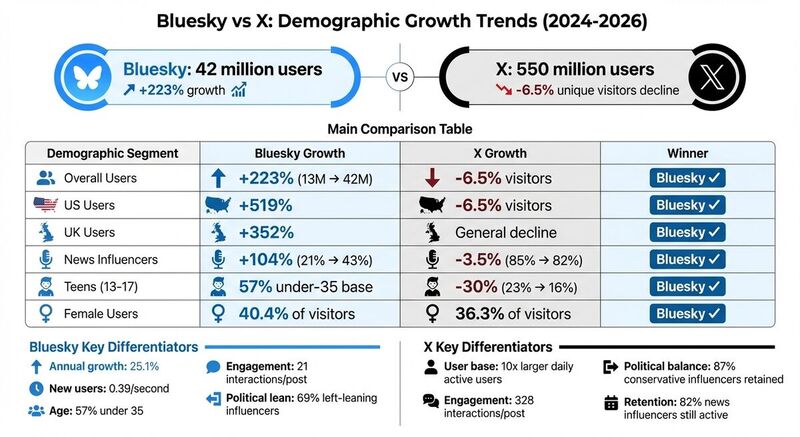 The numbers paint a clear picture of the contrasting trajectories of Bluesky and X. Between 2024 and 2026, Bluesky experienced a staggering 223% surge in key demographics, while X saw a decline in unique visitors. Bluesky's user base skyrocketed, growing from 13 million in October 2024 to over 42 million by January 2026 [5][2]. In contrast, X faced a 6.5% drop in unique visitors during the same period [15].
Summarizing the trends across various demographic groups, the table below highlights the growth rates for both platforms:
| Demographic Segment | Bluesky Growth (2024-2026) | X Growth (2024-2026) | Leading Platform |
|---|---|---|---|
| Overall Users | +223% (13M to 42M) [5][2] | -6.5% (Unique Visitors) [15] | Bluesky |
| US Users | +519% [3] | -6.5% Visitors [15] | Bluesky |
| UK Users | +352% [3] | General decline in unique visitors [15] | Bluesky |
| News Influencers | +104% adoption (21% to 43%) [10] | -3.5% adoption (85% to 82%) [10] | Bluesky |
| Teens (13-17) | Strong growth in under-35 base (57%) [5] | -30% usage (23% to 16%) [15] | Bluesky |
| Female Users | 40.4% of total visitors [5] | 36.3% of total visitors [15] | Bluesky |
These numbers also illustrate the platforms' contrasting political appeal. By March 2025, 69% of left-leaning news influencers had joined Bluesky, compared to just 15% of right-leaning influencers [10]. On the other hand, X retained 87% of conservative influencers but only 75% of liberal ones [10]. This divergence underscores how each platform resonates with specific political groups.
While Bluesky has gained traction, X still commands a much larger overall user base, with approximately 550 million users [6] compared to Bluesky's 42 million. These insights set the stage for tailoring strategies to leverage these demographic differences effectively.
How to Track and Leverage These Trends
Bluesky is growing fast, adding about 0.34–0.39 users per second. It boasts a monthly growth rate of 22.5% and an annual increase of 25.1% [2]. These numbers can guide you on when to focus on specific platforms and which audiences to prioritize.
To make the most of these trends, keeping an eye on real-time data is key.
Using TheBlue.social's Bluesky Analytics Tools

TheBlue.social's Bluesky Network Statistics provides real-time insights that can refine your content strategy. For example, it tracks peak signup times - activity peaks at 10:00 AM and slows down around 4:00 AM [2]. Knowing this helps you schedule posts when users are most active.
The tool also uncovers patterns in domain handle usage, offering clues about geographic trends. Currently, only 1.6% of users use custom domain handles, while 98.4% stick to standard ones. This suggests that professional communities are still emerging on the platform [2]. Additionally, domain indicators like .de for Germany and .jp for Japan highlight regions where Bluesky is gaining traction, enabling you to tailor content for specific markets.
Managing Content Across Both Platforms
These analytics help shape a platform-specific content strategy. Each platform serves a different purpose. Tamilore Oladipo, Senior Content Creator at Buffer, notes:
X is the best platform for viral reach, even though posting there means you run the 'risk' of modest engagement [4].
X is great for viral content with unpredictable engagement, while Bluesky offers more consistent, community-focused interactions.
TheBlue.social’s cross-posting scheduler simplifies managing content across X and Bluesky. You can customize posts for each platform - use X for memes, hot takes, and viral content, and Bluesky for thoughtful conversations and niche community engagement [4]. By aligning your strategy with these metrics, you can maximize both broad reach and meaningful connections.
Conclusion
Bluesky is growing rapidly, surpassing 42 million users by January 2026 with an impressive annual growth rate of 25.1%. However, X still dominates in terms of daily active users, maintaining about ten times more than Bluesky. The platforms also differ in audience makeup. Bluesky leans younger, with 57% of its users under 35, and attracts a politically left-leaning crowd - 69% of left-leaning news influencers are active there. Meanwhile, X boasts a more politically diverse user base and significantly higher engagement, with 83% of influencers posting at least four times a week, compared to Bluesky’s 31%.
These distinctions call for tailored strategies. X thrives on unpredictable viral moments and high engagement variability, making it ideal for campaigns seeking broad reach. On the other hand, Bluesky offers a more consistent and community-driven experience, appealing to audiences who value steady, meaningful interactions. Neither platform is inherently better - it’s all about aligning your goals with the right audience and platform strengths.
To make the most of these insights, tools like TheBlue.social's Bluesky Network Statistics can help track growth trends and uncover new opportunities. Features like the cross-posting scheduler allow you to maintain a presence on both platforms efficiently, tailoring content to X’s viral nature while fostering deeper conversations on Bluesky.
As these platforms evolve, staying adaptable is key. Use real-time analytics to fine-tune your strategy, ensuring your content resonates with each platform’s unique audience. By leveraging the right tools and insights, you can maximize your impact across both spaces.
FAQs
Why is Bluesky growing faster than X?
Bluesky's growth has been nothing short of impressive, especially when compared to X. A significant number of users have flocked to Bluesky, driven by concerns over content moderation and the increasingly polarized nature of conversations on X. In just one week, the platform welcomed hundreds of thousands of new users, with the majority hailing from the United States.
Currently, Bluesky has surpassed 20 million users and is steadily gaining momentum, particularly in the U.S. and U.K. Much of this success can be credited to its decentralized design and emphasis on building community. By offering a more neutral, less divisive social media environment, Bluesky has positioned itself as a refreshing, user-centered alternative in the ever-changing world of social platforms.
What drives the differences in user growth and engagement between Bluesky and X?
The growth and engagement patterns of Bluesky and X reveal their distinct priorities and audience dynamics. Bluesky has experienced a surge in popularity, especially in the US and UK, drawing in younger, tech-savvy users who are intrigued by its decentralized, community-focused features. This has made it particularly appealing to those seeking alternatives to more traditional social platforms.
X, by contrast, boasts a much larger and well-established user base, attracting a diverse global audience, including news influencers and older demographics. Its broad reach and longstanding presence give it a significant edge in scale and visibility. Meanwhile, Bluesky’s smaller, niche community thrives on fostering more intimate and meaningful interactions. These differences explain why each platform connects with its unique audience in distinct ways.
How do age and political views influence the choice between Bluesky and X (Twitter)?
Age and political leanings heavily influence whether users gravitate toward Bluesky or X. Bluesky is gaining traction with younger audiences, particularly those interested in decentralized platforms and features that prioritize privacy. A significant portion of its user base consists of former X users looking for a fresh, less centralized social media alternative.
Meanwhile, X still holds strong appeal among older users, especially those over 35, who often use the platform to engage with news, politics, and professional conversations. From a political standpoint, Bluesky tends to attract individuals dissatisfied with X's content moderation policies or those seeking a less divisive online space. In contrast, X continues to draw politically active users and professionals who value its networking opportunities. These patterns underscore the role age and political views play in shaping users' platform preferences.