Lookalike Audiences for Cross-Platform Growth
Last updated: March 11, 2026
Lookalike audiences are a powerful tool to help you find new customers who resemble your best existing ones. By using data from your current customers - like email lists or website visitors - platform algorithms identify similar users likely to engage with your brand. This approach reduces wasted ad spend and improves targeting precision compared to interest-based methods.
Key Highlights:
- Seed Audience Matters: Use high-value, recent customers (1,000–5,000 people) for better results.
- Precision vs. Reach: A 1% lookalike audience offers the closest match, while 10% provides broader reach.
- Cross-Platform Use: Apply lookalike strategies on platforms like Meta, TikTok, LinkedIn, and even emerging networks like Bluesky.
- Cost Trends in 2026: Lookalike audiences have a 45% higher CPM but remain effective for niche markets and high-ticket items.
Facebook Ads Lookalike Audience Tutorial 2026 (Still Worth It?)
What Are Lookalike Audiences?
Lookalike audiences are a smart way to target new users who resemble your current customers or followers. Instead of guessing at demographics or interests, you provide a "seed audience" (like customer emails or site visitors), and the platform's algorithm identifies similar users for you.
The key difference between lookalike audiences and custom audiences is their purpose. Custom audiences focus on people you already know, while lookalike audiences help you find fresh prospects. Unlike interest-based targeting, which relies on assumptions, lookalike targeting uses actual data and machine learning to detect patterns that might otherwise go unnoticed.
How Lookalike Audiences Work
Here’s what happens behind the scenes: the platform’s algorithm studies your seed audience, analyzing details like demographics, interests, behaviors, and even connections. It processes thousands of signals - such as past ad interactions and conversion trends - to create a predictive model of who might engage with your brand.
Once the algorithm identifies key traits, it scans its entire database to find users who match those characteristics but haven’t interacted with your brand yet. You can even fine-tune how closely the new audience matches your seed audience by setting a similarity range. A 1% audience gives you the closest match, while a 10% audience casts a wider net.
With this in mind, the next step is to focus on building a high-quality seed audience to get the best results.
Building Quality Source Audiences
The effectiveness of your lookalike audience depends heavily on the quality of your seed audience. A smaller group of high-value customers will outperform a large, generic list. For instance, using your top 20% of customers by revenue will yield better results than simply uploading every site visitor.
For the best outcomes, aim for a recent, high-value seed audience of 1,000 to 5,000 users. Customers who made purchases within the last 30 to 90 days typically provide the most accurate data for modeling [1]. It’s also crucial to keep your seed audience homogeneous - made up of users who share similar, high-value traits, like frequent purchases or high spending.
"The quality of your source audience directly impacts the effectiveness of your lookalike audience. A well-defined, high-value source audience will typically yield better results than a broad, undefined one." – ContentStudio
Benefits of Using Lookalike Audiences Across Platforms
Lookalike audiences are a game-changer when it comes to expanding your reach on social platforms. They solve a key challenge for marketers: finding new customers who are genuinely interested in your products or services. By refining targeting, they help reduce wasted ad spend and support consistent growth across channels.
Reaching Users Most Likely to Engage
When you base a lookalike audience on your top customers, advanced algorithms analyze their behaviors and preferences to identify similar users who haven’t interacted with your brand yet. This means your ads are shown to people more likely to click, engage, and convert.
The size of your lookalike audience matters. A 1% lookalike audience provides the closest match to your seed audience and typically delivers the best conversion rates. However, as you expand to 3%, 5%, or even 10%, you gain broader reach but lose some precision. For high-value products or niche markets, starting with a 1% audience ensures you're targeting the most qualified prospects before scaling up [1][3].
Reducing Ad Costs and Improving Performance
Lookalike audiences help you focus your budget on users who are most likely to convert, which optimizes ad spend. But it’s worth noting that, as of 2026, the cost dynamics have shifted. On average, lookalike audiences now have a 45% higher CPM compared to broad targeting, which can affect your return on ad spend [3].
Performance data highlights this shift: broad targeting achieved a 113% ROAS, while lookalike targeting delivered 76% ROAS [3]. However, lookalikes still shine in specific scenarios. For example, if you're working in a niche market, selling high-ticket items, or operating with a limited budget, lookalikes can deliver better efficiency by honing in on high-intent users. The key is to align your budget with these precise audiences when conversions matter most.
"While some advertisers have started shifting toward the Advantage+ Audience feature in recent years, lookalike audiences still deliver excellent results for many accounts." – AdBid [3]
Maintaining Engagement Across Multiple Platforms
Lookalike audiences are also critical for ensuring consistent growth across different social platforms. When you launch on a new network like TikTok, Pinterest, or Bluesky, the platform’s algorithm doesn’t yet understand your audience. By using a lookalike audience from successful campaigns on Facebook or Instagram, you can jumpstart your efforts instead of starting from scratch [3].
This strategy allows you to create tailored lookalikes for platforms like Meta, TikTok, LinkedIn, and emerging networks. It ensures you’re reaching similar user profiles, no matter where they spend their time, helping you build credibility and maintain what marketers often call "omnipresence" [4].
For brands managing campaigns across multiple platforms, tools like TheBlue.social simplify the process. These platforms let you schedule and cross-post between X (Twitter), Threads, Instagram, Pinterest, LinkedIn, Bluesky, and Mastodon - all from a single dashboard. This makes it easier to coordinate your lookalike strategies and maintain consistent messaging as you grow your audience across diverse networks. By keeping your campaigns cohesive, you can scale effectively while maintaining engagement on every platform.
How to Create Lookalike Audiences on Major Platforms
Creating lookalike audiences is all about leveraging quality seed data to find users similar to your existing audience. Each platform has its own tools and workflows for this, so understanding how to navigate systems like Meta, LinkedIn, TikTok, and Google Ads can save you time and effort. For newer platforms like Bluesky and Threads, where native ad tools are still missing, cross-posting strategies can help you replicate success.
Facebook and Instagram: Meta Ads Manager
Meta's Ads Manager simplifies the process of creating lookalike audiences for Facebook and Instagram. Start by heading to the Audiences section, selecting Create Audience, and choosing Lookalike Audience. You'll need to pick a seed source, which could be a Custom Audience based on your email list, website pixel data, or app activity.
After selecting your seed, choose a target country and set the similarity range (1% to 10%). A 1% lookalike delivers the closest match to your seed audience, often resulting in better conversions, while a 10% lookalike offers broader reach but less precision. Meta suggests using a seed audience of 1,000 to 5,000 people for the best outcomes [3].
To optimize your campaigns, make sure to exclude your seed audience from the lookalike campaign. This avoids wasting ad spend on people who have already converted. For campaigns in 2026 and beyond, consider using Meta's Conversion API (CAPI) to bypass browser-based tracking restrictions from iOS 14+ and ATT updates. CAPI provides more accurate data, improving the quality of your lookalike audience [3].
Now, let’s explore how LinkedIn uses its professional data to create lookalikes.
LinkedIn: Matched and Lookalike Audiences
LinkedIn’s Matched Audiences feature is designed with B2B marketers in mind. To create lookalikes, go to Campaign Manager, navigate to Matched Audiences under the Account Assets menu, and upload a seed source like a company list or a contact list of key customers or leads.
What sets LinkedIn apart is its ability to model lookalikes based on professional attributes such as job function, seniority, and industry. This makes it especially effective for targeting decision-makers who resemble your existing high-value contacts. While LinkedIn recommends a seed list of at least 1,000 contacts, smaller lists can still yield results.
TikTok and Google Ads: Behavioral Targeting
TikTok’s Similar Audiences feature allows you to choose from three targeting options: narrow, balanced, or broad. In TikTok Ads Manager, go to the Audiences section and use your high-quality seed audience. Narrow targeting gives you the closest match, while broad expands reach but sacrifices precision.
Google Ads takes a slightly different approach with its Optimized Targeting and Audience Expansion features. By uploading your customer data through Customer Match, Google’s AI can dynamically identify users similar to your seed audience [2].
For platforms like Bluesky, where native tools are still evolving, you’ll need to think outside the box.
Bluesky and Emerging Platforms
On emerging platforms like Bluesky and Threads, where built-in lookalike audience features are absent, you can use creative strategies to achieve similar results. Bluesky, for instance, relies on Custom Feeds and Starter Packs to help users discover accounts with shared interests.
To replicate lookalike growth on these platforms, use a cross-posting scheduler like TheBlue.social. This tool can synchronize content across platforms like X (formerly Twitter), Threads, Instagram, Pinterest, LinkedIn, Bluesky, and Mastodon. When cross-posting, tailor your content to fit each platform - keep it short for Bluesky’s 300-character limit, and remember that Threads imposes restrictions on posts with more than five links starting December 22, 2025 [4].
On Bluesky, getting listed in relevant Starter Packs is key. These curated lists act as manual lookalike tools by recommending your profile to users with similar interests. Additionally, creating content tailored to popular Custom Feeds can help you reach niche audiences. To avoid looking automated, stagger your posts by 15–30 minutes and aim for peak engagement times on each platform [6][4].
Best Practices for Cross-Platform Growth with Lookalike Audiences
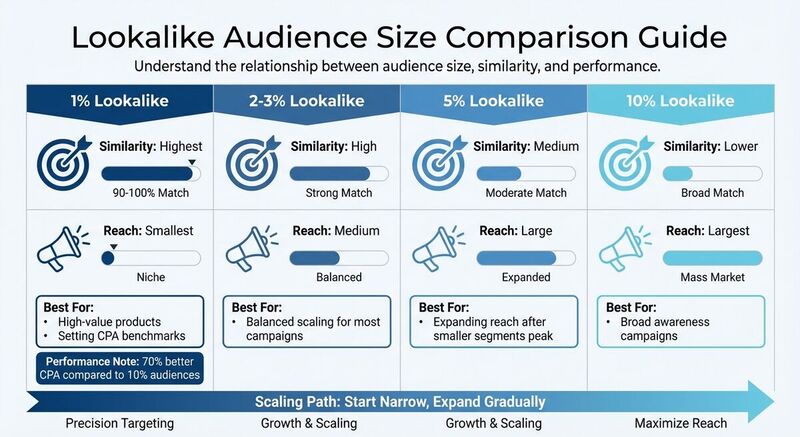 Making the most of lookalike audiences requires a thoughtful strategy. While platforms provide excellent tools, the real key lies in how you apply them. Here's what works in 2026.
Testing and Expanding Audience Sizes
Start with a 1% lookalike audience for the highest similarity and better conversions. If you notice performance leveling off - signaled by an increase in CPA (cost per acquisition) and ad frequency - consider broadening the range to 2–3%. Only push further to 5–10% if your creative assets remain effective.
"Typically, advertisers start with targeting a 1% lookalike audience. To enhance your campaign's reach without saturating your audience, consider increasing this to between 3% and 5%." - AdBid Guide [3]
The numbers back this up: 1% lookalike audiences generally achieve about 70% better CPA compared to 10% audiences because of their closer match to the seed data. When smaller segments show higher frequency rates, it’s a good indicator to expand. Keep an eye on CPA - rising costs could mean your audience is saturated or your creative needs a refresh.
| Lookalike Size | Similarity | Reach | Best For |
|---|---|---|---|
| 1% | Highest | Smallest | High-value products and setting CPA benchmarks |
| 2–3% | High | Medium | Balanced scaling for most campaigns |
| 5% | Medium | Large | Expanding reach after smaller segments peak |
| 10% | Lower | Largest | Broad awareness campaigns |
This scalable approach works best when paired with regular updates to your seed data.
Updating Source Audiences Regularly
To maintain precise targeting, it’s crucial to update your source audience regularly. Your results depend on the quality of the data you feed into the system. As customer behaviors and trends shift, relying on outdated seed lists - especially those more than six months old - can lead to audience fatigue and higher costs. Aim to refresh your source data every 3–6 months (quarterly is ideal) to keep your targeting aligned with current customer behavior.
Prioritize recent converters, focusing on those who converted within the last 30–90 days. This ensures your lookalike audience reflects the most relevant and active customer profiles. Additionally, clean your seed list by removing refunds, low-quality leads, and recent purchasers to avoid wasting ad spend on less valuable users.
If you’re using tools like Meta's Conversion API or Google’s Customer Match, ensure your first-party data is updated and flowing correctly. This helps bypass iOS 14+ restrictions and keeps your seed data fresh.
Using TheBlue.social for Campaign Management
Managing lookalike campaigns across platforms like X (Twitter), Threads, Instagram, LinkedIn, Pinterest, Bluesky, and Mastodon can be overwhelming. TheBlue.social simplifies this process with a cross-posting scheduler, allowing you to manage your content calendar in one place. The platform also lets you stagger posts by 15–30 minutes to target peak engagement times on each network.
TheBlue.social offers Bluesky Analytics to track engagement and follower growth - especially helpful when testing lookalike strategies on newer platforms with limited ad tools. By analyzing post performance, you can fine-tune your content to better resonate with your lookalike audiences. Additionally, free tools like Generate Hashtags and Add Emojis help optimize posts for broader reach.
Conclusion
Lookalike audiences continue to be a dependable way to expand your social media reach in 2026. The concept is simple: base your targeting on actual customer data instead of guesswork. By using high-quality seed data - like your top customers, frequent buyers, or those with high lifetime value - you give algorithms a clear guide to finding similar prospects. Research shows that 79% of marketers see better performance with this method, and 1% lookalike audiences often deliver 70% lower CPAs compared to broader targeting groups [5]. This precision makes it easier to create campaigns that resonate across platforms.
The real advantage lies in applying this strategy across multiple platforms. Running lookalike campaigns on Meta, LinkedIn, TikTok, and newer platforms like Bluesky (which now boasts 35.2 million users) ensures your brand stays top-of-mind as users encounter your message in different contexts throughout their day. This multi-platform approach also shields your campaigns from sudden algorithm changes or dips in reach on any single channel, keeping your efforts steady despite platform-specific shifts.
To maximize results, refresh your seed audiences every quarter and exclude current customers to avoid unnecessary spending. Start with 1% lookalikes for precision, then scale to 3–5% as you grow. As AdSpyder's James Smith explains:
"Lookalike audiences are still one of the most reliable ways to scale performance while staying relevant - because you're expanding from what already works" [5].
Managing campaigns across platforms like X (Twitter), Threads, Instagram, LinkedIn, Pinterest, Bluesky, and Mastodon can feel overwhelming. Tools like TheBlue.social’s cross-posting scheduler and Bluesky Analytics can simplify your workflow, letting you focus on refining seed data and scaling successful campaigns - two essential steps for long-term growth across platforms.
FAQs
What seed audience should I use if I don’t have 1,000 customers yet?
If you’re working with fewer than 1,000 customers, focus on building a seed audience that closely aligns with your ideal customer profile. This could be a group of website visitors, active social media followers, or a smaller, well-defined subset of your audience. Using these groups as a foundation can help you craft a lookalike audience to drive growth effectively.
When should I switch from a 1% lookalike to a larger size?
When deciding whether to move from a 1% lookalike audience to a larger size, it all boils down to your goals and how you balance precision with reach. A 1% lookalike audience is great for accurate targeting, as it closely mirrors your source audience. However, expanding to 2-3% can help you reach more people while still maintaining a reasonable level of similarity. The best approach? Start with 1%, experiment with slightly larger sizes, and use your campaign metrics to fine-tune for the best mix of growth and engagement.
How can I use lookalikes on Bluesky without native ad targeting?
To tap into lookalike audiences on Bluesky without built-in ad targeting, start by diving into your followers' behaviors and interests using tools like Bluesky analytics. Use this data to create content that resonates with them or to interact with communities and hashtags that align with their preferences.
Another approach? Leverage platforms like X (formerly Twitter) or Instagram to build lookalike audiences there. Once identified, guide these users to your Bluesky profile through cross-platform promotions or collaborations. This strategy can help you organically grow your reach while connecting with users who share similar interests.