TikTok vs. Instagram: Engagement Rate Trends
Last updated: June 15, 2026
Engagement rates on TikTok and Instagram show clear differences in 2026. TikTok tends to deliver broader reach and higher public interaction, while Instagram focuses more on deeper connections with existing followers. Here's what stands out:
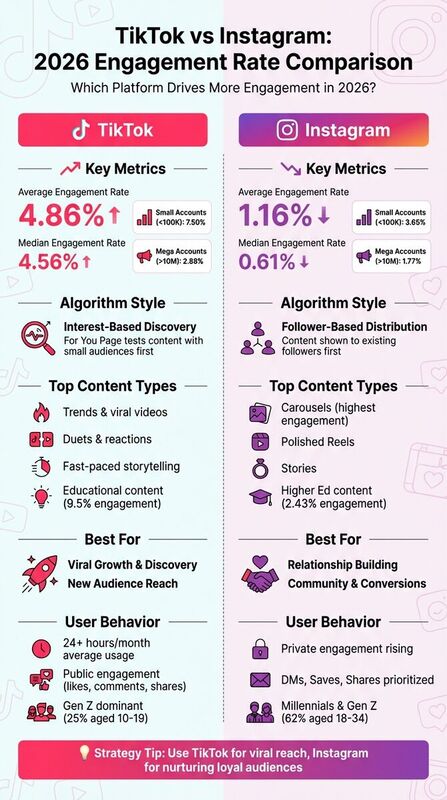
- TikTok: Average engagement rate is 4.86%, with smaller accounts (under 100K followers) achieving 7.50%. Content thrives on discovery, viral trends, and retention metrics like watch time and rewatches. Industries like Fashion and Food lead with engagement rates as high as 19.2%.
- Instagram: Average engagement rate is 1.16%, with private interactions (saves, shares, DMs) driving performance. Smaller accounts see 5.2% engagement, and carousels outperform Reels in interaction. Industries like Higher Education and Construction (Reels) perform best, averaging 2.6%.
Quick Comparison
| Metric | TikTok | |
|---|---|---|
| Average Engagement Rate | 4.86% | 1.16% |
| Median Engagement Rate | 4.56% | 0.61% |
| Top Content Types | Trends, videos | Carousels, Reels |
| Best For | Viral growth | Relationship building |
| Top Industries | Fashion (19.2%) | Higher Ed (2.43%) |
TikTok prioritizes interest-based discovery, making it ideal for viral reach. Instagram, with its follower-based algorithm, is better suited for nurturing loyal audiences and driving conversions. To succeed, tailor your strategy to each platform's strengths.
TikTok engagement rate trends and benchmarks
2026 TikTok Average Engagement Rates
In 2026, TikTok engagement rates ranged between 3% and 17.5%, with smaller accounts generally outperforming larger ones. This trend highlights a shift toward prioritizing consistent, audience-centered content over chasing virality. For instance, accounts with fewer than 100,000 followers achieved an average engagement rate of 7.50%, while those with over 10 million followers averaged just 2.88% [1].
Looking back, TikTok's engagement rates have stabilized after a period of rapid growth. The platform saw an average engagement rate of 5.77% in 2023, which dipped to 4.64% in 2024 before recovering slightly to 4.90% by mid-2025 [2, 5].
TikTok Engagement Rates by Industry
Engagement rates on TikTok vary widely across industries. Fashion dominates with an impressive 19.2% engagement rate, followed by Food at 18.5%. Educational content also performs well, averaging 9.5% engagement [1]. Meanwhile, Food and Drink accounts typically see engagement rates between 6% and 8%, and Sports Teams average around 4.2%.
| Industry | Average Engagement Rate |
|---|---|
| Fashion | 19.2% |
| Food | 18.5% |
| Education | 9.5% |
| Food and Drink | 6-8% |
| Sports Teams | 4.2% |
These figures emphasize the importance of tailoring content to specific audiences, as industry-focused strategies can significantly impact engagement.
What Drives TikTok Engagement
To understand these benchmarks, it's essential to look at how TikTok's algorithm works. The platform prioritizes watch time, rewatches, and video completions over traditional metrics like likes and comments [2, 6]. Each video undergoes a "test run" with a small audience; if it performs well in terms of retention and interaction, TikTok broadens its reach. This system allows smaller creators to outperform larger accounts when their content resonates deeply.
While trends still play a role, strategic content creation is now the key to success. Sam Gillies, Chief Content Officer at Nonsensical, puts it this way:
"When you stop thinking like a brand and start thinking like a creator, that's when TikTok starts working much better." [5]
In 2026, successful TikTok content combines authentic storytelling with smart hooks to capture attention quickly. Grabbing the viewer's interest within the first three seconds is critical for boosting completion rates [2, 5]. Interactive features like duets, reaction videos, and comment replies with video responses create a conversational feel that naturally increases engagement [1, 4]. Additionally, TikTok's native editing tools make it easier to adapt to trends and maintain relevance.
Instagram engagement rate trends and benchmarks
2026 Instagram Average Engagement Rates
As of January 2026, the median engagement rate on Instagram is 3.9% [9], reflecting a steadier performance compared to TikTok. However, engagement rates differ depending on the type of content:
- Carousels: 1.2% to 2%
- Reels: 0.48% to 2.8%
- Static posts: 0.8% to 1.5%
Interestingly, engagement decreases as follower count increases. Accounts with fewer than 1,000 followers (nano-accounts) see about 5.2% engagement, while those with over 10 million followers (mega-accounts) drop to around 1.77% [8]. Smaller communities tend to foster closer connections, which explains this pattern.
There's also been a shift in how people engage with content on Instagram. According to Instagram CEO Adam Mosseri:
"If you're trying to evaluate how your videos (or anything else) are performing on Instagram, one of the best things to look at is the sends" [7].
This highlights a growing trend: engagement is increasingly happening behind the scenes through saves, shares, and direct messages, rather than through public likes and comments [6].
Instagram Engagement Rates by Industry
Engagement rates also vary widely across industries. Some sectors naturally perform better due to their visual and community-oriented nature. Here's a breakdown:
| Industry | Average Engagement Rate |
|---|---|
| Higher Education | 2.43% |
| Construction (Reels) | 2.6% |
| Nonprofits (Reels) | 2.6% |
| Fashion | 1.85% |
| Sports Teams | 1.57% |
| Food & Drink | 1.45% |
Higher Education leads the pack, likely due to its strong community focus, while industries like Fashion and Food & Drink lean on visual appeal. Reels for Construction and Nonprofits also perform especially well, averaging 2.6% engagement.
These patterns emphasize Instagram's focus on fostering relationships and storytelling, which contrasts with TikTok's emphasis on viral content. For brands, this means creating visually compelling and community-driven posts is key.
What Drives Instagram Engagement
Understanding what fuels engagement on Instagram is just as important as knowing the numbers. The platform's algorithm prioritizes consistent posting and strong follower relationships over chasing viral trends [2]. Content is initially shown to existing followers, so posting regularly - ideally 3-5 times per week - can help grow your audience [8].
Reels are unmatched in reach, achieving 36% more reach than carousels and 125% more than static posts [7]. However, carousels outperform in engagement, generating 12% more interaction than Reels and 114% more than single-image posts [7]. This creates a clear strategy: use Reels to attract new followers and carousels to deepen engagement with your current audience.
The algorithm now places significant weight on "sends per reach", meaning how often a post is shared via direct messages [7]. Completion rates for Reels are also crucial, with a 38% benchmark being a key factor for algorithmic visibility [7]. Additionally, responding to comments can increase engagement by 21% [10], making active community management a must.
Tamilore Oladipo, Senior Content Creator at Buffer, sums it up well:
"Instagram engagement isn't disappearing - it's moving behind the scenes. Create saveable content for the algorithm, share your posts with friends, and reply via DM - that's where real engagement is happening" [6].
How TikTok and Instagram calculate engagement
TikTok vs. Instagram Engagement Formulas
TikTok and Instagram approach engagement metrics in slightly different ways, reflecting their unique priorities. TikTok calculates engagement using the formula: (Likes + Comments + Shares + Saves) / Followers × 100 [1]. Another common variation is (Engagement / Views) × 100, which considers the broader reach of content.
Instagram, on the other hand, traditionally uses (Likes + Comments + Saves + Shares) / Followers × 100 [1]. However, many marketers now prefer using reach instead of follower count to measure engagement. This shift acknowledges Instagram's focus on distributing content widely rather than solely engaging existing followers. The main distinction here is that TikTok emphasizes how content resonates with anyone who views it, while Instagram still places more weight on interactions with an established audience [2].
These formulas underline the platforms' differing priorities, which are further reflected in how their algorithms operate.
How Each Algorithm Prioritizes Content
TikTok's algorithm assigns weighted scores to various user actions: Likes (1), Comments (2), Shares (3), Completions (4), and Rewatches (5) [11]. When a new video is uploaded, it's initially shown to about 300 viewers. To gain wider exposure, the video needs to accumulate around 50 points from these interactions. This system prioritizes user engagement over follower count, making TikTok more focused on viral potential.
Instagram, by contrast, leans heavily on established follower relationships and consistency [2]. Content is first displayed to current followers, with engagement signals like saves and shares carrying more weight than likes - especially for feed posts and carousels. While Instagram Reels aim to broaden discovery, the platform still rewards creators who actively engage with their audience through actions like replying to comments and direct messages [2].
Algorithm Comparison Table
| Metric | TikTok | |
|---|---|---|
| Main Formula | (Likes + Comments + Shares + Saves) / Followers × 100 [1] | (Likes + Comments + Saves + Shares) / Followers × 100 [1] |
| Alternate Calculation | (Engagement / Views) × 100 | (Total Engagement / Reach) × 100 [1] |
| Top Priority | Watch time, rewatches, completions [2] | Saves, shares, follower relationships [2] |
| Discovery Model | For You Page (interest-based) [2] | Feed & Explore (follower-based) [2] |
| Average Engagement Rate | 4.64% [2] | 0.43% [2] |
| Best Content Type | Fast-paced storytelling, trends [2] | Carousels, authentic Reels [2] |
How engagement rates changed from 2024 to 2026
TikTok's Growth in Engagement Rates
TikTok managed to hold onto strong engagement rates, even as the platform became more saturated. While the average engagement rate dipped from 5.77% in 2023 to 4.64% in 2024, it bounced back slightly, stabilizing at 4.86% by early 2025 [6]. The increasingly crowded "For You" feed made organic discovery tougher, but smaller accounts (those with under 100,000 followers) still thrived, boasting an impressive 7.50% engagement rate in 2025 [1]. This recovery, though gradual, sets TikTok apart from Instagram, which faced a different trajectory.
Instagram's Flat Engagement Rates
Instagram's engagement rates took a sharp hit. The median rate tumbled from 2.94% in January 2024 to just 0.61% by January 2025, with the average rate settling at 1.16% during 2025 [6].
"Instagram's algorithm is prioritizing reach over deep engagement. While more people are seeing content, fewer are interacting with it."
Unlike TikTok, Instagram's decline highlights a shift in how users interact with content. Instead of public likes and comments, engagement moved behind the scenes into private DMs, saves, and shares - metrics that traditional analytics often miss [6,7]. Meanwhile, Instagram Reels struggled with an average engagement rate of just 0.50% [2], while carousel posts outperformed Reels by generating 12% more engagement [7]. This left creators in a tough spot: should they focus on formats that attract broader reach or ones that spark deeper conversations?
The Rise of Short-Form Video
Short-form video has reshaped engagement trends on both platforms, but in markedly different ways. Instagram Reels achieved 36% more reach than carousel posts and 125% more reach than single-photo posts [7]. However, this boost in visibility didn't translate into proportional engagement [6].
"People are more interested in videos - they're just more engaging."
- Adam Mosseri, CEO, Instagram
TikTok, on the other hand, shifted its focus to metrics like watch time and retention rather than just likes. Videos longer than one minute began to outperform shorter clips in 2025, as the algorithm rewarded completion rates and rewatches [6]. Instagram, despite its push for video, couldn't quite replicate TikTok's success. Carousel posts continued to foster stronger engagement than Reels, even though they received less algorithmic promotion [7]. This highlights the ongoing challenge Instagram faces in aligning its video strategy with user behavior.
Why engagement rates differ between platforms
Content Discovery and Trends
TikTok and Instagram take very different approaches to how users discover content, and this plays a big role in their engagement rates. TikTok's "For You" page relies on an interest-based algorithm that tests videos with small audiences, regardless of how many followers the creator has [2]. This means even a brand-new account can go viral if the content connects with viewers. On the other hand, Instagram leans on a follower-based system, prioritizing posts from accounts users already follow and rewarding consistent posting over one-off viral hits [2].
"TikTok rewards immediate interaction - rewatches, shares, and watch time. Instagram rewards consistency over time."
TikTok also thrives on trends and interactive content. Features like duets, reactions, and trends sparked by comments create a highly engaging environment [1][4]. Instagram, while offering opportunities for discovery through its Reels feed, primarily focuses on content from followed accounts in the main feed. This makes TikTok far better suited for viral growth compared to Instagram [7].
Next, let's dive into how the type of content and posting habits shape engagement on these platforms.
Content Types and Posting Schedule
The kind of content you create and how often you post it can make or break engagement. On Instagram, posting 3-5 times per week can double your follower growth compared to posting just once or twice [8]. TikTok, however, places more emphasis on watch time, rewatches, and shares than how frequently you post [2]. Longer videos - those over one minute - now perform better on TikTok as the platform's algorithm increasingly favors retention metrics [6]. Educational content is especially successful on TikTok, boasting engagement rates as high as 9.5% [1]. Meanwhile, Instagram tends to shine with lifestyle, fashion, and beauty content [1][2].
Instagram's varied content formats serve different goals. Reels generate 36% more reach than carousels and 125% more reach than single-photo posts [7]. However, carousels drive 12% more engagement than Reels, making them a great option for building deeper connections with your followers.
These differences in content and posting strategies naturally lead to how each platform approaches commerce.
Shopping Features and Platform Integration
Shopping features are another area where TikTok and Instagram diverge, further influencing engagement. Instagram has heavily invested in e-commerce tools, offering features like product tags, Reels ads, and in-app shopping to turn engagement into sales. TikTok, by contrast, focuses on viral discovery with TikTok Shop, where products can gain massive attention through trends and endorsements from creators.
"TikTok may give you more bang for your buck... TikTok users are very much dialed into the content they're seeing."
How users interact with shopping content also varies. Instagram users often save posts or share them privately through DMs, signaling purchase intent that traditional metrics might overlook [6][7]. TikTok users, who spend over 24 hours a month on the app [1], are more likely to engage publicly through comments and shares. TikTok is strong for awareness and viral discovery, while Instagram is stronger for relationship-building that can convert into sales [2].
TikTok vs. Instagram: side-by-side comparison
When comparing TikTok and Instagram, the numbers paint a clear picture of their differences. TikTok boasts an average engagement rate of 4.86%, while Instagram lags behind at 1.16% [6]. The median engagement rates tell a similar story: TikTok sits at 4.56%, compared to Instagram's 0.61% [6]. Smaller accounts (<100k followers) thrive on TikTok with a **7.50% engagement rate**, far surpassing Instagram's **3.65%**. Even mega-accounts (>10M followers) perform better on TikTok, achieving 2.88% versus Instagram's 1.77% [1].
| Metric | TikTok | |
|---|---|---|
| Average Engagement Rate | 4.86% [6] | 1.16% [6] |
| Median Engagement Rate | 4.56% [6] | 0.61% [6] |
| Primary Audience | Gen Z (25% aged 10-19) [3][4] | Millennials & Gen Z (62% aged 18-34) [3] |
| Algorithm Style | Interest-based; Performance-driven [1][2] | Follower-based; Consistency-driven [2] |
| Top Content Types | Trends, duets, fast-paced storytelling [1][4] | Carousels, polished Reels, Stories [1][4] |
| User Behavior | High active interaction (24+ hrs/month) [1] | Increasing private engagement (DMs, Saves) [6] |
| Best For | Viral reach and discovery [2] | Community nurturing and conversions [2] |
| Top Industries | Education (9.5%), Food (6-8%) [1] | Higher Ed (2.43%), Sports (1.57%) [1] |
TikTok's audience leans heavily toward younger users, with 25% aged 10-19 [3][4]. Meanwhile, Instagram's user base is older, with 62% aged 18-34 [3]. TikTok users in the U.S. spend an average of 24+ hours a month on the app [1], while Instagram users are increasingly focusing on private interactions, such as direct messages and saves [6].
The type of content that thrives on each platform also varies. TikTok rewards trendy, fast-paced storytelling and uses an interest-based algorithm that tests content with smaller audiences first, offering new accounts the potential to go viral [1][2]. On the other hand, Instagram prioritizes polished visuals, such as carousels and Reels, and its follower-based algorithm favors consistent posting and content from already-followed accounts [2].
These differences highlight the importance of tailoring your strategy for each platform if you want to succeed in 2026. TikTok is useful for reaching new audiences and creating viral moments, while Instagram is better for building deeper connections and driving conversions.
How to improve your engagement in 2026
To thrive on social media in 2026, you'll need to approach platforms like TikTok and Instagram with strategies tailored to their strengths. On TikTok, focus on content that consistently solves problems, inspires, or entertains rather than chasing fleeting trends. The algorithm now favors creators who provide sustained value over time [5].
For Instagram, shift your attention to private engagement metrics - such as saves, DMs, and shares - rather than public-facing likes. Instagram CEO Adam Mosseri highlights this shift, stating:
"Shareable content tends to perform the best because it drives the most value for the overall community" [7].
Use Reels to attract new followers and Carousels to deepen connections with your current audience. These formats cater to Instagram's evolving algorithm, which increasingly rewards content that fosters meaningful interactions.
TikTok: Treat It Like a Search Engine
TikTok is becoming more like a search engine, so create content around popular queries and search terms [5]. Start your videos with a compelling hook in the first three seconds to grab attention [2][5]. Engage with your audience by replying to comments using videos, which can spark deeper conversations [5]. Don't shy away from "lo-fi" content or behind-the-scenes footage - these often outperform polished, high-production videos [2][5].
Instagram: Build Relationships
On Instagram, consistency and relationship-building are key. The algorithm prioritizes your connections with existing followers, so focus on maintaining a steady posting schedule that aligns with your audience's preferences [2][6].
Use TheBlue.social for the posting workflow around the campaign: draft once, adapt posts for connected accounts, check link previews, generate image alt text, and schedule supporting posts. It is not a TikTok or Instagram engagement-rate analytics tool. Use the native platform analytics for those numbers, then use TheBlue.social to keep the next cross-platform batch organized.
When crafting posts, aim to spark meaningful engagement by asking specific questions, such as, "Which one would you choose?" This encourages thoughtful comments and boosts your content's visibility [5].
Timing and Quality Matter
Both platforms reward quality over quantity. On TikTok, watch time and replays are critical, while Instagram values consistent posting and strong follower relationships [2][6]. Before increasing how often you post, check that each piece gives the audience a reason to watch, save, share, or reply [5].
FAQs
Why is TikTok's engagement rate higher than Instagram's?
TikTok generally boasts higher engagement rates compared to Instagram, largely because it resonates with a younger, highly interactive demographic - especially Gen Z. The platform thrives on fast-paced, trending vertical videos, relatable memes, and raw, unfiltered content that invites frequent interaction and participation.
On the other hand, Instagram tends to attract users who favor polished, visually curated content, particularly through features like Reels. Although Instagram Reels have grown in popularity, the engagement dynamics differ. TikTok leans into spontaneity and playful creativity, creating a distinct style of user interaction.
Why do smaller TikTok accounts often have higher engagement rates?
Smaller TikTok accounts often experience higher engagement rates because TikTok's algorithm prioritizes the quality of content and how viewers interact with it, rather than the number of followers. This creates an opportunity for accounts with fewer followers to have their videos showcased to highly engaged audiences. For example, accounts with under 5,000 followers typically see engagement rates of about 4.2%, as their content tends to connect more with niche or highly targeted communities.
These smaller creators often zero in on specific topics or trends that resonate with dedicated audiences. TikTok's discovery system further amplifies this by promoting fresh, engaging content regardless of the creator's follower count. This unique setup allows smaller accounts to gain notable visibility and interaction, often outperforming larger accounts when you compare engagement relative to their follower base.
How can you boost Instagram engagement in 2026?
If you're looking to stand out on Instagram in 2026, short-form videos like Reels should be your go-to content. Thanks to Instagram's algorithm, these videos still dominate in terms of visibility and interaction. Pair this with consistent posting at the right times, and you'll see better reach. Don't overlook carousel posts or user-generated content (UGC) either - both are excellent for connecting with your audience and expanding your community.
To keep your followers engaged, take advantage of interactive features like Stories, polls, and even direct messages. Staying in tune with trending topics and content can also give you an edge. Focus on authentic storytelling. By sticking to a clear niche, you can build stronger, more meaningful connections with your audience. And, of course, don't forget the basics - high-quality visuals and a regular posting schedule are still crucial for making an impact on this ever-evolving platform.