7 Tips for Balancing Post Frequency and Engagement
Want better engagement on social media? The secret lies in balancing how often you post with the quality of your content. Post too little, and your audience forgets you. Post too much, and you risk losing their interest. Here's how to find the sweet spot:
- Consistency matters: Accounts with regular posting schedules see up to 5x more engagement.
- Platform-specific strategies: Each platform has unique posting rules. For example, post 3–5 times a day on X (formerly Twitter) but only 2–5 times a week on LinkedIn.
- Quality over quantity: Fewer high-quality posts outperform frequent, low-effort content.
- Use analytics: Track when your audience is most active and adjust your schedule.
- Scheduling tools save time: Tools like TheBlue.social simplify posting across multiple platforms.
Masterclass: How Often You Should Post On Each Platform On Social Media
To maintain this consistency, you can [schedule and cross-post](https://theblue.social/schedule-post) your content across all major networks simultaneously.1. Study Each Platform's Best Posting Frequency
Consistency is key, but every social media platform has its own rhythm and rules when it comes to how often you should post. User behavior, platform algorithms, and content lifespan all play a role in determining the ideal posting frequency. A one-size-fits-all approach simply won't work.
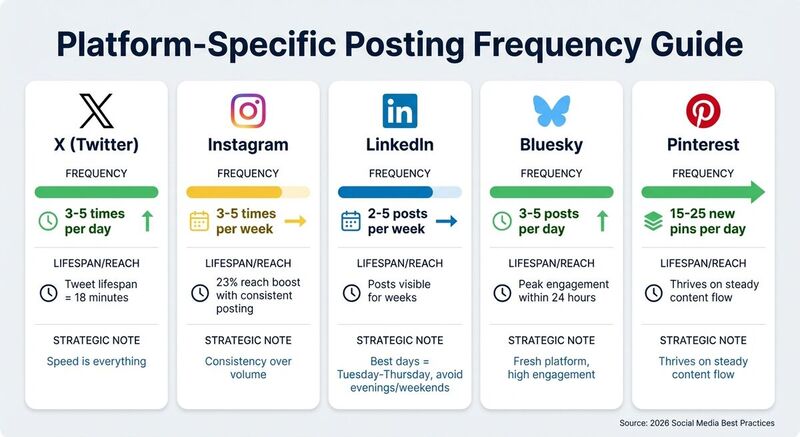
Take X (formerly Twitter), for example. Here, speed is everything. Tweets have an incredibly short lifespan - about 18 minutes - so staying visible means posting 3–5 times a day [3].
On Instagram, the game changes. Instead of focusing on volume, consistency is what counts. Posting 3–5 times per week on a regular schedule can boost your reach by up to 23% compared to inconsistent posting [3]. The algorithm rewards regularity and ensures your content appears when your audience is most active.
LinkedIn, on the other hand, values quality over quantity. Posts can remain visible for weeks [2], so aim for 2–5 posts per week, focusing on weekdays - especially Tuesday through Thursday. Avoid evenings and weekends, as professional engagement tends to dip during these times [3].
For Bluesky, engagement peaks within 24 hours [1], making 3–5 daily posts the sweet spot [1]. Meanwhile, Pinterest thrives on a steady flow of fresh content, with 15–25 new pins per day being ideal [2].
Managing multiple platforms can feel overwhelming, but tools like TheBlue.social simplify the process. They allow you to tailor posting schedules for platforms like X, Threads, Instagram, Pinterest, LinkedIn, Bluesky, and Mastodon - all from one dashboard.
2. Use Analytics to Find When Your Audience is Active
Timing matters just as much as how often you post. Even the best content can fall flat if your audience isn’t online to see it. To make your posting schedule more precise, you’ll need to dive into the data.
Start by reviewing your last 90 days of analytics. Focus on your top 20 posts, and note details like the day, time, format, and theme. This will help you identify when your audience is most engaged [3].
Why does timing matter so much? The speed of initial engagement - how quickly likes and comments roll in - can be a game-changer. If your audience interacts right after you post, it’s a clear sign you’ve hit a time slot when they’re actively scrolling [3].
Most platforms, such as Instagram and TikTok, provide built-in analytics showing when your followers are most active [5]. If you’re using Bluesky, tools like TheBlue.social's analytics can help you spot peak activity patterns.
It’s also important to avoid one-size-fits-all advice. For example, a B2B company targeting professionals might see the best results in the mornings on weekdays, while a lifestyle brand might perform better in the evenings or on weekends. Experiment with posting at different times on various days to discover when your audience is most likely to engage [3].
3. Track Engagement Data and Adjust Your Schedule
Once you’ve identified your peak posting times, the next step is to dive into how your audience interacts with your content. Pay close attention to metrics like likes, comments, shares, and reposts to understand what resonates and what might need tweaking.
To get a clear picture, focus on median engagement per post instead of averages, which can be skewed by outliers. A 2024 study revealed that accounts posting consistently - active in 20 out of 26 weeks - achieved a staggering 450% higher median engagement compared to less frequent posters [4]. Beyond that, keep an eye on how quickly your audience engages with your posts. This "engagement velocity" (how fast interactions occur) can help fine-tune your posting strategy [3]. For instance, if most of your likes and comments come within the first hour, you’re likely hitting the mark. On the flip side, if engagement tapers off, it might be time to experiment with new posting times or adjust your frequency.
Be mindful of overposting, though. Watch for signs of diminishing returns, such as a drop in engagement per post. This could indicate content fatigue among your followers [4]. Interestingly, accounts that post five times per week tend to see 2.3x more follower growth than those posting only twice weekly - as long as the content maintains its quality [3]. Using unified analytics tools can make it easier to track performance across platforms without juggling multiple apps.
"The pattern was crystal clear: The highly consistent posters saw more than 5 times the engagement per post compared to those who posted sporadically." – Kirsti Lang, Senior Content Writer, Buffer [4]
Stick with your updated schedule for at least eight weeks to allow algorithms and audience behaviors to adjust [5]. Set aside time each Friday to review your data, identify your top-performing content, and use those insights to plan your posts for the upcoming week.
4. Create Better Content Instead of More Content
After fine-tuning your posting schedule, the next step is to shift your attention to creating content that truly resonates. Three well-thought-out, high-quality posts a week will always outperform ten rushed, forgettable ones. Why? Because in 2026, algorithms prioritize content that keeps users engaged - not just content that exists for the sake of posting [5]. Pushing out low-effort content isn’t just unproductive - it actively signals to the algorithm that your account isn’t worth prioritizing.
Here’s a telling example: moving from 1–2 posts per week to 3–5 posts can increase your reach per post by about 12%. But ramping up to 10+ posts per week only nets a modest 24% gain in reach [2]. Doubling your output doesn’t mean doubling your results. The sweet spot lies where quality and consistency meet, not in exhausting yourself to post daily.
"Quality beats quantity on every platform in 2026. Algorithms have evolved to reward content that keeps people engaged - not content that simply exists." – Jamie Partridge, Founder & CEO, PostEverywhere [5]
To preserve your creative energy, try batching your workflow. For example, dedicate Monday to brainstorming ideas, Tuesday to creating visuals or videos, Wednesday to writing captions, and Thursday to scheduling posts [3]. This approach reduces the mental toll of constantly switching tasks, which can waste about 23 minutes every time you change focus [3]. Teams using this method report saving up to 8 hours per week [3], leaving more time for research, storytelling, and crafting content that delivers real value.
When it comes to content, focus on depth and relevance. Share well-reasoned opinions, personal experiences with broader lessons, or actionable tips that your audience can use [1]. On platforms like Bluesky, posts with meaningful visuals - like annotated screenshots, charts, or infographics - see roughly twice the engagement of text-only posts [1]. But here’s the catch: those visuals need to add real value. Generic stock photos won’t cut it. Modern algorithms reward saves, shares, and meaningful interactions over sheer volume, so always ask yourself: "Would I save this to reference later?"
5. Use Scheduling Tools to Post Consistently
Creating quality content is just one piece of the puzzle - posting it consistently is just as important for maximizing engagement. Did you know social media managers often spend 6–10 hours a week simply clicking "post"? That’s time that could be better spent on strategy or interacting with followers[3]. This is where cross-platform scheduling tools come in handy. Instead of juggling multiple apps every day, you can manage your entire content calendar from a single dashboard.
Take TheBlue.social, for example. It allows you to schedule posts across platforms like X (Twitter), Threads, Instagram, Pinterest, LinkedIn, Bluesky, and Mastodon - all in one place. This not only simplifies your workflow but also lets you batch schedule your content. Imagine setting aside a couple of hours - say, Thursday afternoon - to plan and schedule an entire week’s worth of posts. Teams that adopt this method report saving as much as 8 hours per week[3]. That’s 8 extra hours to focus on crafting better content and engaging directly with your audience.
Another key benefit? Scheduled posts go live during peak engagement times, even if you’re not online. For instance, if your Bluesky followers are most active between 7–10 PM Eastern and you’re based on the West Coast, the scheduler ensures your content hits their feeds at the perfect time. Consistency is also favored by social media algorithms, which means sticking to a predictable posting schedule can boost your reach and help grow your audience.
"The most consistent posters received a whopping 5x more engagement - likes, comments, and shares - per post than users who posted inconsistently." – Kirsti Lang, Senior Content Writer, Buffer[4]
Here’s a pro tip: maintain a two-week runway by scheduling content at least 14 days ahead. This creates a buffer for unexpected events or creative slumps[3]. No more scrambling to figure out, "What do I post today?" Instead, you’ll have the freedom to focus on the human side of social media - replying to comments, joining discussions, and building genuine connections with your audience. By incorporating these scheduling strategies, you’ll keep your content calendar running smoothly while staying focused on what matters most.
6. Test Different Content Types and Formats
Posting the same type of content over and over can quickly bore your audience. People crave variety, and mixing up your formats keeps things engaging while helping you figure out what truly clicks with your followers. For example, on Instagram, Reels reach the most people, engaging 30.81% of followers, while carousels are great for generating saves[5]. On LinkedIn, PDF carousels often drive strong engagement per impression[5], and on Bluesky, posts with images tend to get twice the engagement compared to text-only posts[1].
To keep things fresh, try experimenting with your content mix. But don’t just guess - test strategically. Use A/B testing tools like TheBlue.social's scheduler to compare different formats. For instance, post a carousel on Tuesday and a Reel on Thursday, then analyze the results. Another idea is the Pillar Rotation Method: assign specific formats to certain days, like educational threads on Mondays, behind-the-scenes videos on Wednesdays, and user stories on Fridays. This approach adds variety while making it easier to track what works best[3].
Dive into your analytics to see which formats perform well. If carousels consistently outperform single images, focus more on those. If short videos aren’t gaining traction but text threads are, adjust accordingly. Remember, different formats achieve different goals - guides and threads are great for gaining followers and saves, while visuals like images boost reach and reposts[1].
"The accounts that grow fastest on Bluesky are constantly experimenting. Try different formats, posting times, and content types. Track what works and double down on it." – Selina Lynn, Schedulala[1]
Here’s another tip: tailor content to each platform instead of reposting the same thing everywhere. For example, break a long video into short clips for TikTok, turn a successful thread into a PDF carousel for LinkedIn, or reimagine a blog post as an infographic for Instagram. This way, you make the most of your content while meeting platform-specific expectations[5]. By varying your formats, you’ll not only keep your audience engaged but also strike a better balance between content quality and posting frequency. These testing strategies help you refine your approach and make smarter content decisions.
7. Plan Content in Batches and Check Results Weekly
Creating content in batches can help you maintain a steady posting schedule while keeping your audience engaged across platforms. By producing multiple pieces of content at once, you save time and avoid the productivity loss that comes with frequent task switching - estimated to cost about 23 minutes every time you shift focus [3]. Teams that use scheduled posting tools report saving up to 8 hours per week [3]. This method provides a foundation for a structured weekly workflow.
Here’s a simple plan for batching content over the course of a week:
- Monday: Focus on planning and brainstorming. Review any content gaps and generate ideas for upcoming posts.
- Tuesday: Dedicate time to creating visuals. Shoot videos and design graphics in one go to keep the creative flow uninterrupted.
- Wednesday: Write captions while your visuals are still fresh in your mind. Drafting all at once ensures consistency in tone and messaging.
- Thursday: Schedule your content using tools like TheBlue.social. Double-check previews to ensure quality and alignment with your goals.
- Friday: Analyze performance and engage with your audience. Review the week’s data to see what worked and interact with your community [3].
Planning content at least two weeks ahead offers a safety net for maintaining consistency. Algorithms tend to favor accounts with predictable posting habits, rewarding them with up to 23% more reach compared to sporadic posters [3]. For those who stay consistent over 20 out of 26 weeks, engagement per post can skyrocket by 450% [5].
Batching also simplifies your ability to track and refine your strategy. Set aside 15–30 minutes each Friday to evaluate your top-performing posts. Dig into details like the posting day, time, format, and theme. Pay attention to engagement velocity - how quickly likes and comments come in after a post goes live - to fine-tune your posting schedule [3]. Use these insights to adjust your content rotation for the following week.
"The data you gather Friday makes next week's content better, which improves results, which gives you better data, and the cycle continues." – Selina Lynn, Schedulala [3]
However, avoid overreacting to short-term data. Stick to the 8-week rule: maintain the same posting frequency for at least eight weeks before drawing conclusions. Algorithms and audience behavior need time to adapt [5]. If you notice that increased posting frequency lowers engagement or hurts content quality, scale back to a sustainable pace. Remember, three well-crafted posts a week will always outperform seven rushed ones [5].
Conclusion
Finding the right balance between how often you post and how much engagement you get means shaping your strategy around each platform's unique audience and rhythm. Every social network has its own vibe, and understanding those differences is key to keeping your content relevant and engaging.
Focus on quality over quantity. A few well-thought-out posts will always outperform a flood of rushed ones. Use analytics to figure out when your audience is most active - those "golden hours" - instead of following one-size-fits-all advice. Save time by batching your content creation, and let scheduling tools handle the rest. This frees you up to interact authentically and build real connections with your audience. Consistency and quality together are what drive lasting engagement.
The numbers back this up: consistent posting leads to much higher engagement. For instance, accounts that post regularly see 5x more engagement per post compared to sporadic posters [2]. Similarly, posting five times a week can result in 2.3x more follower growth than posting just twice a week [3]. A simple habit like setting aside 15 minutes every Friday to review your performance and tweak your strategy can make a big difference. Use these insights to refine your approach and integrate them into your scheduling tools.
Platforms like TheBlue.social make it easier to stay consistent across various networks like X (Twitter), Threads, Instagram, Pinterest, LinkedIn, Bluesky, and Mastodon. With these tools, you can focus more on creating content that resonates with your audience. The goal isn't just to post more - it's to post smarter. Let your data guide your decisions, stay consistent, and watch your engagement grow.
FAQs
How can I tell if I’m posting too much?
If you're noticing a decline in likes, comments, or shares, it could be a sign you're posting too often. When your audience feels overwhelmed, engagement can drop due to fatigue. Another red flag is consistently low interaction rates, even with frequent updates, which might indicate you're oversaturating your followers.
To address this, keep a close eye on your analytics. Adjust your posting schedule to find a balance between quality and quantity. It's not just about how often you post but ensuring each update adds value. Tools like those from TheBlue.social can help you analyze trends and fine-tune your posting strategy to boost engagement.
Which engagement metrics matter most for scheduling?
When it comes to scheduling content, keeping an eye on engagement metrics like likes, reposts, comments, and shares is key. These metrics reveal how your audience interacts with your posts and help pinpoint when your followers are most active. By posting during these peak activity times, you can increase your content's visibility and reach.
Platforms like Bluesky Analytics offer real-time data to help you track audience behavior. With these insights, you can fine-tune your posting schedule and improve engagement effortlessly.
How can I batch-create content without losing quality?
Batch-creating content while maintaining quality requires a combination of smart planning and the right tools. Start by dedicating specific time blocks to produce a variety of content in bulk - whether it's posts, images, or videos. This approach helps you focus and create consistently high-quality material.
To streamline the process, use scheduling tools like TheBlue.social, which allows you to plan and post across multiple platforms. These tools also provide insights into engagement and help you determine the best times to publish. By scheduling your content in advance, you can ensure a steady stream of engaging posts while keeping your workload manageable.
Last updated: March 25, 2026