Gender Growth Patterns: Bluesky vs. Mastodon
Last updated: March 2, 2026
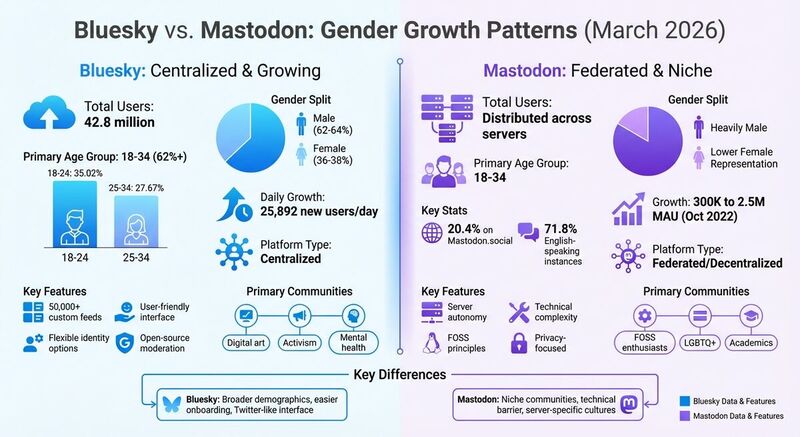
Bluesky and Mastodon are reshaping social media, but their user demographics differ significantly. As of March 2026, Bluesky has 42.8 million users, with a gender split of 62% male and 38% female. Mastodon, while also male-dominated, operates through decentralized servers, making its data harder to quantify. Both platforms attract younger, tech-savvy audiences (ages 18–34), but their growth patterns and design features influence gender diversity differently.
- Bluesky: Centralized platform with customizable feeds and a growing presence of women and non-binary users in niches like digital art and activism.
- Mastodon: Federated network with server-specific communities, often appealing to FOSS enthusiasts and niche groups like LGBTQ+ users.
Key Differences:
- Bluesky's user-friendly design and algorithmic customization attract broader demographics.
- Mastodon's technical complexity and server autonomy cater to niche, male-heavy audiences.
| Platform | Male % | Female % | Primary Age Group | Total Users (Mar 2026) |
|---|---|---|---|---|
| Bluesky | 62-64% | 36-38% | 18-34 (62%+) | ~42.8 million |
| Mastodon | Heavily Male | Lower Female Representation | 18-34 | Distributed across servers |
Understanding these trends can help you tailor strategies for each platform, whether you're engaging with Bluesky's diverse creators or Mastodon's niche technical communities.
Gender Growth Trends on Bluesky
Gender Distribution on Bluesky
Bluesky's audience skews male, with estimates showing 62–64% male and 36–38% female users as of early 2026. This gender split places Bluesky in a similar category as Reddit (63.6% male) and Discord (66.6% male), though the balance is slightly more even compared to these platforms, which also lean toward tech-savvy communities.
The disparity is most noticeable among younger users. The 18-24 age group accounts for 35.02% of users, with the 25-34 group contributing another 27.67%. Together, these two groups make up more than 62% of Bluesky's user base and lean heavily male. This reflects the platform's early identity as a technical experiment based on the AT Protocol.
That said, the gap is gradually closing. While early 2024 saw an even more male-dominated audience, Bluesky's shift from a developer-focused niche to a broader microblogging platform has drawn a more diverse crowd. Women and non-binary users are increasingly prominent in communities centered on digital art, mental health, and activism. Despite these gains, men still form the majority.
What Drives Gender Growth on Bluesky
Two key factors influence Bluesky's gender distribution: its technical origins and large migration waves from X (formerly Twitter). The platform's decentralized and open-source design initially appealed to a tech-savvy audience, which tends to have a male majority. Features like algorithmic customization - with over 50,000 custom feeds - and flexible moderation tools attract users who prefer control over their experience, rather than relying on corporate-driven algorithms.
Migration events have further shaped the demographic. Bluesky gained 1.2 million users when X altered its "block" feature in late 2024. Usage in the U.S. surged by 500% following the 2024 election, and the suspension of X in Brazil brought in 3 million users within a single week. These waves often bring in users already familiar with tech-forward platforms, reinforcing the male-dominated user base.
However, Bluesky's inclusive approach to identity is changing the dynamics. Unlike platforms that require binary gender choices, Bluesky allows users to define their identities freely. This has drawn a notable trans and non-binary community, though official statistics don't fully capture this trend. As Keith Kakadia, Founder of Sociallyin, pointed out: "The platform's distinctive decentralized architecture has attracted a demographically diverse audience, though SimilarWeb data indicates a clear skew toward younger users" [2].
Understanding these drivers offers valuable insights, and analytics tools help track their impact.
Using Bluesky Analytics to Track Gender Metrics
Bluesky doesn't release official gender data, so third-party tools are essential for monitoring demographic changes. Platforms like TheBlue.social offer creators analytics to track audience growth and engagement. Their free tier provides 7-day insights, while the Pro plan ($20/month) extends this to 30- and 90-day periods.
Additional data can be found through Bluesky Network Statistics, which tracks the platform's user base (approximately 42.8 million as of March 2, 2026) and daily growth of about 25,892 users. By correlating spikes in user growth with external events, these tools help identify demographic shifts.
Bluesky's open API also allows researchers to analyze profiles and detect trends in gender diversity. While not perfect, this approach provides a clearer picture than the platform’s limited public data. For those building communities, analyzing which custom feeds - like "Techsky" or "Booksky" - are gaining traction can help tailor content to the interests of specific demographic groups.
Next, we'll explore gender trends on Mastodon to provide a comparative look.
Gender Growth Trends on Mastodon
How Federation Affects Gender Data
Mastodon's decentralized nature makes gathering gender-related statistics a unique challenge compared to centralized platforms. Instead of having a single entity collecting demographic information, Mastodon’s data is distributed across thousands of independently run servers, each with its own rules and privacy protocols. Researchers Roel Roscam Abbing and Robert W. Gehl highlight this complexity:
"Mastodon is not one distinct site; it is operated by a plurality of actors that exists in a larger ecosystem... its structure and culture demands that researchers change their approaches" [6].
This decentralized setup leads to the creation of tightly-knit, gender-specific communities that don’t necessarily reflect the broader network. Many instances are designed specifically for marginalized groups, including queer, trans, and non-binary users. For instance, Colorid.es, a Portuguese-language server for LGBTQIAPN+ users, saw its user base grow from 895 to 2,230 between October 2022 and October 2023 [5]. Privacy concerns are also a key factor - users generally expect their data to stay within their instance rather than be analyzed externally [6]. This fragmentation results in growth patterns that vary significantly between servers.
Growth Patterns Across Mastodon Servers
Mastodon’s growth often happens in waves, driven by specific communities. After Elon Musk’s acquisition of Twitter in October 2022, the number of Mastodon’s monthly active users skyrocketed from 300,000 to 2.5 million [5]. However, this growth wasn’t evenly distributed - it was shaped by the interests of distinct subcultures. As Eugen Rochko, Mastodon's founder, observed:
"Queer people joined, and Furries. It comes in waves" [4].
Despite its prominence, Mastodon.social accounts for only 20.4% of the platform’s total users as of February 2024 [5]. Other instances, such as Mastodon.world and Ursal.zone, showcase how growth varies across servers. For example, Mastodon.world expanded from 121 to 178,791 users, while Ursal.zone grew from 921 to 2,796 users during the same timeframe [5]. Additionally, about 71.8% of Mastodon users are part of English-speaking instances [5].
Tools for Tracking Mastodon Growth
Given Mastodon’s federated structure, tracking growth requires monitoring individual instances rather than analyzing a centralized network. Tools like TheBlue.social offer free status checkers for prominent instances such as Mastodon.social, Mastodon.art, Hachyderm.io, Scholar.social, and Fosstodon.org. These tools help track the stability and growth of individual communities.
For demographic insights, collaboration with instance administrators is more effective than relying on API scraping, which often misses important context and can lead to inaccurate conclusions [6]. Third-party analytics firms like SimilarWeb provide high-level data on gender distribution, though Mastodon’s user base is known to skew male, with a strong focus on technical users aged 18–34 [1][3]. These tools and partnerships make it easier to compare gender trends across platforms and understand Mastodon’s unique dynamics.
Bluesky vs. Mastodon: Gender Pattern Comparison
Gender Distribution Data Comparison
Both Bluesky and Mastodon show a male-dominated user base, but their trends reveal some differences. As of early 2026, Bluesky's user demographics are approximately 62% male and 38% female, with the platform showing steady growth. By March 2, 2026, Bluesky had amassed 42,841,499 users, adding an average of 25,892 new users daily. Interestingly, the gender balance on Bluesky is slowly shifting, as more women and gender-diverse individuals - particularly digital artists, writers, and mental health advocates - join the platform.
Mastodon's demographic data is trickier to quantify due to its federated structure. Unlike Bluesky, which centralizes its metrics through bsky.app, Mastodon's user data is fragmented across thousands of independent servers. However, it is clear that Mastodon remains heavily male-dominated, with a significant portion of its community drawn from "decentralization purists" and the Free and Open Source Software (FOSS) movement.
| Platform | Male % | Female % | Primary Age Group | Total Users (Mar 2026) |
|---|---|---|---|---|
| Bluesky | 62-64% | 36-38% | 18-34 (62%+) | ~42.8 million |
| Mastodon | Heavily Male | Lower Female Representation | 18-34 | Distributed across servers |
These numbers highlight how platform design and structure impact user demographics. Next, let’s explore how the features and user interfaces of these platforms contribute to these trends.
Platform Features That Shape Gender Growth
The design and functionality of Bluesky and Mastodon play a key role in shaping their user bases. Bluesky, for instance, prioritizes inclusivity by offering flexible identity options. According to Osamu Ekhator from Techpoint Africa:
"Unlike X or Threads, Bluesky lets users define their identities on their terms. There's no forced dropdown, no binary lock-in."
This flexibility has made Bluesky particularly appealing to trans, non-binary, and queer users who value open and customizable identity options.
On the other hand, Mastodon's higher technical complexity tends to attract a more tech-savvy audience. Understanding concepts like "instances" and "federation" is necessary to navigate the platform effectively. Ekhator humorously describes this as requiring:
"a PhD in federation to get around here."
This steep learning curve naturally draws a predominantly male audience, often those with an interest in FOSS principles and server autonomy. In contrast, Bluesky’s interface, which mimics Twitter, and its user-friendly features - like over 50,000 custom feeds - make it more accessible to a broader audience, including those without technical expertise.
Bluesky also stands out with its "open-source moderation" system. This feature allows users to create and subscribe to third-party moderation tools, empowering communities to establish safer spaces independently of centralized policies. This system, combined with algorithmic customization through custom feeds, has fostered growth among marginalized gender groups. Tools like Bluesky Analytics further support these efforts by providing insights into community engagement and demographic trends, helping creators understand and connect with their audiences on both platforms.
How to Use Gender Growth Data for Your Strategy
Reaching Male Audiences on Bluesky
Bluesky already has a predominantly male user base, so your approach needs to align with what resonates most with this audience. As Osamu Ekhator from Techpoint Africa explains:
"Bluesky isn't algorithm-heavy. That's great for authenticity, but it also means your content won't be artificially boosted to the wrong crowd. Relevance matters more than ever."
Focus on topics like tech, media, and design, which appeal to the male demographic (ages 18–34) on the platform. Avoid overly corporate or aggressive messaging - Bluesky users value authenticity and privacy. Instead, aim to spark genuine conversations while using inclusive language to connect with the growing number of women and non-binary users in niches like digital art and mental health.
Take advantage of custom feeds like "Techsky" to directly engage your target audience. Tools like Bluesky Analytics can help you identify which posts resonate most with male users, allowing you to fine-tune your content strategy. With Bluesky gaining approximately 25,892 new users daily, timing your posts during peak growth periods can significantly increase your reach.
From here, you can shift focus to Mastodon’s distinct, server-based communities.
Engaging Niche Communities on Mastodon
Mastodon's decentralized structure creates unique opportunities to target specific audiences. While the platform leans male overall - especially among FOSS (Free and Open Source Software) enthusiasts - its server-based setup means gender demographics vary widely. For instance, Fosstodon.org attracts tech-savvy users, whereas Scholar.social caters to academics, each with its own audience makeup.
Your strategy on Mastodon should be server-specific rather than one-size-fits-all. Identify the instances where your target audience is most active and tailor your content accordingly. Tools like TheBlue.social's server status checkers can help you monitor activity on key servers like Mastodon.social, TechHub.social, and Hachyderm.io, ensuring your posts go live when these communities are most engaged.
On Mastodon, technical content tends to perform best. Users here value depth and expertise, so detailed posts about decentralization, privacy, or open-source projects will likely outperform more superficial updates. The audience appreciates complexity, so don’t shy away from diving into technical details.
With tailored strategies for each platform, the next step is integrating your efforts for streamlined content management.
Managing Content Across Both Platforms
Using gender insights to guide your strategy, it’s crucial to maintain separate, tailored approaches for Bluesky and Mastodon. Simply cross-posting the same content won’t cut it - each platform has distinct user expectations and cultures. Tools like TheBlue.social's cross-posting scheduler can help you manage both platforms efficiently while customizing messages for each audience.
Real-time tracking is essential for timing your posts effectively. Use Bluesky Network Statistics to monitor growth trends - currently 0.30 users per second - and schedule important announcements during peak activity. For Mastodon, focus on specific instances to determine when your target communities are most active. This data-driven approach ensures your content reaches the right audience at the right time without the hassle of managing multiple platforms manually.
The goal is to stay consistent without being repetitive. Both platforms value authenticity, so adapt your core message to fit each platform’s unique culture rather than duplicating content. With the right tools and strategies, you can effectively connect with male-majority audiences while engaging the diverse voices joining these decentralized networks.
Microblogging: which tools are right for my business?
Conclusion
Gender trends on Bluesky and Mastodon highlight two unique trajectories within decentralized social media. Bluesky, with a user base that's about 62% male, is gradually diversifying as women and non-binary creators carve out spaces in areas like digital art and mental health advocacy. Mastodon, on the other hand, operates on a federation model, where diverse server-based communities demand tailored engagement strategies.
Success on these platforms hinges on understanding their distinct dynamics. Bluesky thrives on quick, authentic interactions, with about 25,892 new users joining daily, making genuine conversations and personalized feeds especially effective. Mastodon, however, leans toward detailed discussions within its server-based communities. As Osamu Ekhator from Techpoint Africa aptly puts it:
"Demographic data fuels smarter decisions. It shapes how products get designed, how content gets positioned, and how communities either flourish or quietly fade."
To navigate these platforms effectively, tools like the Bluesky Network Statistics for tracking real-time growth and server status checkers for identifying active Mastodon communities are invaluable. Additionally, TheBlue.social's cross-posting scheduler can help tailor content to suit each platform's unique audience.
Beyond just gender breakdowns, understanding these networks requires attention to age trends and platform-specific expectations. Mastodon's technical and FOSS-oriented culture contrasts sharply with Bluesky's evolving, diverse user base. By leveraging platform-specific data to refine your content strategy, you can foster meaningful connections rather than simply broadcasting messages to an indifferent audience.
FAQs
How accurate is Bluesky’s gender data?
Bluesky's gender data offers a reasonable approximation but should be viewed as an estimate. While Mastodon reports about 66.38% male users, Bluesky's gender breakdown is less specific. This is partly due to its decentralized structure and the reliance on data from APIs or surveys. These methods can lead to regional variations and limit precision. As a result, the figures provide a general sense of Bluesky's user demographics but may not capture the full picture.
Why is Mastodon gender data so hard to measure?
Mastodon’s gender data is tricky to pin down due to its decentralized nature. The platform operates across numerous independent servers, each with its own rules for collecting and managing data. This setup creates inconsistencies and leaves gaps in the available information. On top of that, only a fraction of users share their gender details, making it tough to gather reliable insights into gender-specific audience trends.
How should my posting strategy differ on Bluesky vs. Mastodon?
Your posting strategy needs to match the vibe and audience of each platform. On Bluesky, where the crowd is younger and more tech-savvy, lean into content that's genuine, community-oriented, and taps into current trends. Meanwhile, on Mastodon, known for its niche communities and a predominantly male user base, focus on creating targeted, personalized posts that resonate with specific groups and encourage meaningful engagement. The key is aligning your approach with the unique culture and preferences of each platform.