10 Hashtag Tips for Multi-Platform Posts
Last updated: April 11, 2026
Hashtags are essential for boosting visibility on social media, but every platform treats them differently. Using the same approach everywhere can hurt engagement. Here's a quick breakdown of the key points to help you optimize your hashtag strategy:
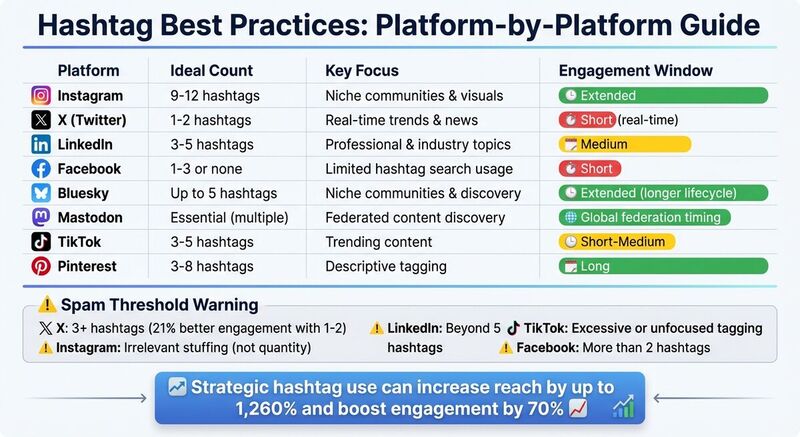
- Platform-Specific Counts: Instagram works well with 9–12 hashtags, X (formerly Twitter) performs best with 1–2, LinkedIn prefers 3–5, while Facebook often benefits from 1–3 or none.
- Mix Broad, Niche, and Branded Hashtags: Combine general tags (#Marketing), niche tags (#B2BContentStrategy), and branded tags to reach diverse audiences.
- Natural Integration: Place hashtags seamlessly in your text for a professional look.
- Research Before Posting: Check hashtags for unintended meanings or irrelevant associations.
- Tailor for Each Platform: Avoid copy-pasting hashtags across platforms; adjust for culture and algorithm differences.
- Monitor Performance: Use analytics tools to track engagement and refine your strategy.
- Moderation is Key: Overusing hashtags can make posts look spammy and reduce reach.
Quick Comparison Table
| Platform | Ideal Hashtag Count | Key Focus |
|---|---|---|
| 9–12 | Niche communities and visuals | |
| X (Twitter) | 1–2 | Real-time trends |
| 3–5 | Professional and industry topics | |
| 1–3 or none | Limited hashtag search usage | |
| Bluesky | Up to 5 | Niche communities and discovery |
| Mastodon | Essential | Federated content discovery |
To simplify your hashtag management, tools like TheBlue.social can help customize, schedule, and analyze hashtags for each platform. Focus on relevance, moderation, and platform-specific strategies to maximize engagement.
1. Match Hashtag Counts to Each Platform's Standards
Platform-Specific Best Practices
Every social media platform has its own sweet spot when it comes to hashtag usage, and ignoring these guidelines can hurt your reach. Take X (formerly Twitter), for example. Posts with just 2–3 hashtags tend to perform better - adding more can actually lower engagement [2]. With only 280 characters to work with, you need to be strategic about where you place your hashtags, whether it's at the beginning or the end of your post.
On Bluesky, using up to 5 hashtags can help you connect with niche communities and improve visibility [2]. Mastodon, on the other hand, relies heavily on hashtags for content discovery, making them essential for extending your reach [2].
Engagement and Visibility Impact
The number of hashtags you use doesn’t just affect how your post looks - it directly influences your content's performance. Overloading your X posts with hashtags can hurt their chances of going viral, while using too few on Mastodon might mean your content gets overlooked [2]. On Bluesky, using the right amount of hashtags ensures your posts remain visible to the communities you’re targeting, helping to maintain discoverability over time.
Cross-Platform Usability and Optimization
Customizing your hashtag strategy for each platform is just as important as knowing the rules. When cross-posting between platforms, avoid using the same set of hashtags everywhere. What works on one platform might backfire on another due to differing hashtag norms [2]. Tools like TheBlue.social's Social Network Character Limits tool can help you ensure your hashtags fit within each platform's limits [1]. Plus, their real-time analytics let you monitor how various hashtag counts affect engagement over 7-, 30-, or 90-day periods, giving you valuable insights into what works best [1].
2. Mix Broad, Niche, and Branded Hashtags
Hashtag Relevance and Context
Combining broad, niche, and branded hashtags is a smart way to connect with different audience segments. Broad hashtags like #SocialMedia or #Marketing can reach massive audiences, but they come with heavy competition. On the other hand, niche hashtags such as #B2BContentStrategy or #SocialMediaManagers focus on smaller, more engaged groups, where your content is more likely to make an impact. Then there are branded hashtags, like your company name or campaign-specific tags, which help establish your identity and make it easier for followers to find all your related content.
Platforms like Bluesky and Mastodon rely heavily on hashtags for content discovery. On these decentralized networks, niche hashtags are especially important. They help your posts reach the right communities by using clear, category-based tags, ensuring your content resonates with the intended audience [2]. By blending these types of hashtags, you can achieve both broad reach and targeted engagement.
Engagement and Visibility Impact
Each type of hashtag serves a purpose: broad tags expand your reach, niche tags connect you with specific audiences, and branded tags reinforce your identity. However, balance is crucial. For example, while a hashtag strategy might succeed on Instagram, using too many on X can come off as spammy.
Tools like TheBlue.social's Generate Hashtag tool can help you identify the best hashtags for different platforms [1]. Their real-time analytics feature also allows you to track which combinations perform well, offering insights over 7, 30, or 90-day periods. This data helps you fine-tune your hashtag strategy to focus on what drives the most engagement [1].
Cross-Platform Usability and Optimization
When sharing content across platforms, it’s essential to adapt your hashtag mix to fit the unique culture and discovery features of each. For example, X thrives on trending topics and real-time conversations, so broad, timely hashtags work best there [2]. Bluesky, with its community-driven approach, benefits from niche tags that connect users to specific interest groups [1][2]. Meanwhile, Mastodon depends on hashtags for federated discovery, making them an absolute must [2]. Customizing your hashtag strategy for each platform not only boosts visibility but also strengthens your overall presence across multiple networks.
How to Create a Social Media Strategy for Multiple Platforms
3. Integrate Hashtags Naturally Into Your Text
Once you've nailed the right hashtag counts and combinations, the next step is weaving them seamlessly into your content. Thoughtful integration can make your posts more engaging and professional across platforms.
Platform-Specific Best Practices
Each platform has its own hashtag etiquette, and following these can make a big difference in how your posts are received. On X (Twitter), stick to 2–3 hashtags for a polished and uncluttered appearance [2]. Bluesky allows for up to 5 hashtags, helping you connect with smaller, niche communities [2]. Over on Mastodon, hashtags are critical for content discovery across its federated network, so using clear and descriptive tags is especially important [2].
Hashtag Relevance and Context
It's not just about how many hashtags you use but also about how relevant they are to your content. Hashtags should feel like a natural part of your message. On platforms like Bluesky and Mastodon, descriptive hashtags that provide context work far better than generic or trendy ones [2]. This ensures your content feels authentic and avoids coming across as spammy. If you're unsure which tags to use, tools like TheBlue.social's Generate Hashtag tool can help you find tags that align perfectly with your content [1].
Cross-Platform Usability and Optimization
When posting across multiple platforms, tailor your hashtag strategy to fit each one’s unique style. For instance, on X, place hashtags at the beginning or end of your post to keep the flow of your message intact [2]. Adjusting your approach for each platform ensures your hashtags enhance your content rather than detract from it, helping you create posts that resonate with your audience everywhere.
4. Research Hashtags Before Using Them
Doing your homework on hashtags before posting can help you connect directly with your audience. Taking the time to research ensures you’re using the right tools and insights to boost engagement on each platform.
Hashtag Relevance and Context
The key to effective hashtags is making sure they fit your content and audience. For example, Bluesky offers Starter Packs that include curated hashtags for specific communities, helping you avoid overly generic options[1]. You can also try their built-in hashtag generator for tailored suggestions[1].
Engagement and Visibility Impact
On platforms like X, trending hashtags can give your content a quick boost in visibility. Meanwhile, on Bluesky and Mastodon, it’s better to focus on descriptive tags that foster deeper connections and long-term community engagement[2].
Cross-Platform Usability and Optimization
Analytics tools can show you which hashtags are delivering results. Tools like Bluesky Analytics let you track performance over time - whether it’s 7, 30, or even 90 days - so you can see which tags consistently resonate with your audience[1]. Before finalizing your hashtags, preview them to ensure they display as intended. Once your research is complete, tailor your hashtag strategy for each platform to get the most out of your posts.
5. Keep Hashtag Use Moderate to Avoid Looking Like Spam
Hashtags are great for boosting visibility, but overusing them can make your posts appear spammy. Striking the right balance is key.
Platform-Specific Best Practices
Different platforms have different rules when it comes to hashtags. For example, on X (formerly Twitter), posts with 1–2 hashtags perform 21% better in engagement compared to those with 3 or more. In fact, using 5 or more hashtags can significantly hurt your reach [3]. On Instagram, while the platform allows up to 30 hashtags, it’s better to focus on relevance rather than hitting the maximum limit [4]. For LinkedIn and TikTok, aim for 3–5 well-chosen hashtags to keep your content professional and targeted [4]. The goal isn’t just to follow platform limits but to avoid coming across as spammy.
Engagement and Visibility Impact
Using too many or irrelevant hashtags can hurt your visibility and engagement. In some cases, it might even lead to shadowbans, where your content is hidden from searches [3][4]. On the flip side, strategic hashtag use can make a massive difference, increasing reach by up to 1,260% and boosting engagement by 70% compared to posts without hashtags [4].
Cross-Platform Usability and Optimization
When posting across multiple platforms, tweak your hashtag strategy for each one instead of using the same set everywhere. On X, stick to 1–2 hashtags and try to weave them naturally into your text for better readability [3]. On Instagram, placing hashtags in the first comment can help keep captions clean while still benefiting from discoverability [4]. Regularly rotating your hashtag sets also prevents you from falling into repetitive patterns that algorithms might penalize [4].
| Platform | Recommended Count | "Too Many" Threshold |
|---|---|---|
| X (Twitter) | 1–2 hashtags [3][4] | 3+ hashtags [3] |
| 20–30 hashtags [4] | Irrelevant stuffing [4] | |
| 3–5 hashtags [4] | Beyond professional relevance [4] | |
| TikTok | 3–5 hashtags [4] | Excessive or unfocused tagging [4] |
| 1–2 hashtags [4] | Overuse [4] | |
| 3–8 hashtags [4] | Beyond descriptive tagging [4] |
Jumping into trending conversations can work wonders, but only if your hashtags genuinely align with the topic. Irrelevant tags can trigger spam filters [3]. By keeping your hashtags relevant and adjusting your strategy to each platform, you can maximize engagement without crossing the line into spammy territory.
6. Build and Share Your Own Branded Hashtags
Creating a branded hashtag can help you connect with your audience and keep track of conversations about your brand. A well-thought-out hashtag becomes a central point for your community and makes it easier to measure campaign performance across various platforms.
Platform-Specific Best Practices
On X, stick to 2–3 hashtags per post, including your branded one. This keeps your posts clean and focused. Platforms like Bluesky allow up to 5 hashtags per post, giving you more flexibility [2]. For decentralized platforms like Mastodon and Bluesky, ensure your branded hashtag is both clear and descriptive to make it easier for niche audiences to find you. On X, placing your branded hashtag at the start or end of your posts can improve readability and engagement [2].
Hashtag Relevance and Context
Before rolling out your branded hashtag, do some homework. Research platform-specific trends and double-check that your hashtag doesn’t carry any unintended meanings. For example, check its usage across different Mastodon instances or within Bluesky’s starter packs to avoid conflicts. Instead of chasing broad trends, focus on niche topics - this can give your hashtag staying power. Pairing your branded hashtag with both broad and niche tags strikes a balance between reaching a wider audience and staying relevant to your community [2]. A well-researched, context-aware hashtag can make your brand recognizable across platforms.
Cross-Platform Usability and Optimization
Tools like TheBlue.social can help you align your branded hashtag strategy across platforms like Instagram, Threads, and Bluesky through centralized scheduling. Before launching your campaign, use multi-platform username checkers to ensure your brand handle is consistent across major networks. This reinforces your brand identity. You can also use hashtag generators to find complementary tags that enhance the visibility of your branded hashtag.
Engagement and Visibility Impact
Once your branded hashtag is live, track its performance using real-time analytics and unified dashboards. These tools can highlight differences, such as its viral potential on X versus community-driven interactions on Mastodon [2]. Reviewing weekly growth reports can show how your hashtag usage is impacting follower growth. For deeper insights, TheBlue.social provides 30- and 90-day analytics to pinpoint which hashtags drive the most engagement. With over 1,164 active creators on the platform and an average of 82.7 posts per user [1], leveraging scheduling tools can help you maintain steady brand visibility over time.
7. Verify Hashtags Don't Have Unintended Meanings
When crafting a hashtag strategy, it's essential to ensure your hashtags communicate the right message and avoid unintended interpretations.
Hashtag Relevance and Context
Before publishing, search each hashtag on every platform you plan to use. A harmless-looking tag might carry unexpected connotations or be linked to niche subcultures. To avoid missteps, consult resources like TheBlue.social's Social Media Terms glossary to check for slang or platform-specific meanings that could shift your hashtag's tone or intent[1]. Keep in mind that what resonates on LinkedIn might come across as off-key on platforms like X or TikTok.
Platform-Specific Best Practices
Each social platform has its own unique culture and norms. For instance, on decentralized platforms such as Mastodon and Bluesky, hashtags are critical for discovery, so choosing the wrong one could attract an unintended audience. On Instagram, where visuals dominate, hashtags may be interpreted differently than they would on LinkedIn's professional network. To avoid misalignment, test your hashtags by typing them into the search bar of each platform. If the content that appears doesn't reflect your brand's message, it's time to rethink your choice. Also, consider how the hashtag looks when presented visually.
Cross-Platform Usability and Presentation
TheBlue.social's Open Graph Preview tool can be a lifesaver, allowing you to preview how your hashtags and posts will appear across platforms like Facebook, Threads, X, LinkedIn, and Discord before publishing[1]. This step can help you catch awkward phrasing or formatting issues that might lead to misinterpretation.
Engagement and Visibility Impact
A sudden drop in engagement or visibility after introducing a new hashtag could signal trouble. It might be shadowbanned or linked to restricted content. Use tools like TheBlue.social's real-time analytics to monitor these changes[1]. If you notice a significant dip in reach, investigate whether the hashtag has been flagged by the platform's algorithms. Proper hashtag research can dramatically boost your content's reach - by as much as 1,260%[4] - while a poorly chosen tag can have the opposite effect. Taking these precautions ensures your hashtags enhance your content and align with your brand's message across all platforms.
8. Adjust Hashtags for Each Platform When Cross-Posting
Using the same hashtags across all platforms might seem convenient, but it often leads to missed opportunities. Each social network has its own culture, algorithms, and audience behavior, which means your hashtag strategy needs to be tailored for each platform. By making these adjustments, you can ensure your posts perform well no matter where they’re published.
Platform-Specific Hashtag Strategies
To get the best results, you’ll need to adapt your hashtags to fit the norms of each platform. For example:
- X (formerly Twitter): Focus on real-time trends and breaking news. Stick to 2–3 hashtags and place them at the beginning or end of your post for better readability.
- Bluesky: Use up to 5 hashtags that target specific niche communities. Hashtags on Bluesky tend to have a longer lifespan, making them ideal for reaching smaller, engaged audiences. Tools like TheBlue.social, which has indexed over 90,777+ Starter Packs[1], can help you find the best tags for your audience.
- Mastodon: Hashtags are essential for content discovery because of Mastodon’s federated setup[2]. Use clear, category-based tags that align with the platform’s structure. Unlike X, Mastodon hashtags benefit from longer engagement periods and global reach.
How to Optimize Hashtags Across Platforms
When scheduling posts for multiple platforms, don’t just copy and paste your hashtags. Instead, adjust for each network’s character limits, audience preferences, and formatting rules. For instance, TheBlue.social’s scheduling tools allow you to customize hashtag placement for each platform[1], ensuring your posts are optimized for visibility and engagement.
| Platform | Primary Focus | Engagement Window |
|---|---|---|
| X (Twitter) | Real-time trends/News | Short (real-time) |
| Bluesky | Niche communities/Descriptive | Extended (longer life cycle) |
| Mastodon | Instance-specific/Federation | Global federation timing |
Measure and Refine Your Strategy
Tracking hashtag performance is key to improving your strategy. For example, a hashtag that trends on X might not gain traction on Bluesky. Use analytics tools like TheBlue.social’s 30-day and 90-day reports[1] to monitor metrics such as "viral potential" on X or "post longevity" on Bluesky. This data-driven approach helps you refine your strategy over time, ensuring your hashtags consistently deliver results across platforms.
9. Monitor How Your Hashtags Perform on Different Platforms
Keeping an eye on how your hashtags perform across platforms is key to fine-tuning your strategy. Each platform has its own way of measuring success, so understanding these differences can help you improve engagement and reach. Here's a closer look at how to evaluate hashtag performance on various platforms.
Platform-Specific Best Practices
X (Twitter) is all about speed. The platform thrives on real-time interactions, so tracking early engagement is critical. If a hashtag doesn't gain momentum quickly, it likely won't trend. Focus on metrics like how fast your tags pick up engagement and their overall reach to see whether they're resonating with ongoing conversations.
Bluesky takes a different approach. It values sustained engagement over instant virality. Posts can remain active for days, making it important to track how long your content stays relevant in feeds and how well it connects with niche communities. Tools like Bluesky Analytics from TheBlue.social help with this, offering insights for over 1,164 active creators looking to optimize their hashtag usage.
Mastodon operates across decentralized instances, so its metrics are unique. Here, you’ll want to measure how many instances your post reaches and how widely it spreads across the federated network. Since hashtags play a major role in discovery, tracking discovery rates can show which tags are effectively connecting with various communities.
Engagement and Visibility Impact
Each platform emphasizes different aspects of engagement. On X, metrics like viral growth and trend duration reveal whether your hashtag is catching on. Bluesky focuses on community interactions and how relevant your hashtags are to specific topics. Mastodon highlights federation reach, showing how far your content spreads across its decentralized ecosystem.
For deeper insights, TheBlue.social offers free 7-day analytics and Pro plans at $20/month, which provide extended tracking. These tools help you distinguish between temporary spikes and sustained performance. Weekly growth reports sent via email make it easier to identify trends and adjust your strategy as needed.
Cross-Platform Usability and Optimization
Using a unified dashboard can simplify the process by displaying metrics for all your platforms in one place. This allows you to directly compare hashtag performance across X, Bluesky, and Mastodon with real-time analytics.
For example, if a hashtag performs well on Instagram but falls flat on X, you can tweak your strategy to better suit the platform. By tracking short-term results, you can capitalize on trending opportunities, while long-term data helps you develop consistent hashtag strategies that deliver steady results over time.
10. Use TheBlue.social to Simplify Hashtag Management
Managing hashtags across platforms like X, Threads, Instagram, Pinterest, LinkedIn, Bluesky, and Mastodon can feel like a juggling act. Each platform has its own rules and audience preferences, making manual adjustments time-consuming and prone to mistakes. That’s where TheBlue.social steps in, streamlining your workflow and reducing errors through automation.
Cross-Platform Usability and Optimization
With TheBlue.social's cross-posting scheduler, you can create a single post and tailor hashtags for each platform. For example, you might schedule a post with 30 hashtags for Instagram, 2–3 for X, and custom hashtags for Bluesky - all in one go. This eliminates the hassle of posting manually while ensuring your hashtag strategy is optimized for each platform’s unique algorithms and audience behavior.
Currently, over 1,164 active creators use TheBlue.social, averaging 82.7 posts [1]. The platform also offers tools like the free hashtag generator to quickly create relevant tags based on your content type, saving you from hours of manual research. Additionally, the Open Graph Preview Tool lets you preview how your posts will appear across platforms like Facebook, Threads, X, LinkedIn, and Discord, ensuring your link previews are clean and professional before publishing.
Engagement and Visibility Impact
TheBlue.social goes beyond scheduling by offering actionable insights to improve your hashtag performance. Real-time analytics and weekly growth reports help you see which hashtags are driving the most engagement. For instance, you can track whether branded hashtags perform better on Instagram or if niche hashtags resonate more on Bluesky. This data-driven approach makes it easier to refine your strategy.
The free plan provides 7-day analytics, while the Pro plan ($20/month) unlocks 30- and 90-day analytics for a deeper dive into long-term trends.
"You can enter this link and follow/unfollow people with a single click. It's an extremely comfortable app. It has statistics, auto-posting features, etc. ✌🏼" - OZOzy
Conclusion
Creating a customized hashtag strategy is crucial for increasing visibility on social platforms, but success lies in tailoring your approach to each network's audience and algorithm. For example, the impact of using 30 hashtags on Instagram differs significantly from using just 2–3 on X. Striking the right balance between broad, niche, and branded hashtags can help you maximize reach while staying relevant. And don’t forget to research your hashtags carefully to avoid any unintended meanings or spam-like impressions.
The bigger challenge? Consistently applying these strategies across multiple platforms without losing hours to manual adjustments. That’s where tools like TheBlue.social come in handy. Their free hashtag generator and cross-posting scheduler simplify the process by suggesting platform-specific hashtags and counts, all in one seamless workflow.
Tracking performance is key to refining your strategy. Use analytics to figure out which hashtags are driving engagement on platforms like Instagram or Bluesky. TheBlue.social offers free 7-day analytics, with Pro plans ($20/month) providing 30- and 90-day reports. These insights, delivered via email as weekly growth updates, make it easy to spot trends without juggling spreadsheets or jumping between platforms.
Once you’ve got the tools in place, it’s time to act. Start small: choose one tip - like integrating hashtags into your captions or launching a branded hashtag - and test it on two platforms. Measure the results and adjust as needed. Consistency and iteration are what truly drive progress. With over 1,164 creators already using TheBlue.social to streamline their hashtag game, simplifying this once-tedious task is easier than ever.
Don’t let your hashtags stagnate. Start today, track your progress, and adapt as your audience evolves.
FAQs
How do I pick the best niche hashtags for my audience?
To find the right niche hashtags, start by understanding your audience and what you want to achieve. A good mix of broad, mid-range, and niche hashtags ensures you strike a balance between reaching a wider audience and targeting a specific group.
Make sure the hashtags you pick match your content and connect with your community. Tools like TheBlue.social can make this process easier by helping you generate relevant hashtags, track trends, and analyze their performance.
Don’t forget to regularly review and tweak your hashtags to keep them effective and aligned with your audience’s interests.
Should I put hashtags in my caption or the first comment?
Including hashtags directly in your caption is a smarter move than placing them in the first comment. Why? Because this way, they’re indexed right away, which can help boost your post’s visibility and increase engagement.
How long should I test hashtags before changing my set?
Testing hashtags over a period of 2 to 4 weeks is a smart way to gather sufficient data about their performance. This timeframe helps you spot engagement patterns and make adjustments based on real insights.