Posting Too Often vs. Too Little: Engagement Impact
Last updated: April 20, 2026
Posting too much or too little on social media can hurt your engagement. Here's the breakdown:
- Posting too often: Overwhelms your audience, reduces engagement per post, and risks audience burnout. Algorithms may restrict your reach if posts underperform.
- Posting too little: Leads to lower visibility, slower follower growth, and weaker brand recognition. Algorithms deprioritize inactive accounts.
Key Stats:
- Consistent posting (e.g., 3–5 Instagram posts/week) can double follower growth and boost reach by 12%.
- Overposting on LinkedIn (11+ posts/week) can reduce visibility due to content competing with itself.
- Sporadic posters see 450% lower engagement compared to consistent ones.
What works? Post consistently at a frequency that balances quality and quantity. Use platform-specific guidelines:
- Instagram: 3–5 posts/week
- LinkedIn: 2–5 posts/week
- Twitter (X): 21–35 posts/week (3–5 daily)
- TikTok: 7 posts/week (1 daily)
Tip: Use analytics to find your "sweet spot" and scheduling tools to stay consistent without sacrificing content quality.
How Often to Post on LinkedIn in 2026 (Data From 2 Million+ Posts)
The Problems with Posting Too Often
Posting more frequently doesn’t necessarily translate to better engagement. In fact, overposting can create several problems that harm your engagement rates and even tarnish your brand’s reputation.
Lower Engagement on Each Post
Here’s the catch: Posting several times a day might increase your overall reach, but it often waters down the engagement on individual posts. Each post competes for the same limited attention span of your audience. For instance, on LinkedIn, posting 11 or more times per week can result in nearly 17,000 additional impressions per post compared to posting just once a week[2].
However, when posts underperform, platforms may interpret this as a signal to restrict your organic reach. This creates a downward spiral, making it increasingly difficult to gain visibility[6]. Instagram data highlights this issue: while increasing posts from 1–2 per week to 3–5 adds a 12% boost in reach per post, pushing further to 6–9 posts only provides a modest 6% gain[1].
"Quality beats quantity on every platform in 2026. Algorithms have evolved to reward content that keeps people engaged - not content that simply exists." - Jamie Partridge, Founder & CEO, PostEverywhere[3]
This drop in engagement doesn’t just limit your reach; it also risks alienating your audience.
Audience Burnout and Lost Followers
Overposting doesn’t only dilute engagement - it can also tire out your audience. Posting too often can lead to follower fatigue, where people start ignoring your content, hiding it from their feeds, or unfollowing you altogether[6].
When this happens, engagement becomes superficial - automatic likes rather than meaningful interactions. Research shows that after 21 consecutive weeks of nonstop posting, engagement per post often plateaus or begins to decline[5]. Overloading feeds with excessive content can make your brand seem unprofessional or even desperate, which erodes credibility and trust[6].
Look out for these red flags: fewer likes and comments, declining reach despite increased posting, and a growing number of unfollows. If these trends sound familiar, it’s time to cut back. Spacing out your posts strategically allows your key content to gain traction and keeps your audience engaged without overwhelming them[6].
The Problems with Posting Too Little
While overposting has its pitfalls, underposting can be just as harmful to your social media presence. Platforms like Instagram, LinkedIn, and X thrive on activity. Staying silent for too long doesn’t just keep you out of the spotlight - it can actively hurt your growth.
Decreased Visibility in Feeds
Social media algorithms prioritize engagement. If you’re not posting regularly, you’re essentially teaching the algorithm to overlook your content. Accounts that go silent for weeks often experience what Buffer’s Data Scientist Julian Winternheimer calls the "no-post penalty." This phenomenon leads to follower growth dropping far below the usual baseline, sometimes even causing stagnation or decline[4].
For example, on Instagram, weeks without posts result in follower growth falling about 0.08 standard deviations below normal performance[4]. Simply increasing your posting frequency from 1–2 times a week to 3–5 times can boost your reach per post by 12% and more than double your follower growth rate from 0.12% to 0.26%[4]. LinkedIn shows even more dramatic results - posting 2–5 times weekly instead of just once adds an average of 1,182 more impressions per post[2].
"Channels that don't post at all significantly under-perform their baseline growth rates. Even posting once or twice a week results in a significant increase in follower growth compared to weeks with no posts." - Julian Winternheimer, Data Scientist, Buffer[4]
On platforms like X, where content moves quickly, posting infrequently is especially damaging. Posts vanish from timelines in hours, so posting less than daily can leave your account virtually invisible to your audience[1].
Lower visibility doesn’t just limit your reach - it also reduces opportunities for meaningful engagement with your followers.
Fewer Interactions and Weaker Brand Recognition
Posting too little doesn’t just hurt visibility; it also impacts engagement and brand recall. Every post is a chance to connect with your audience, and fewer posts mean fewer opportunities to build those connections. The numbers are clear: users who post consistently (20+ weeks out of 26) see 5x more engagement per post than those who post sporadically[5].
This engagement gap grows over time. Inconsistent posters - those active for only 4 weeks or fewer out of 26 - experience a 450% lower engagement rate per post compared to consistent users[5]. On TikTok, creators posting daily gain followers 3.5x faster than those posting just 2–3 times weekly[3].
Beyond metrics, posting infrequently makes it harder for your audience to remember you. Brand recognition thrives on repetition. Posting fewer than 2–3 times a week makes it nearly impossible to stay top-of-mind. Each post is also a chance to be discovered through features like Instagram’s Explore page or TikTok’s For You feed. By posting less, you reduce your chances of creating a viral moment[4].
"One post a week isn't enough. It keeps you active, but leaves growth on the table." - Tamilore Oladipo, Sr. Content Creator, Buffer[2]
Recommended Posting Frequency by Platform
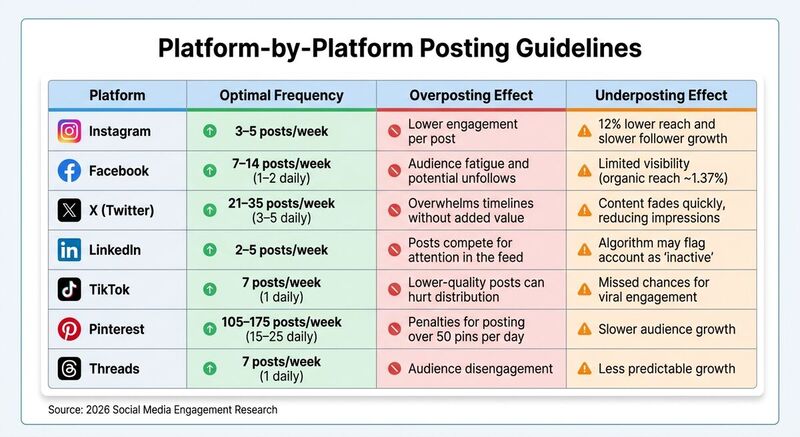 Finding the right posting frequency isn’t about guesswork - it’s about understanding what works for each platform’s algorithm and what your audience expects. Different platforms have distinct pacing, and the ideal number of posts can vary widely depending on where you're sharing content.
Platform-by-Platform Posting Guidelines
Every platform has its own rhythm and audience behavior. Take X (Twitter), for example - it’s fast-paced, with posts quickly disappearing from timelines. That’s why the suggested frequency is 21–35 posts per week (about 3–5 times daily). Contrast this with LinkedIn, where content has a longer shelf life, making 2–5 posts per week more effective. Posting more frequently on LinkedIn could mean your posts compete with each other, reducing overall visibility.
| Platform | Optimal Frequency | Overposting Effect | Underposting Effect |
|---|---|---|---|
| 3–5 posts per week | Lower engagement per post | 12% lower reach and slower follower growth | |
| 7–14 posts per week (1–2 daily) | Audience fatigue and potential unfollows | Limited visibility (organic reach ~1.37%) | |
| X (Twitter) | 21–35 posts per week (3–5 daily) | Overwhelms timelines without added value | Content fades quickly, reducing impressions |
| 2–5 posts per week | Posts compete for attention in the feed | Algorithm may flag account as "inactive" | |
| TikTok | 7 posts per week (1 daily) | Lower-quality posts can hurt distribution | Missed chances for viral engagement |
| 105–175 posts per week (15–25 daily) | Penalties for posting over 50 pins per day | Slower audience growth | |
| Threads | 7 posts per week (1 daily) | Audience disengagement | Less predictable growth |
These recommendations provide a solid starting point to align your posting strategy with platform algorithms and user behavior. For instance, Buffer's Senior Content Creator, Tamilore Oladipo, used experimental posting strategies to reach 20,000 LinkedIn followers in August 2025. Her colleague Sabreen achieved 17,000 followers by committing to daily posts for a year[2].
Adjusting Guidelines for Your Audience
While these benchmarks are helpful, they’re not set in stone. The ideal posting frequency depends on your ability to create quality content, how your audience engages, and your specific goals. For example, a B2B SaaS company might find success with 3 LinkedIn posts weekly, while a lifestyle influencer may need daily Instagram Reels to keep their audience engaged.
If you’re aiming for 5 Instagram posts a week but find it hard to maintain quality, it’s better to stick with 3 strong posts rather than 5 mediocre ones. Consistency is more important than sheer volume - users who post consistently (at least 20 out of 26 weeks) see 450% more engagement per post than those who post sporadically[5].
Use analytics to fine-tune your strategy. For instance, if engagement drops after posting more than 4 times a week on Instagram, you’ve likely hit your optimal limit. Similarly, if LinkedIn posts perform poorly on weekends, focus your efforts on weekdays, especially Tuesday through Thursday. The "perfect" frequency is one you can sustain for at least 8 weeks without compromising quality, giving both algorithms and your audience time to adjust.
To simplify the process, tools like TheBlue.social can help you stay consistent. By scheduling content across platforms like X, Threads, Instagram, Pinterest, LinkedIn, Bluesky, and Mastodon, you can batch-create posts in just a couple of hours each week. This ensures a steady presence without the stress of daily posting.
Using Data to Find Your Ideal Posting Frequency
Monitoring Your Engagement Metrics
When it comes to fine-tuning your posting frequency, your data is your best guide. Metrics like impressions, engagement rate, and reach per post can tell you if you're posting too much or too little. Instead of focusing on total engagement, look at how each post performs individually. This approach helps you spot if frequent posting is watering down your content's impact or if sparse posting is making your audience lose interest.
For example, if you notice declining engagement rates or reach, it could mean you're overposting. On the flip side, a stagnant account or a slow decline in followers during quiet periods might signal underposting. Adjustments can make a big difference: moving from 1–2 Instagram posts per week to 3–5 posts can increase reach per post by 12% and more than double your follower growth rate (from 0.12% to 0.26%). However, going beyond 10 posts per week only boosts reach by 24%, showing that more isn't always better[1].
It's important to measure your progress against your own historical data rather than industry benchmarks. Smaller accounts in niche spaces often have different expectations compared to large brands. Using median engagement rates instead of averages is also helpful since it avoids skewing results with viral outliers. For instance, in early 2025, the median engagement for posts on X and Threads was 4 interactions, while Bluesky posts averaged 3 interactions[7].
Consistency plays a huge role in driving results. Data shows that users who post consistently - 20 or more weeks out of a 26-week period - see five times more engagement per post compared to those who post irregularly[5].
"The pattern was crystal clear: The highly consistent posters saw more than 5 times the engagement per post compared to those who posted sporadically." - Kirsti Lang, Senior Content Writer, Buffer[5]
How Scheduling Tools Help Maintain Consistency
Once you've identified your ideal posting frequency through data, scheduling tools can help you stick to it. Managing multiple platforms manually can be overwhelming, but tools like TheBlue.social simplify the process. They let you batch-create and schedule posts for X, Threads, Instagram, Pinterest, LinkedIn, Bluesky, and Mastodon - all from a single dashboard. This ensures your posts are spaced out evenly, preventing you from overwhelming your audience with back-to-back content.
Scheduling tools also make it easier to avoid burnout. Instead of scrambling to post daily, you can spend a few hours each week building a content calendar for the upcoming weeks. For instance, if your LinkedIn analytics show that posting three times a week on Tuesdays, Wednesdays, and Thursdays works best, you can plan and schedule an entire month in one sitting. This method keeps your posting consistent while reducing stress.
Another advantage of scheduling tools is their ability to help you spot overposting patterns. By visualizing your content calendar, you can see if similar posts are scheduled too close together or if you're focusing too heavily on one platform. Giving your content "breathing room" ensures each post gets the attention it deserves, avoiding audience fatigue. Tools like Bluesky Analytics also let you monitor engagement in real time, making it easier to tweak your strategy as needed.
Conclusion
Finding the right posting frequency is all about striking a balance. Post too often, and you risk overwhelming your audience, seeing engagement drop, or even facing penalties from algorithms that push your content out of sight. On the other hand, posting too infrequently can lead to stagnation - your account might lose visibility, and you could miss chances to grow your audience. It’s a delicate dance, but getting it right is crucial for maintaining a strong presence.
Consistency plays a huge role here. Data shows that highly consistent posters can generate 5x more engagement per post, as long as their content remains high-quality[5]. While platform-specific recommendations provide a helpful starting point, your own analytics will give you the clearest picture of what works for your audience. Every platform and audience is different, so discovering the "sweet spot" for posting requires a tailored approach.
The process boils down to testing, measuring, and adjusting. Dive into your engagement metrics to spot patterns - are you seeing diminishing returns, or is your audience disengaging? Tools like TheBlue.social can simplify this by allowing you to schedule posts across platforms like X, Threads, Instagram, Pinterest, LinkedIn, Bluesky, and Mastodon, all from a single dashboard. Plus, Bluesky Analytics helps you track real-time engagement trends, so you can fine-tune your strategy.
To get started, commit to a specific posting frequency for at least 8 weeks. This gives algorithms enough time to adapt to your schedule. Monitor your performance closely - watch for warning signs like declining reach or an uptick in unfollows - and adjust based on what the data reveals. Ultimately, the best posting frequency is the one you can maintain consistently without compromising on content quality. Use these steps to keep your audience engaged and your strategy on point.
FAQs
How can I tell if I’m overposting?
If you're seeing a drop in engagement - fewer likes, comments, or shares - even though you're posting often, it might be a sign you're overposting. Other red flags include followers unfollowing your account, hiding your content, or even leaving comments about your posting frequency. Analytics can also tell the story: if your reach and engagement rates are shrinking despite ramping up your posting schedule, it’s time to reassess. Keep an eye on audience feedback, like direct messages or comments, to fine-tune your approach and keep engagement steady.
What’s the fastest way to recover after posting too little?
To bounce back from posting infrequently, start by increasing how often you share content. Try sticking to a regular schedule of 3–5 posts per week. This steady rhythm can help you reconnect with your audience and improve engagement over time. The secret? Consistency. It’s the best way to regain momentum and rebuild your presence.
How can I find my posting “sweet spot” using analytics?
To discover the best time and frequency for your posts, rely on analytics tools to monitor engagement metrics and audience behavior over time. Dive into the data regularly to spot trends, like when your audience is most active or which types of content perform best. Try out different posting schedules and adjust based on what the numbers show. This approach ensures you're staying visible and relevant without bombarding your audience, leading to better engagement and a more personalized posting strategy.