How TikTok Handles User Data Globally
Last updated: January 7, 2026
TikTok's data practices differ across regions due to varying privacy laws and regulations. Key points:
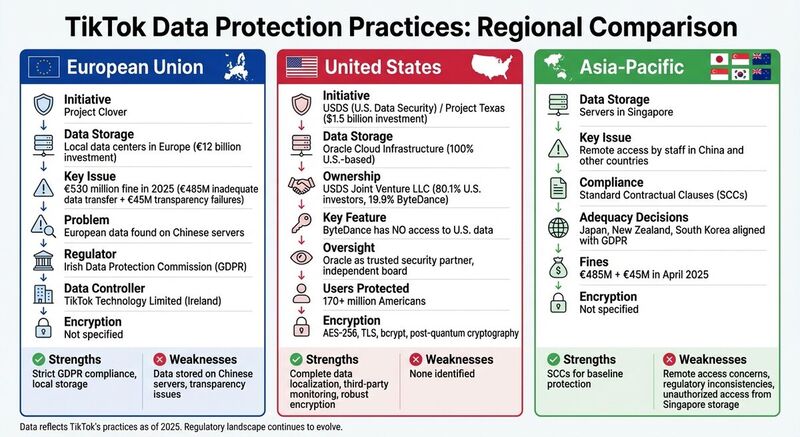
- Europe: TikTok launched "Project Clover" to store European user data locally in new data centers. However, it faced a $620M (€530M) fine in 2025 for inadequate safeguards and transparency issues, including storing some European data on Chinese servers.
- United States: TikTok restructured its operations under "TikTok U.S. Data Security (USDS)" with Oracle managing U.S. user data. This ensures local storage and compliance with federal and state privacy laws.
- Asia-Pacific: TikTok stores data on servers in Singapore but allows remote access by staff in other countries, including China, raising concerns in regions with weaker privacy protections.
Each region's approach reflects its regulatory environment, but challenges remain, particularly around transparency and cross-border data access. Users should stay informed about privacy settings and data permissions.
1. TikTok's Data Protection in the EU
Data Localization
To address concerns about data storage and access within Europe, TikTok introduced Project Clover, a major initiative aimed at improving data protection. This project involves the construction of three dedicated data centers in Europe to store user data from the European Economic Area (EEA) and the UK locally [6]. Previously, TikTok stored European user data on servers located in the United States and Singapore, with remote access granted to employees in China [3].
Despite these efforts, issues arose in February 2025 when a small amount of EEA user data was discovered on Chinese servers [2][5]. TikTok identified the problem and promptly reported it to the Irish Data Protection Commission (DPC) in April 2025. The company stated:
"Our teams proactively discovered this issue through the comprehensive monitoring TikTok implemented under Project Clover. We promptly deleted this minimal amount of data from the servers and informed the DPC." [6]
Regulatory Compliance
As TikTok's lead regulator in the EU, the Irish DPC plays a critical role in ensuring the company's compliance with GDPR. In April 2025, the DPC concluded an extensive investigation (IN-21-9-2) and issued a $620 million (€530 million) fine - one of the largest GDPR penalties to date [3]. The fine addressed two major violations:
- €485 million for failing to ensure sufficient protection for data transfers to China (Article 46[2]).
- €45 million for not providing clear information about these transfers and remote access (Article 132).
| GDPR Article | Violation | Fine Amount |
|---|---|---|
| Article 46[2] | Inadequate protection for data transfers to China | €485 Million |
| Article 132 | Lack of transparency on data transfers and remote access | €45 Million |
| Total | €530 Million |
In addition to the fine, the DPC ordered TikTok to halt unauthorized data transfers to China and ensure its operations fully comply with GDPR [3]. For users in the EEA, UK, and Switzerland, TikTok Technology Limited (Ireland) and TikTok Information Technologies UK Limited serve as joint data controllers, taking responsibility for managing personal data [4]. This regulatory scrutiny has prompted TikTok to strengthen its security measures, as outlined below.
Encryption Standards
TikTok claims to use comprehensive security protocols to protect user data from unauthorized access [1][7]. According to the TikTok Privacy Center:
"Project Clover is an initiative through which we intend to further strengthen our approach and move from meeting industry standards to setting a new standard altogether when it comes to data security." [1]
However, TikTok has not provided specific details about its encryption methods, such as whether it employs AES-256 encryption, leaving questions about the strength of its safeguards unanswered.
Youth Data Protection
TikTok uses age-gating technology and age-inference models to identify younger users and implement tailored privacy protections [4][7]. For users under 18, the platform offers features like content removal rights and parental oversight tools through its "Guardian's Guide" [4][7]. These measures are designed to align with GDPR's stricter rules for protecting children’s data. However, the platform's age verification methods remain under regulatory review for further scrutiny.
2. TikTok's Data Practices in the US
Data Localization
In December 2025, TikTok underwent a significant restructuring of its U.S. operations, signing a divestment agreement that led to the creation of USDS Joint Venture LLC. This new entity is majority-owned by U.S. investors (80.1%), with ByteDance retaining a minority stake of 19.9% [8]. As part of this arrangement, all U.S. user data is now stored exclusively within Oracle Cloud Infrastructure [8][9].
ByteDance no longer has access to U.S. user data. Instead, Oracle acts as TikTok's "trusted security partner", tasked with auditing compliance and safeguarding the data of over 170 million American users [8]. Additionally, TikTok is retraining its algorithm under U.S. supervision to remove any potential Chinese influence [9]. TikTok CEO Shou Zi Chew explained:
"The joint venture will operate as an independent entity with authority over U.S. data protection, algorithm security, content moderation and software assurance." [8]
This restructuring marks a significant step toward meeting U.S. regulatory requirements.
Regulatory Compliance
The joint venture complies with a 2024 federal law mandating divestiture to avoid a nationwide ban [8]. An independent board, primarily composed of American members, oversees critical areas like data protection, content moderation, and algorithm monitoring [8]. This new model shifts TikTok's approach from global data management to a localized system, referred to as "USDS" (U.S. Data Security), granting Oracle full oversight of data access and algorithmic processes [8][9].
TikTok's restructuring also aligns with various state-specific privacy laws. For instance, in California, users under 18 can request the removal of their posted content [7]. Similarly, in Connecticut, users under 18 - or the parents of those under 16 - can request the deletion or unpublishing of their accounts [7]. This U.S.-focused approach contrasts sharply with TikTok's strategies in Europe, underscoring the company’s region-specific responses to privacy issues.
Encryption Standards
To complement its localized data storage, TikTok has implemented robust encryption protocols to secure U.S. user data. The platform relies on Advanced Encryption Standard (AES) with a 256-bit key for data at rest and Transport Layer Security (TLS) to encrypt data in transit [10][11][12]. A zero-trust infrastructure further ensures that only authorized services can access plaintext data, with encryption managed locally on user devices [11].
For secure key delivery, TikTok employs Diffie-Hellman IES and HPKE (IETF RFC 9180) [11]. User passwords are safeguarded using the bcrypt hashing algorithm [12]. Additionally, TikTok has begun integrating post-quantum cryptographic solutions, combining classical elliptic curve cryptography with module-lattice-based key encapsulation mechanisms to prepare for future security challenges [11]. Through its $1.5 billion investment in "Project Texas", TikTok has also enhanced its encryption capabilities and implemented multi-factor authentication [13].
Youth Data Protection
TikTok offers a separate, restricted experience for users under 13 in the U.S., limiting data collection to the bare minimum [7]. If a user under 13 is detected on the standard version, their account is terminated, and any associated personal information is deleted [7]. Parents can access the "Guardian's Guide" to better understand the platform's safety features, request account deletion for their underage child, or download their child’s account data [7].
Research shows that 92% of business accounts on TikTok utilize the platform's privacy controls to protect their digital assets [13]. TikTok’s U.S. Privacy Policy outlines its commitment to safeguarding user information:
"We use reasonable measures to help protect information from loss, theft, misuse, unauthorized access, disclosure, alteration, or destruction." [7]
3. TikTok's Data Handling in APAC
Data Localization
The Asia-Pacific region (APAC) presents a patchwork of data protection standards, shaped by each country's unique regulations, unlike the more unified approaches seen in the EU and U.S. TikTok stores user data for APAC on servers located in Singapore. However, concerns arise over the platform's practice of allowing remote access to this data by staff in other countries, including China. This has led to regulatory pushback, with fines totaling €485 million and an additional €45 million in April 2025 for failing to adequately protect data and maintain transparency in its practices [14]. These issues highlight the difficulties of enforcing localized data protection in a region with such diverse legal frameworks.
Regulatory Compliance
When it comes to legal frameworks, APAC countries take varied approaches to safeguarding user data. Some nations, such as Japan, New Zealand, and the Republic of Korea, benefit from European Commission Adequacy Decisions, which align their privacy laws with the stringent GDPR standards [2]. These alignments allow for smoother data handling and transfers under EU regulations.
For countries in APAC that lack Adequacy Decisions, TikTok relies on Standard Contractual Clauses (SCCs) to ensure data transfers meet privacy requirements [2]. As the Data Protection Commission explains:
"Transfers of personal data can take place only if the conditions laid down in Chapter V of the GDPR are complied with... This ensures that the high level of protection provided within the European Union continues where personal data is transferred to a third country." [2]
This approach allows TikTok to navigate the diverse legal landscapes of the region while maintaining compliance with international standards.
Youth Data Protection
TikTok also prioritizes youth safety across APAC by implementing specific protocols to protect younger users. The platform collects birthdates during account creation and may request additional identity verification when users contact support [4]. To further safeguard minors, TikTok uses behavioral analysis to estimate age ranges, ensuring that younger users are subject to content restrictions [4]. Both automated tools and human moderators work together to review and remove content that violates youth safety guidelines [4]. These measures aim to create a safer environment for TikTok's younger audience in the region.
US to Have Complete Control of Tiktok's American User Data | US Investors to Have Ownership | DNA
Pros and Cons
Looking at TikTok's data practices across different regions, the table below summarizes the main strengths and weaknesses tied to their approach:
| Region | Strengths | Weaknesses |
|---|---|---|
| United States | Operates under the TikTok U.S. Data Security (USDS) entity, which manages data access; uses Oracle Cloud for storage; third-party monitoring ensures compliance [1] | No notable weaknesses identified |
| European Union | Implements Project Clover to establish higher standards; local data storage reduces international transfers; adheres to strict GDPR rules [1] | Data was still stored on Chinese servers [2]; fined €530 million in April 2025 for inadequate protection and transparency issues [14] |
| APAC | Uses Standard Contractual Clauses for international data transfers to maintain a baseline of protection | Remote access by China-based personnel raises security concerns; regulatory inconsistencies; earlier storage practices in Singapore allowed unauthorized access [14] |
This comparison shows how TikTok's data protection efforts vary by region, depending on local regulations and infrastructure decisions.
These regional differences stem from varying compliance measures and organizational safeguards. Past issues, such as discrepancies in data storage practices, continue to shape these regional strategies. For instance, the DPC expressed "deep concern that TikTok had submitted inaccurate information" regarding its data handling [2].
Conclusion
TikTok's approach to data protection reveals a complex and uneven landscape shaped by regional regulations. In the European Union, the General Data Protection Regulation (GDPR) sets the bar for stringent oversight. The United States, on the other hand, relies on a mix of state-level laws and partnerships, while the Asia-Pacific (APAC) region grapples with inconsistent oversight and varying data access controls.
To address concerns in Europe, TikTok has committed €12 billion to Project Clover, which includes localized data storage and independent monitoring by the NCC Group. This initiative underscores the platform's efforts to align with European regulatory standards [15][16]. However, TikTok's 2025 admission that user data from the European Economic Area (EEA) had been stored on servers in China - despite years of assurances to the contrary - highlights significant transparency issues [15][16].
"TikTok failed to verify, guarantee and demonstrate that the personal data of (European) users, remotely accessed by staff in China, was afforded a level of protection essentially equivalent to that guaranteed within the EU."
– Graham Doyle, Deputy Commissioner, Irish Data Protection Commission [15]
For users, vigilance is key. Regularly reviewing privacy settings, utilizing tools like "Request Your Data", and limiting app permissions can help minimize risks [7]. Meanwhile, regulators must stay proactive, conducting thorough audits of data localization claims and enforcing transparency on remote data access, especially in jurisdictions with conflicting surveillance laws [15][16].
The Irish Data Protection Commission's six-month compliance deadline will serve as a critical test. It remains to be seen whether TikTok can implement technical measures that reconcile the legal contradictions between Chinese surveillance laws and Western data protection frameworks [16].
FAQs
How does TikTok comply with GDPR regulations after receiving fines?
TikTok has made notable efforts to align with GDPR requirements and address previous issues. The platform now stores data from European users within Europe, including at its data center in Ireland, and restricts access to a limited group of authorized personnel. To further safeguard user information, TikTok employs robust physical and digital security protocols.
On top of that, the company has established procedures to promptly remove any data previously stored in locations that did not meet compliance standards, such as China. These actions reflect TikTok's commitment to transparency and compliance with GDPR regulations, particularly after receiving a €530 million fine for past violations.
How does TikTok ensure U.S. user data is protected from unauthorized foreign access?
TikTok keeps U.S. user data on servers located within the United States and protects it with multiple layers of security measures. These include firewalls, intrusion detection systems, and strict access controls, ensuring that only a carefully vetted group of authorized personnel can access the data.
Beyond digital safeguards, TikTok also uses physical security measures like gated entry points and advanced monitoring systems. These steps are specifically aimed at preventing unauthorized access from foreign entities and aligning with U.S. data protection standards.
Why are there concerns about TikTok's data storage and privacy in the APAC region?
TikTok's handling of user data in the APAC region has sparked concerns, particularly due to its storage practices in places like Singapore and Malaysia. The debate revolves around cross-border data transfers, how well the platform complies with local privacy laws, and whether staff based in China might have remote access to this data.
This situation underscores the challenges of navigating regional regulations while tackling broader privacy issues, all within the fast-changing digital world.